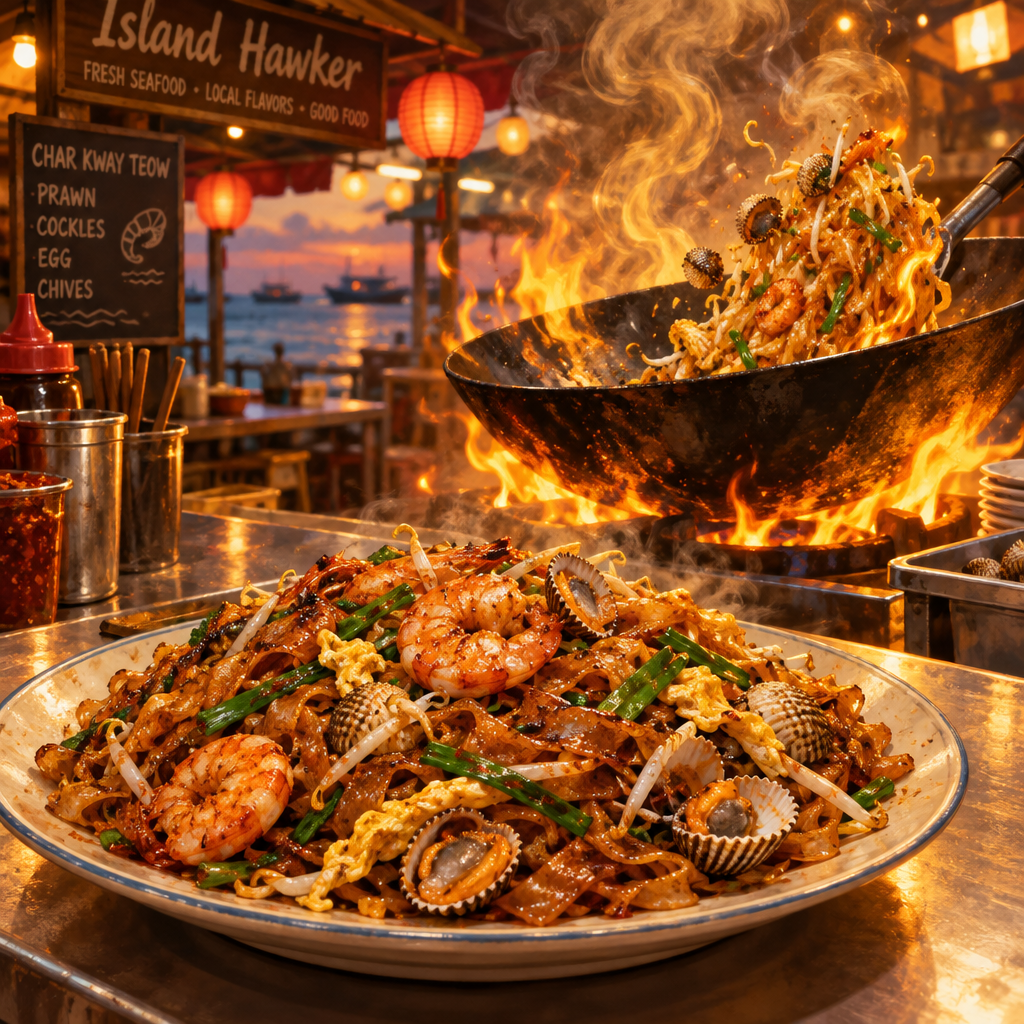
At first bite, Penang’s char kway teow announces itself: smoky, savoury, and intensely immediate. According to VisitPenang (updated 3 May 2026), this stir‑fried flat‑rice noodle dish—whose name comes from Hokkien (char = stir‑fried; kway teow = flat rice noodles)—is the island’s signature hawker plate. Its character comes from high heat, a well‑seasoned iron wok and ingredients chosen for flavour and economy: flat rice noodles, prawns, blood cockles, egg, bean sprouts, Chinese chives and a judicious mix of light and dark soy sauces.
The dish began life in George Town as working‑class food in the early 20th century. Chinese immigrant communities—particularly Teochew and Hokkien families—sold char kway teow from pushcarts and shoulder poles to feed dock workers, farmers and rickshaw pullers. Cheap, quick and calorie‑dense, it was built from what was locally available and affordable: kway teow (cheaper than egg noodles), abundant cockles, a scramble of egg and, traditionally, pork lard for cooking.
Those technical choices matter. VisitPenang stresses pork lard rendered from crackling as the classic cooking fat—many traditionalists consider it essential to the dish’s flavour—while modern stalls may offer vegetable oil as an alternative. Fresh blood cockles are added late in the cook so they stay barely warm inside; overcooking makes them rubbery. Some Penang plates also mix thin yellow egg noodles with the flat rice sheets; others keep to kway teow alone. Optional touches include lap cheong (Chinese sausage) at some stalls.
But the defining magic is wok hei (鑊氣): the smoky, slightly charred note produced by very hot, vigorous tossing in a seasoned iron wok. VisitPenang points out that wok hei is fleeting—best savoured immediately at the stall—because it dissipates quickly (within roughly 90–120 seconds). That is why many aficionados urge you to eat your plate at the hawker counter rather than take it away.
Char kway teow’s story is also a social one. From its modest origins it rose—especially from the mid to late 20th century—into a celebrated culinary icon. Coverage by food writers and tourists pushed prices up, which in turn allowed top vendors to invest in better ingredients and techniques. Some stalls became famous, and many are now run by multi‑generation families who preserve traditional methods. At the same time, debates about “the best” char kway teow reflect broader concerns over preserving local techniques and whether younger generations will continue hawker livelihoods.
If you want to taste it in Penang, VisitPenang highlights a handful of well‑discussed spots: Siam Road Char Kway Teow (noted for small‑batch, one‑wok cooking and long queues), New Lane Hawker Centre (Jalan Macalister), Lorong Selamat and Sisters Char Kway Teow near Armenian Street. Practical tips from the same source: eat at the stall to catch wok hei; pair the plate with a local drink such as teh tarik or kopi; read queues with care (no queue isn’t an automatic fail); expect many vendors to finish lunch service by about 2–3pm, and consider evenings for the best char kway teow. The guide also notes halal variants—made with vegetable oil or chicken sausage—exist locally but are regarded as a distinct version.
The VisitPenang article does not claim a single inventor, exact year of invention, step‑by‑step recipe proportions or hard economic data on price changes—its account gives a broad early‑20th‑century timeframe and emphasizes cultural context over archival minutiae. Taken together, the piece paints char kway teow as more than a plate: it is Penang’s taste memory, a technique‑driven craft and a living symbol of the island’s hawker heritage.
Leave a Reply