Blog

  • Beyond Rockets: How Starlink Is Powering SpaceX’s AI Ambitions

    Beyond Rockets: How Starlink Is Powering SpaceX’s AI Ambitions

    SpaceX is often associated with rockets and spaceflight, but its latest reported results point to a business with several connected parts. In the third quarter, revenue rose 161% from a year earlier to $14.6 billion, beating analysts’ estimate of $12.72 billion, according to LSEG data cited by Reuters. The reported growth came from a surge in artificial-intelligence business and the continued expansion of Starlink.

    Starlink, SpaceX’s satellite-internet service, is described as the company’s main financial engine. It serves consumers as well as business, aviation, maritime and government customers, while the company continues investing in network coverage and capacity. SpaceX is also working on direct-to-device mobile services. The report does not give a subscriber count or separate revenue figures for Starlink and the company’s other operations, so it is not possible to see exactly how much each part contributes.

    Alongside connectivity, SpaceX has been building an AI and computing business. It includes the Grok models and social-media platform X, as well as a growing data-centre operation. A substantial part of its AI income comes from renting computing capacity to other developers, including Anthropic, Google and Reflection AI. That makes this side of the business resemble a cloud-computing provider as well as an AI lab.

    The expansion comes with a significant challenge: the AI unit has recorded large operating losses. SpaceX has said sustained investment will be needed before it can generate profits consistently. The report does not establish when that might happen. It also notes that as Starlink reaches less wealthy markets, pressure on average revenue per user could become a concern.

    SpaceX’s plans also reach beyond the ground. The company hopes its next-generation reusable rocket system, Starship, will help deploy higher-bandwidth Starlink satellites and eventually support computing infrastructure in orbit. But Starship has not yet entered commercial service, and making it reliably reusable is an important part of the longer-term strategy. A recent orbital test flight ended earlier than expected after an engine issue, although several Starlink satellites were successfully deployed.

    Taken together, the report shows how SpaceX’s businesses are linked: connectivity revenue helps support investment in AI and data centres, while Starship is intended to enable future satellite and computing plans. Yet those ambitions remain uncertain. AI profitability, Starlink’s growth in new markets and Starship’s technical and commercial progress are all unresolved. SpaceX’s story is therefore not only about reaching space, but also about whether its expanding network of businesses can deliver on plans that are still taking shape.

    Source: SpaceX quarterly revenue jumps, beats estimates as AI business surges, Reuters (republished by Investing.com)


  • A Festive Night Out: What to Expect at Christmas Wonderland 2026

    A Festive Night Out: What to Expect at Christmas Wonderland 2026

    As evening settles over Gardens by the Bay, Christmas Wonderland is set to bring festive lights, performances, games and seasonal treats to Supertree Grove and The Meadow. The event is scheduled to run from 27 November 2026 to 3 January 2027, with opening hours listed as 6.30pm to 11pm. For families and other visitors, the article previews an evening full of different sights and activities to explore.

    One of the centrepieces is the Spalliera at Supertree Grove: a 20-metre installation illuminated by 90,000 bulbs. It will be joined by “Blizzard Time”, an effect described as foam snowfall. The snowfall is scheduled three times daily, after the Garden Rhapsody light-and-sound show. Both are listed at 7.45pm, 8.45pm and 9.35pm, giving visitors several chances to catch the spectacle. On weekends, there is also a Borealis light show at 9.05pm.

    Over at The Meadow, the preview includes Flying Santa, an attraction featuring Santa in a sleigh with reindeer. Families can also visit a zone with arts-and-crafts workshops, treats and other festive activities. Reindeer Town is another stop, where visitors can meet Santa and see a quartet of reindeer.

    There are more themed places to discover, too. The article mentions an enchanted forest, Merry Bears and a Winter Solstice realm, alongside carnival games, festive performances and food. Together, these attractions offer a mix of things to watch, do and enjoy, whether visitors are drawn to the glowing displays or the family activities.

    Admission tickets will be available, and children under three are admitted free. The article does not give ticket prices or a schedule for Flying Santa, so those details are not part of its preview. It also does not specify how long the shows last or whether every attraction will operate each night. Christmas Wonderland is organised by Blue Sky Events and presented by Trip.com.

    With its illuminated centrepiece, scheduled snowfall effects and a range of family-focused attractions, Christmas Wonderland is shaping up to be a festive evening outing at Gardens by the Bay. Visitors can plan around the listed showtimes while leaving room to explore the different areas.

    Source: Christmas Wonderland At Gardens By The Bay 2026: Flying Santa, Snowfall, Light Displays & Carnival, Sassy Mama Singapore

  • QR Codes at the Stall, Cash in the Till: Hawkers’ Uneven Digital Shift

    QR Codes at the Stall, Cash in the Till: Hawkers’ Uneven Digital Shift

    At West Coast Food Centre, QR codes were easy to spot on many stalls. But at Angie Sim’s noodle stall, one sign made the payment choice clear: “Cash Only”. For Sim, 65, cash felt simpler and more convenient. Many of her customers were older too, she said, and were more comfortable carrying cash than using technology.

    Sim had worked at the centre with her stall partner for more than 20 years. Her preference is part of a wider picture described by The Straits Times: hawker centres are gradually adopting digital payments, but not every stallholder is ready to leave cash behind.

    The newspaper spoke to stallholders across eight hawker centres who continued to resist digital payments. Their reasons were practical and personal. Some had limited experience with digital tools; others faced poor eyesight or found it difficult to navigate devices. Some worried that a new payment method might inconvenience customers.

    At ABC Brickworks Market & Food Centre, a drinks-stall owner in his 70s said he struggled to remember how to use digital platforms and to check whether payments had gone through. Those tasks could be especially difficult during peak periods, when serving customers was already demanding.

    Digital-payment options have become more accessible through SGQR, a standardised QR code introduced in 2018 to bring payments from multiple mobile wallets together. By the time of the article, more than 11,500 hawkers had started using SGQR. That figure points to significant uptake, but it does not mean every stall or centre accepts cashless payments.

    There was also financial support for stallholders considering the switch. The Hawkers Go Digital programme, launched in 2020, waived the 0.5 per cent transaction fee on the first S$20,000 of a stallholder’s monthly transactions. On October 10, 2024, Enterprise Singapore and the Infocomm Media Development Authority announced that the waiver would be extended until the end of 2025. The programme aimed to encourage digital-payment adoption among 18,000 stallholders in government-run food centres.

    Yet the transition is not simply a matter of putting up a QR code. Stallholders need to feel confident using the technology, and customers need to be comfortable paying that way too. For some hawkers, checking a digital payment while serving a queue can feel less straightforward than accepting cash. For some customers, cash remains familiar and easy to use.

    The story of Singapore’s hawker centres is therefore not one of cash disappearing overnight. It is a gradual change, with digital payments becoming more visible while cash continues to matter to people on both sides of the counter. Making the shift work means recognising those everyday concerns alongside the promise of convenience.

    Source: Why cash is still king for some hawkers in Singapore despite digitalisation push, The Straits Times

  • From a Chat Message to a Calendar Event: Building with n8n

    From a Chat Message to a Calendar Event: Building with n8n

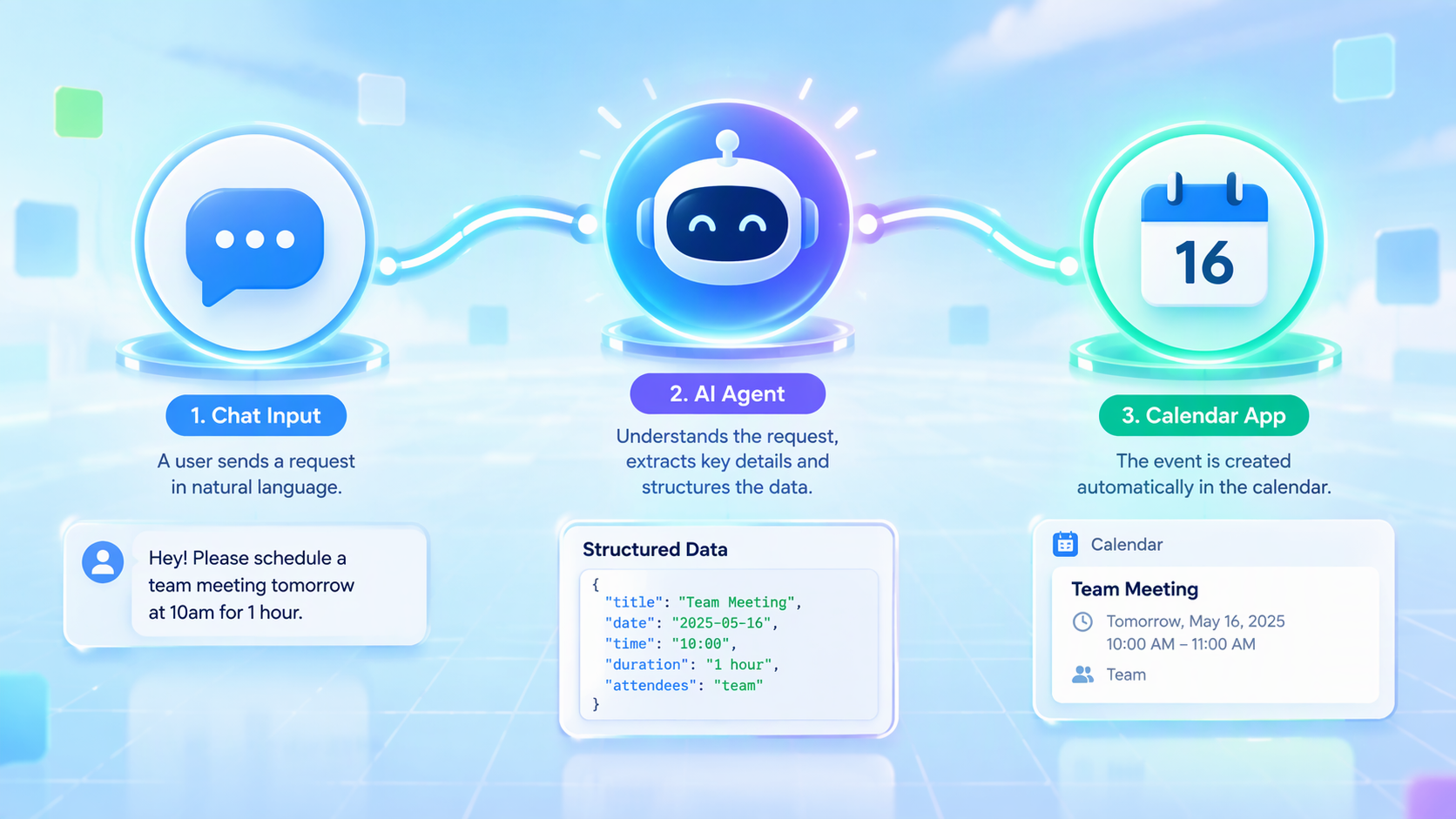
    Imagine typing a message about an event and having the details turned into a calendar entry. In a tutorial by Soham Mehta, that simple idea becomes a small AI-assisted workflow built with n8n: a visual automation platform where connected nodes each handle a step in a process.

    The example begins with an “On chat message” trigger. Its role is to listen for an incoming message, giving the workflow something to respond to. Next, an AI Agent processes the request and identifies event information such as the title, location and times. Instead of asking readers to build every part of this process as code, the tutorial presents it as connected components in a visual workflow.

    The agent is paired with an OpenAI Chat Model node, which provides the model it uses. The tutorial describes four parts of the agent setup: its model, prompt, tools and output. Together, these pieces let the agent interpret the message and produce details that can be used by the next step.

    That next step is a Google Calendar node. It takes the extracted event information and creates a calendar entry. The flow is therefore easy to follow: a message arrives, the agent turns it into structured event details, and the calendar node uses those details to create an event.

    The tutorial also covers what readers need to try the example: an n8n account and a Google account. It outlines two ways to run n8n: through its cloud service or by hosting it locally, including with npm or Docker. These options give readers a starting point for setting up the platform before assembling the workflow.

    What makes the example interesting is the hand-off between understanding a natural-language request and taking an action in another app. The AI agent interprets the message, while the connected calendar node carries out the specified task. It is a compact illustration of how separate steps can be linked into one automated workflow.

    The tutorial focuses on showing how this example is assembled; it does not report measured accuracy, time savings, costs or business results. Nor does the example establish that the workflow is ready for production or explain broader safeguards such as human approval, security, privacy or error handling. Those limits are worth keeping in mind: a demonstration can show how a process is connected without proving how it will perform in every situation.

    For readers curious about AI and automation, the calendar agent offers a clear way to see the basic idea in action: connect a message trigger, an AI agent and an app action, and pass useful information from one step to the next.

    Source: How to Build AI Workflows with n8n, freeCodeCamp.org

  • Singapore’s Unemployment Picture: Steady Overall, Slightly Higher for Residents

    Singapore’s Unemployment Picture: Steady Overall, Slightly Higher for Residents

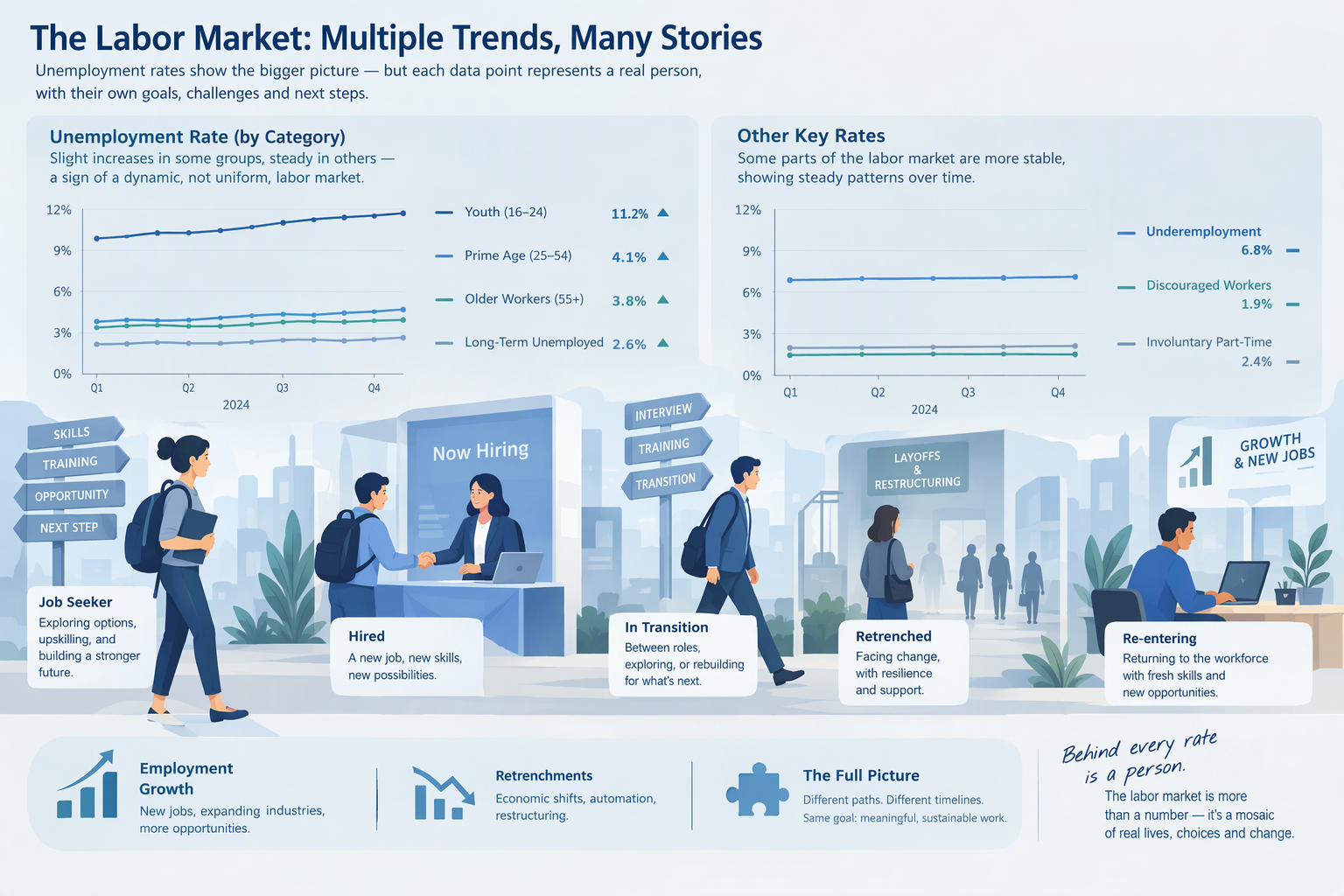
    A small change in a percentage point can be easy to miss. But in Singapore’s latest labour market snapshot, the overall unemployment rate stayed level while the rates for residents and citizens edged up. The figures offer a useful glimpse of the job market—but they describe different groups, and they cannot tell every job seeker’s story.

    The Ministry of Manpower’s advance release gives September 2026 unemployment rates. The overall rate was 2.0%, unchanged from August. Among residents, the rate rose from 2.9% to 3.0%. For citizens, it increased from 3.0% to 3.1%. Each rise was 0.1 percentage point.

    Those categories matter. The overall rate covers the wider workforce, including residents and non-residents. The resident rate covers Singapore citizens and permanent residents, while the citizen rate focuses on citizens within that resident population. Because the groups differ, their rates should not be treated as interchangeable or compared as if they describe exactly the same people.

    The release also reports that total employment grew by 27,700 in the third quarter, up from growth of 11,400 in the second quarter. At the same time, retrenchments increased from 4,620 to 4,800 between those quarters. Together, these numbers show several parts of the labour market moving at once: employment expanded, retrenchments rose, and the monthly unemployment rates were steady overall but slightly higher for residents and citizens.

    The figures do not establish that employment growth or retrenchments caused the changes in the monthly rates. They are separate indicators in the release, and the information provided does not explain a direct link between them. A growing total number of jobs, for example, does not by itself tell us how those jobs are distributed or who is able to take them up.

    For anyone thinking about finding work, these rates are best read as a broad snapshot, not a personal forecast. They describe unemployment at an aggregate level for measured groups. They do not show how long people had been searching, how many vacancies were available, or whether a particular person could find a suitable role. Nor do they break the figures down by age, occupation or sector.

    So what can we take away? In September, the overall rate held at 2.0%, while the resident and citizen rates each rose slightly. That is a measured update, not a verdict on every job seeker’s prospects. The numbers help sketch the wider picture; understanding an individual’s experience would require details this release does not provide.

    Source: 1030 Labour Market Advance Release 3Q 2026, Ministry of Manpower, Singapore

  • The Ship That Changed Piece by Piece: When Is It Still the Same Ship?

    The Ship That Changed Piece by Piece: When Is It Still the Same Ship?

    Imagine looking at a familiar table, mug or phone tomorrow. It may seem obvious that it is still the same object you saw today. But what makes it the same? Is it its material, its shape, its history—or something else? Philosopher Chad Vance explores this puzzle through the famous thought experiment of the Ship of Theseus.

    Picture a wooden ship that has one plank replaced at every port stop. The repairs happen gradually, one piece at a time. Eventually, every plank from the original ship has been replaced. Vance gives the ship at the beginning the name “Original” and calls the fully repaired vessel “Repaired.” The question is simple to ask but difficult to answer: are Original and Repaired one and the same ship?

    The article considers a principle called “Gradual Replacement.” According to this idea, replacing one part of a larger object does not, by itself, turn that object into a different one. If a mechanic replaces a car’s spark plugs, for instance, we would ordinarily still call it the same car. The repair changes something about the car, but it does not seem to erase its identity.

    Now apply that reasoning to the ship. If it remains the same ship after the first plank is replaced, why would it stop being the same ship after the next plank? The replacements continue in small steps, and each step appears to preserve the ship’s identity. Follow the principle all the way through, and the conclusion is that Repaired is the same ship as Original—even though none of the original parts remain.

    That conclusion can feel surprising because we often connect an object with the material it is made from. The ship seems to invite a choice: either its original wood matters most, or its continuous history through all those repairs does. Vance’s reasoning asks us to notice that those ideas can pull in different directions. The ship’s parts have all changed, yet the process of replacing them one by one seems to preserve a continuous object.

    The puzzle also reaches beyond ships. Ordinary objects do not remain perfectly unchanged in their material composition: the article notes that they continually exchange atoms and electrons with their surroundings. That observation makes the question feel less like a remote riddle and more like a challenge about how we think of everyday things that persist while changing.

    The thought experiment does not settle the identity question for everyone, and it does not show that all philosophers accept Gradual Replacement. Instead, it gives us a clear way to examine our assumptions. When something changes little by little, at what point—if any—does it become something else? The Ship of Theseus leaves that question open, inviting us to look again at what we mean when we say an object is “the same.”

    Source: The Ship of Theseus: What Makes an Object the Same Object Over Time?, 1000-Word Philosophy: An Introductory Anthology

  • Please Share the Research Brief

    Please Share the Research Brief

    I can write the school blog post, but I don’t yet have a research brief or article about Jesus to base it on. Please share the article or its key facts, along with its title, publisher and URL. You can also say whether you’d like the post to focus on what historians say about Jesus, what the Bible says, or a particular event or teaching.

  • More Than a Meal: How Hawker Centres Bring Singapore Together

    More Than a Meal: How Hawker Centres Bring Singapore Together

    A hawker centre can be many things at once: a place to find an affordable meal, a familiar meeting point, and a shared space where Singaporeans from different backgrounds sit down to eat. That everyday mix is at the heart of Singapore’s hawker culture.

    SG101 describes hawker centres as “community dining rooms”. People gather there throughout the day, whether they are meeting friends, sharing a meal with family or simply eating alongside others. The surroundings can bring back memories of busy tables and conversations. In this way, a hawker centre is not just somewhere to buy food; it can also be part of how people experience community and national identity.

    The culture’s importance has also been recognised beyond Singapore. In December 2020, Singapore’s hawker culture was inscribed on UNESCO’s Representative List of the Intangible Cultural Heritage of Humanity. That recognition highlights a living tradition rooted in the everyday: people preparing and enjoying food, and gathering in shared spaces.

    The food itself reflects different influences. SG101 gives rojak as one example, describing it as a dish that combines Indian, Malay and Chinese influences. Roti prata offers another glimpse of how a familiar food can be adapted locally, with additions such as cheese and mushroom. These examples show how hawker fare can bring different culinary influences together, while continuing to change.

    Affordability is another reason hawker centres matter. The article notes that hawker fare is affordable and that eating out in Singapore can cost less than cooking at home. It also points to international recognition: Hong Kong Soya Sauce Chicken Rice in Chinatown and Hill Street Tai Hwa Pork Noodles are named as hawker eateries that have won Michelin stars. The article does not give the dates of those awards, but their inclusion reflects the range of recognition hawker food has received.

    A 2018 National Environment Agency poll, as reported in a 2019 NEA media release, found that 83 per cent of Singaporeans visited a hawker centre at least once a week. That figure offers a snapshot from that poll, rather than current visitor data. Still, it helps illustrate how closely hawker centres were woven into many people’s routines at the time.

    Keeping the tradition going is not automatic. SG101 notes that as experienced hawkers retire, the trade and its food traditions risk becoming endangered. Younger Singaporeans are taking up hawker apprenticeships, but the article gives no figures on how many. Their involvement points to one way the knowledge behind hawker food may be passed on.

    Hawker culture brings together food, memory and shared space. Its future depends on the people who continue the craft—and on communities that keep gathering around the tables.

    Source: Hawker Culture in Singapore, SG101

  • Is Opera GX Spyware? Separating Suspicion from Evidence

    Is Opera GX Spyware? Separating Suspicion from Evidence

    A browser can raise privacy questions without being spyware. That distinction is at the heart of Comparitech’s article on Opera GX: it concludes that the browser is legitimate and does not contain spyware, malware or viruses. The article says the “spyware” label is driven largely by worries and allegations—not by evidence it presents that Opera GX secretly spies on its users.

    One source of suspicion is ownership. Comparitech says Chinese investors bought Opera’s browser businesses in 2016. Some people see this as a reason to distrust Opera GX. But the article stresses that ownership alone does not show that the browser shares users’ data with Chinese authorities. It describes Opera as a Norwegian company subject to European data-protection laws.

    The article also looks at features that have prompted questions. Promotional businesses may appear on Opera GX’s Speed Dial page, but Comparitech says users can switch off those promotions in Settings, under Privacy and Security. That may be unwelcome to people who prefer a quieter start page, but the article presents it as a visible feature with an off switch—not proof of hidden spying.

    Another point involves Android notifications. Opera previously used Google Cloud Messaging for push notifications. Comparitech argues that this did not, by itself, show that Opera continuously tracked users’ activity. The distinction matters: a browser feature that raises a privacy question is not automatically evidence of a broader, secret practice.

    The article says Opera checks domain names against known malicious sites to help protect users from phishing and malware, and that users can disable this feature. It also notes complaints about Google being the default search engine, automatic crash-report submission and what Private Browsing does—and does not—provide. Critics have cited these as privacy concerns, but Comparitech does not treat them as proof that Opera GX is spyware.

    The suspicion has a history, too. Comparitech reports that a German IT blog made an early accusation about Opera’s privacy in 2021, two years after Opera GX launched. An accusation can draw attention to a real question, but it is not the same as evidence proving the claim.

    So what can readers conclude? According to Comparitech, the concerns are worth understanding, but the article does not establish that Opera GX secretly spies on users or sends their information to Chinese authorities. It also does not independently establish what data any particular current version collects or transmits. That is an important limit: the article’s conclusion is not a detailed audit of every version or setting. For anyone weighing privacy, it helps to separate documented features and settings from claims that the article says are not proven.

    Source: Is Opera GX spyware? What you need to know, Comparitech

  • Please share the article or research brief

    Please share the article or research brief

    I’m happy to help write the school blog post. Please provide the research brief or article text, along with its URL, title and publisher, so I can accurately base the post on the source.