Blog

  • The Future of AI: From Agentic AI to Physical and Multi-Agent Systems

    The Future of AI: From Agentic AI to Physical and Multi-Agent Systems

    Artificial intelligence is rapidly evolving beyond traditional boundaries, and the next wave of innovation promises to reshape how machines interact with the world. Following the era of agentic AI, which focused on autonomous decision-making, the spotlight is now turning to physical AI, multi-agent orchestration, and model-native agentic AI—each representing a crucial step forward.

    Physical AI marks a revolutionary integration of AI capabilities into tangible systems. Companies like Nvidia highlight how this fusion allows robots, autonomous vehicles, and other devices to perceive their surroundings, reason through complex data, and act decisively in the physical environment. Imagine manufacturing floors where humans and robots seamlessly collaborate, guided by machines interpreting sensory inputs and making real-time decisions. This melding of AI with the physical world transcends traditional software limitations, unlocking new potential for automation and smart interaction.

    Parallel to this, multi-agent orchestration is transforming how AI systems handle complex, long-term tasks. Rather than relying on a single AI agent, networks of specialized agents work collaboratively—planning, delegating, and executing tasks more efficiently. This collective intelligence approach offers heightened adaptability and robustness, enabling organizations to tackle workflows that are too intricate for monolithic AI models.

    Simultaneously, the AI community is advancing toward embedding autonomy deeper within models themselves through model-native agentic AI. This approach integrates capabilities such as self-planning, tool utilization, and memory directly within AI architectures, reducing dependence on external orchestration. Reinforcement Learning (RL) is a fundamental driver here, allowing AI systems to learn and adapt dynamically from experience, thereby enhancing their independence and effectiveness.

    Together, these advancements illustrate a rich, multifaceted trajectory for AI development. From enabling machines to physically engage with the world, to fostering collaboration among specialized agents, and embedding autonomy directly within AI models, the future envisions intelligent systems that are seamlessly integrated, highly adaptive, and remarkably autonomous both digitally and physically. The journey beyond agentic AI promises to unlock remarkable new capabilities that will redefine the landscape of artificial intelligence.


  • How the U.S.–Singapore FTA and the 10% Additional U.S. Tariff Work Together

    How the U.S.–Singapore FTA and the 10% Additional U.S. Tariff Work Together

    The U.S.–Singapore Free Trade Agreement (FTA) still matters — but it doesn’t completely remove import costs. Under the FTA, qualifying goods are relieved of the United States’ standard Most Favored Nation (MFN) duties. However, an additional 10% U.S. tariff introduced in April 2025 is applied to imports from all countries (including Singapore) on top of any existing duties. That means even FTA-eligible shipments remain subject to this extra 10% charge, while non-qualifying products will face both the standard MFN duty and the 10% tariff.

    What makes a shipment FTA-eligible? The FTA’s rules of origin — the conditions that determine whether a product “originates” in Singapore — must be satisfied. Common pathways to eligibility include undergoing a change in tariff classification during production or meeting a minimum local value-content requirement. When importers want to claim the FTA’s duty-free treatment for standard MFN duties, the claim must be filed at the time of entry and supported by a Certification of Origin that contains the specific required data elements.

    What this means for businesses importing from Singapore
    – Don’t assume zero duties just because there’s an FTA: even qualifying goods will incur the 10% additional tariff.
    – For non-qualifying goods, budget for both MFN duty and the 10% surcharge.
    – File your FTA claim at entry and have the Certification of Origin ready; the claim must be made at the time of entry.

    Practical next steps
    – Assess each product against the FTA rules of origin (for example, tariff classification changes or minimum local value content).
    – Prepare and review the Certification of Origin and the documentation you’ll submit at entry.
    – Factor the 10% additional tariff into pricing, landed-cost calculations, and supply‑chain decisions.

    Bottom line: the U.S.–Singapore FTA still provides valuable duty relief for qualifying goods, but the April 2025 10% U.S. tariff reduces — and in some cases removes — that advantage. Importers should verify eligibility carefully and factor the additional tariff into all import planning and cost forecasts.

  • Malaysia’s 2026 Durian Tsunami: When a Bumper Harvest Became a Season of Parties and Price Pain

    Malaysia’s 2026 durian season has been nothing short of dramatic: an exceptional bumper harvest created a supply glut that sent prices plunging and transformed the nation’s love affair with the fruit into a social celebration.

    At the heart of the story is oversupply. Local kampung durians are being sold for as little as RM1 to RM4 per kilogram, depending on location and quality, a stark contrast to the heady prices seen for some varieties in past seasons. The sheer volume of fruit forced authorities to act to protect both consumers and growers.

    The Federal Agricultural Marketing Authority (FAMA) moved quickly, buying surplus durians and opening extra sales points in major producing states such as Pahang, Perak and Selangor to help stabilise the market. In Penang, FAMA rolled out a Durian Marketing Intervention Plan specifically designed to manage increased production and limit steep price drops. Those interventions aim to create more outlets for growers and to prevent a long-term collapse in prices that would hurt orchard owners.

    Beyond economics, the oversupply produced a cultural ripple. With durians abundant and affordable, communities have been turning the season into an excuse for feasts — communal gatherings that celebrate the fruit, reconnect friends and family, and turn surplus into shared joy. Media commentary has even dubbed the phenomenon a ‘‘durian tsunami,’’ capturing how widespread and fast-moving the season’s effects have been.

    Not all durians are equal in the market shake-up. Premium cultivars such as Musang King and Black Thorn remain in demand despite the glut, while experts are urging moderation: durian is rich and calorie-dense, and overindulgence carries a health cost.

    The 2026 season is a reminder of how weather, production cycles and demand can collide — delivering cheap, plentiful fruit to tables and markets, but putting pressure on the value chain. For now, Malaysians are making the best of a bountiful harvest: farmers, policymakers and communities navigating a season that’s as much about celebration as it is about finding sustainable market solutions.

  • Spring/Summer 2026 Trends You Can Shop Now: Vogue’s Runway-to-Street Playbook

    Spring/Summer 2026 fashion is framed as a moment of renewed experimentation and shifting industry dynamics. British Vogue’s June 4, 2026 piece situates a season where dozens of designers debuted fresh visions, emphasizing individual style and reimagined classics. The result is a runway-to-street narrative that invites readers to translate bold new ideas into wardrobe updates without chasing a single universal look. Below is a practical, trend-by-trend guide drawn from the article to help you shop the season with intention.

  • When “Hougang Block ABC” Went Viral: Mabel Kee’s Tell‑All on a Broken Engagement

    When “Hougang Block ABC” Went Viral: Mabel Kee’s Tell‑All on a Broken Engagement

    On July 15, 2026, 22‑year‑old Singapore content creator Mabel Kee published a lengthy YouTube video in which she described the collapse of a seven‑year relationship and the painful decision to end her engagement. Kee and her then‑fiancé had been together since their mid‑teens and became engaged on October 17, 2025. In the video she said she had planned the wedding, paid deposits to vendors—mostly with her own money—and together they intended to apply for a June 2026 HDB Build‑To‑Order flat.

    Kee told viewers that the relationship had weathered major breakups in 2020, 2022 and 2025. The most recent crisis began after a night out on May 2, 2026, when Kee said she became upset that her fiancé did not want her to join his friends at a club. After she sent angry messages and forwarded a friend’s joking remark about divorcing him, he reportedly became distant and told her he was reconsidering the engagement. Kee said she tried to salvage the relationship with apologies, gifts, concert tickets and a heartfelt letter.

    Her account then turned to a series of discoveries that, she said, led her to suspect infidelity. Kee described finding a photograph of a handwritten comparison between herself and one of her fiancé’s female polytechnic classmates, and alleged that he had concealed long Discord calls with that classmate and admitted to having been infatuated with her in 2025. A phrase that quickly became central to the online conversation was “Hougang Block ABC,” which Kee said appeared when she reviewed her fiancé’s Grab ride history. The records, she said, showed repeated trips to that location—including at times when he had told her he was unwell or reconsidering the engagement. Her fiancé, according to the article, explained the rides as trips to the area with male friends for supper, socialising, smoking and drinking.

    Kee described carrying out further investigations with friends: creating a fake social‑media account to question one of his friends, reviewing the classmate’s public posts and commute information, and comparing a wall visible in a photograph to walls at the Hougang location. Kee said she and friends later confronted the classmate, who denied involvement and gave an account consistent with the fiancé’s explanation; Kee nevertheless maintained the evidence suggested her fiancé had repeatedly visited the classmate’s home and stayed overnight. After Kee posted hints online, several people from the fiancé’s polytechnic contacted her saying they had known of the relationship but assumed she already knew.

    According to AsiaOne’s report, Kee ultimately ended the engagement, calling the decision painful but necessary. She was also selling a wedding‑planner book for $30 to recover some of the money she had spent preparing for the wedding. The episode drew substantial public attention: Kee’s video reportedly amassed more than 400,000 views in under two days and provoked a mix of support and criticism. “Hougang Block ABC” became an online meme, with people visiting the area and creators publishing satire and commentary, including a TikTok review of a nearby dim‑sum stall.

    The AsiaOne article makes clear important limitations: it reports Kee’s account and allegations but does not independently verify that her former fiancé cheated, nor does it establish the precise identity of “Hougang Block ABC” or confirm the classmate’s alleged involvement. The fiancé denied the accusations and reportedly told the outlet he had lost feelings for Kee; AsiaOne said it had contacted Kee for more information. The story that unfolded online was therefore grounded in Kee’s personal account and the public reaction to her video, rather than independent verification of the allegations.

  • Oil Surges Past $100: What It Means for Gas, Groceries, and Back-to-School Shopping

    Oil Surges Past $100: What It Means for Gas, Groceries, and Back-to-School Shopping

    Oil has spiked to a level that touches the everyday costs of a shopping trip, according to a recent Associated Press report. The news brief notes that renewed hostilities in the Iran war have pushed Brent crude above $100 per barrel as of Thursday, July 23, 2026, marking a sharp rebound from a brief dip in June when tensions eased. That price move is described as a supply-side disruption in the Middle East that is rippling through the global oil market.

    For consumers, the implications aren’t limited to what you pay at the pump. The piece points out that downstream costs for consumer goods could rise as well. In particular, Matt Priest, the CEO and president of a trade association, is cited as saying petroleum-based materials used in manufacturing—including items found in footwear and other goods—have increased by roughly 25% because of the conflict. The ripple effects of higher oil costs can show up in the prices of everyday items, including gas, groceries, and back-to-school supplies.

    The report also notes what it does not provide: exact dates when prices first topped $100, and detailed data such as prior price levels or broader economic consequences. It does not offer analysis of the underlying supply-and-demand dynamics, policy responses, or forecasts for future price trends. Still, it offers a timely snapshot of the immediate impact of renewed Iran-related hostilities on oil prices and the downstream costs faced by manufacturers and shoppers alike.

    Bottom line: shoppers may feel the pressure at multiple points of the value chain—from energy bills to the cost of goods produced with petroleum-based materials—as oil prices continue to navigate this renewed period of volatility.

  • Understanding the Book of Romans – Paul’s Letter to the Early Church

    Understanding the Book of Romans – Paul’s Letter to the Early Church

    The Book of Romans, authored by Paul the Apostle, stands as one of the most significant and theologically rich texts in the New Testament. Written around A.D. 57, this letter addresses the believers in Rome during a formative period for early Christianity. To fully appreciate the context of this epistle, it’s important to explore why Paul was persecuted and why he was compelled to write to the Roman church.

    Why Was Paul the Apostle Persecuted?

    Paul, originally known as Saul of Tarsus, was a zealous Pharisee who initially persecuted early Christians. However, after a dramatic encounter with Jesus Christ on the road to Damascus, he converted and became one of Christianity’s most fervent missionaries. His preaching challenged traditional Jewish beliefs and the established social order, which led to widespread opposition.

    Paul’s message of salvation through faith in Jesus, accessible to both Jews and Gentiles, was revolutionary and threatening to many religious and political authorities. His efforts to spread Christianity beyond Jewish communities stirred tensions, resulting in multiple imprisonments, beatings, and ultimately his martyrdom. The Roman authorities and Jewish leaders often perceived Paul’s teachings as subversive, leading to his persecution.

    Why Was Paul Writing to the Church in Rome?

    Paul’s letter to the Romans was written during a time when Christianity was expanding rapidly but also facing doctrinal and cultural challenges. The Roman church was a diverse body composed of Jewish and Gentile believers, and they needed guidance on unity and faith.

    Paul wrote to:

    1. Clarify the Gospel Message: Romans systematically lays out the Christian faith—sin, salvation, grace, faith, righteousness, and sanctification. Paul aimed to establish a clear theological foundation for the believers, explaining that salvation is a gift from God, not a result of works.

    2. Address Division: The Roman church grappled with tensions between Jewish and Gentile Christians, particularly around adherence to the Jewish Law. Paul emphasized that both groups are equal in Christ and urged them to accept one another.

    3. Prepare for Missionary Work: Paul planned to travel to Rome before heading to Spain to spread the Gospel further. Writing this letter helped him establish a spiritual connection with the Roman Christians, gain their support, and prepare them for his visit.

    The Enduring Legacy of Romans

    The letter to the Romans remains a cornerstone for understanding Christian doctrine and faith. It captures the early church’s struggles, Paul’s theological insights, and the call for unity amid diversity. It is a timeless document that continues to inspire believers worldwide.

  • Agentic AI in the Enterprise: From Automation to Autonomous Problem-Solving

    Agentic AI in the Enterprise: From Automation to Autonomous Problem-Solving

    Agentic AI marks a transformative leap in artificial intelligence, moving beyond traditional static, rule-based systems to dynamic, autonomous agents capable of planning, reasoning, and acting toward specific goals with minimal human oversight. Unlike older models confined to pre-set workflows, agentic AI adapts, learns, and optimizes behaviors in response to changing environments and objectives—a capability that positions it as a catalyst for next-generation enterprise automation.

    In the enterprise sector, this evolution is profound. Agentic AI systems not only automate tasks but also bring goal orientation and iterative problem-solving to the table. They enable organizations to overcome rigid automation limits, offering flexibility and smarter decision-making in complex scenarios. However, this shift is not without its challenges. Deploying such AI agents demands robust data infrastructure, strong governance, and clear operational controls.

    A critical issue impeding broader trust and adoption of agentic AI is data quality. According to recent industry reports, many companies that have advanced beyond pilot projects still hesitate to fully trust their AI agents. The root cause is often not the intelligence or capability of the AI models themselves but foundational problems with the underlying data. This data challenge highlights the necessity for enterprises to prioritize data integrity, seamless integration, and sound governance when implementing agentic AI.

    To truly harness the potential of agentic AI, experts advise focusing on specialized AI agents designed for targeted tasks within a well-architected environment. Such architectural clarity and strategic focus enable enterprises to capitalize on the adaptability and autonomy of these systems, leading to more efficient, effective, and reliable automation outcomes.

    In summary, agentic AI is reshaping how businesses approach automation—transforming it from rigid, rule-bound processes into dynamic, intelligent problem-solving frameworks. Success in this domain hinges on balancing advanced AI technologies with foundational data excellence and governance discipline, paving the way for a future where AI agents can be trusted autonomous collaborators in enterprise ecosystems.

  • Nvidia H100 vs. Huawei Ascend 910: Inside the Race for AI Chip Supremacy

    Nvidia H100 vs. Huawei Ascend 910: Inside the Race for AI Chip Supremacy

    The landscape of AI chips is rapidly evolving, with powerful processors designed to train and run the next generation of artificial intelligence models. Two key players in this field are Nvidia’s H100 (and its anticipated successor, the H200) and Huawei’s Ascend 910, each reflecting unique architectural philosophies and strategic market positioning.

    Nvidia’s H100 chip, built on the Hopper architecture, is a powerhouse for large-scale AI training and inference. It significantly improves upon its predecessor, the A100, by delivering up to 4.9 teraflops for FP64 computations and an impressive 60 teraflops for FP8 operations — a format crucial for efficient AI model training. The Hopper Transformer Engine is central to this acceleration, making H100 the chip of choice for many international datacenters. The upcoming H200 promises even greater memory bandwidth and scalability, specifically targeting the demands of large language models and complex AI workloads.

    In contrast, Huawei’s Ascend 910 was heralded as the most potent AI processor at its 2019 debut. Utilizing the Da Vinci architecture, it targets similar AI training tasks but emphasizes raw throughput in FP16 and INT8 operations. Huawei claims the Ascend 910 can deliver up to 256 teraflops for FP16 and an astonishing 512 TOPS for INT8, all while operating at a maximum power consumption of 310W — a demonstration of competitive energy efficiency within its performance class. Strategically, the Ascend 910 plays a critical role within China’s AI ecosystem, driven partly by restricted access to Nvidia technology and the desire for sovereign AI hardware solutions supported by Huawei’s MindSpore framework.

    Comparing the two, Nvidia’s H100 excels in newer data formats like FP8, which benefits model efficiency and performance — attributes increasingly important for next-gen AI tasks. Conversely, the Ascend 910’s strength lies in higher throughput with FP16 and INT8 operations, carving out a strong niche especially in regions prioritizing hardware independence and tailored ecosystems.

    While precise benchmarking data contrasting these chips head-to-head is not yet fully available, the differences in architecture, software integration, and global adoption shape their distinct roles. Nvidia dominates in cloud services and international markets with a mature, widely supported software ecosystem (CUDA, cuDNN), whereas Huawei solidifies its position within China, fostering a robust domestic AI hardware-software stack.

    As AI models grow ever more complex and critical, the competition between chip manufacturers like Nvidia and Huawei drives innovation further, shaping the technical and geopolitical contours of artificial intelligence development worldwide. The Nvidia H100/H200 vs. Huawei Ascend 910 comparison underscores this dynamic competition — a glimpse into the future of how AI chips will enable tomorrow’s technology breakthroughs.

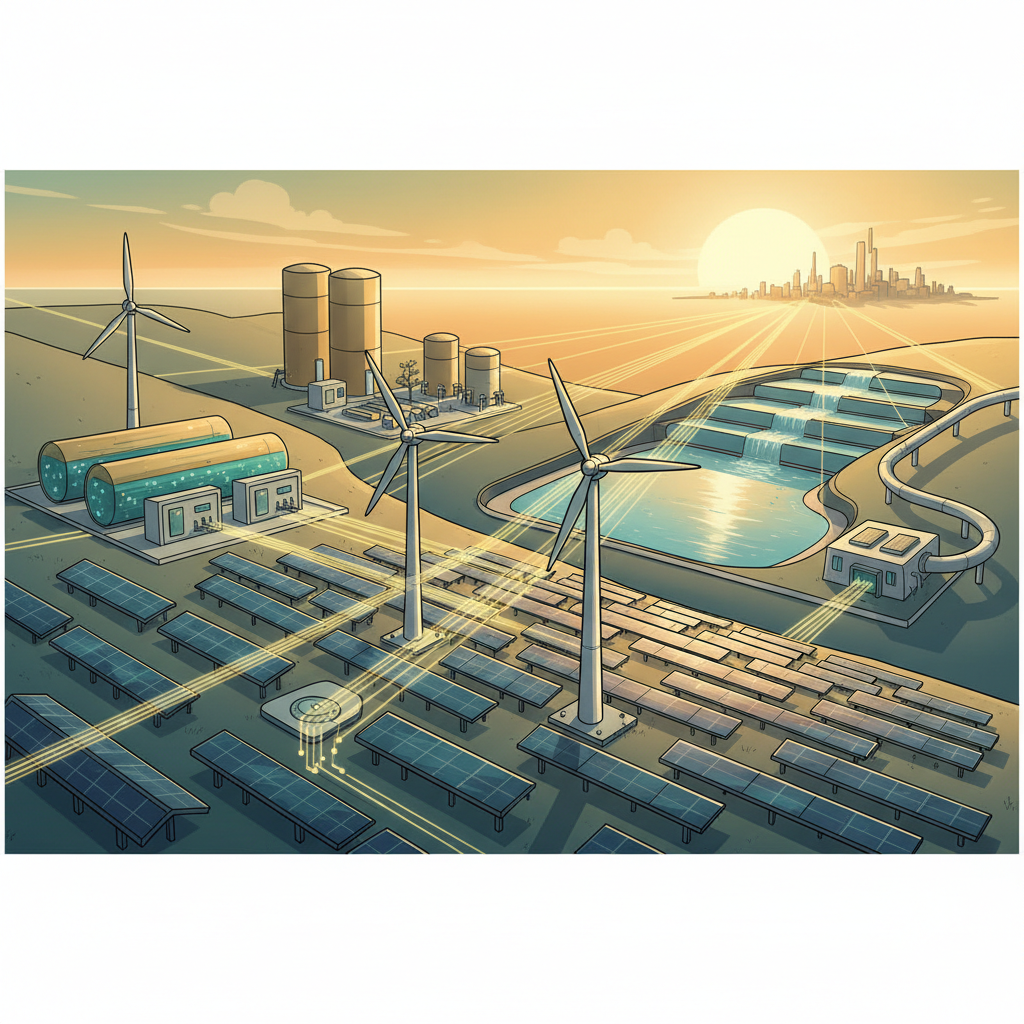
  • Long‑Duration Storage: The Missing Piece for a Zero‑Carbon, Solar‑Dominated Grid

    Long‑Duration Storage: The Missing Piece for a Zero‑Carbon, Solar‑Dominated Grid

    As solar and wind supply a growing share of electricity, the familiar problems of intermittency broaden from day‑night swings to multi‑day and seasonal imbalances. A Commentary in Nature Energy argues that meeting deep decarbonization goals cost‑effectively will require moving beyond today’s short‑duration batteries toward long‑duration energy storage (LDES) that can deliver energy for tens to thousands of hours — from several days up to seasonal storage.

    Why does duration matter? Lithium‑ion batteries have proved transformational for diurnal balancing and fast grid services, but they are neither economical nor practical for holding large quantities of energy for days or months. Solar‑dominated systems face variability across many timescales: intra‑day peaks, stretches of low renewable output lasting multiple days, and seasonal mismatches between generation and demand. LDES technologies would fill that gap, enabling grids to shift energy across weeks and seasons and thereby unlock much deeper decarbonization.

    The Commentary groups promising LDES pathways into broad technology classes and assesses their prospects. Electrochemical systems — notably flow batteries — stand out because they decouple power (kW) from energy (kWh) and can be scaled to long durations. Established chemistries such as vanadium redox flow are already being deployed, while new chemistries are being investigated to lower cost and broaden resource availability. Mechanical options include mature pumped hydro, which is highly cost‑effective where geography permits, and compressed air energy storage (CAES) with advanced adiabatic variants under consideration. Thermal storage approaches — from high‑temperature systems to seasonal thermal concepts and power‑to‑heat‑to‑power chains — can store very large quantities of energy, though they face conversion losses and integration challenges. Finally, chemical fuels produced by power‑to‑gas or power‑to‑liquid processes can provide seasonal storage and leverage existing fuel infrastructure, but their round‑trip efficiency is low and economics hinge on progress in electrolyzers and availability of carbon‑free feedstocks.

    Crucially, the authors emphasize that the value of LDES is context‑dependent. Resource profiles, transmission expansion, demand flexibility and market design all shape what kinds of storage make sense in a given region. That means we should stop judging storage solely by a single metric such as levelized cost per MWh of stored energy. Useful evaluation must capture whole‑system value: duration, dispatchability, cycle life, interaction with transmission and demand response, and integration costs.

    To accelerate deployment, the Commentary calls for coordinated R&D, demonstration projects and policy action. Priorities include improving cost and performance across candidate technologies (materials, scaling and manufacturing), producing representative performance and cost data from large demonstrations to reduce uncertainty, and creating markets and procurement mechanisms that recognize the distinct services long‑duration storage provides — from capacity and resource adequacy to seasonal shifting. The authors also urge expansion of modeling tools so planners can capture dynamics across multiple timescales and properly evaluate storage alongside transmission and demand‑side measures.

    The article points to growing signals that multiple pathways are being pursued — from flow battery rollouts and advanced pumped‑hydro proposals to power‑to‑gas pilots — but it is careful to note limitations. As a Commentary, it synthesizes literature and expert judgment rather than presenting new experimental data, and it acknowledges uncertainty in future technology costs. Rather than prescribing a single winner, the authors recommend a pluralistic approach: support multiple technologies while using system‑level evaluation to determine where each option fits best.

    For planners and policymakers working to integrate large amounts of solar, the takeaway is clear: short‑duration lithium‑ion batteries are necessary but not sufficient. Long‑duration storage — across electrochemical, mechanical, thermal and chemical pathways — is essential to bridge multi‑day and seasonal gaps and to deliver a reliable, zero‑carbon electricity system. Achieving that will require both technology innovation and new market and policy frameworks that recognize the unique value of duration.