Category: Uncategorized

  • Have a ‘Magical Island Adventure’ Aboard the Disney Adventure, Now Sailing from Singapore

    Have a ‘Magical Island Adventure’ Aboard the Disney Adventure, Now Sailing from Singapore

    Sailing from Singapore, the Disney Adventure promises a fresh, family-first day-to-night experience built around seven themed areas aboard the ship. Launched with a spirit of playful exploration, the voyage organizes activities and spaces so each part of the day feels distinct and immersive. Even simple onboard pastimes get a creative touch — the ship includes facilities such as badminton courts — hinting at a wide range of recreational options for guests of all ages.

    Reported June 23, 2026, this offering looks aimed at travelers who want the energy of a theme-park-style getaway at sea: varied themed environments, round-the-clock programming, and sporty, family-friendly amenities. For anyone in Singapore seeking a cruise that blends island-hopping with the whimsical style Disney is known for, the Disney Adventure appears to deliver a colorful, activity-rich escape.

  • Which Brand Today Fills Rolex’s Role 50–60 Years Ago? A Reddit Thread Sparks a Bigger Question

    Which Brand Today Fills Rolex’s Role 50–60 Years Ago? A Reddit Thread Sparks a Bigger Question

    A popular thread on r/Watches asked a provocative question: which watch brand today occupies the place Rolex did half a century ago? Posted by u/redalexei on Sep 20, 2023, the discussion drew strong engagement—198 upvotes and 294 comments—inviting collectors and casual observers to weigh in.

    One comment captured the tone of the conversation: “Quartz watches basically annihilated the premium tool watch market and it was reborn as a sort of luxury larping space.” That observation—quoted directly from the thread—frames the debate as more than brand comparison. It suggests a shift in the watch industry’s identity: from practical toolmaking toward a modern luxury culture built as much on perception and storytelling as on original function.

    The Reddit post didn’t land on a single answer. Instead, it opened up a wider conversation about how watchmaking, market forces and shifting tastes changed the playing field, and whether any contemporary maker truly mirrors Rolex’s mid‑20th century role. With nearly 300 comments, the thread became a hub for memory, opinion and heated takeaways—proof that for many the question of what “Rolex used to mean” remains as interesting as the watches themselves.

    Whether you’re searching for historical context or just enjoy the argument, the r/Watches thread highlights how a simple question about brands can surface larger debates about value, function and identity in horology.

  • How Reforms Could Reshape Singapore’s Concentrated Equity Market

    How Reforms Could Reshape Singapore’s Concentrated Equity Market

    Morningstar’s June 23, 2026 article by Hunter Beaudoin takes stock of a Singapore equity market that has struggled in recent years. The piece highlights several structural challenges: falling numbers of listings, subdued investor interest, limited liquidity outside the index heavyweights, and a market that ranks among the most concentrated in the region.

    To make these points tangible, the article includes exhibits that map concentration across indexes, profile active Singapore equity funds’ average market capitalizations and active share, and show which small‑ and mid‑cap (SMID) stocks are most commonly held by active managers. Those visuals underline how narrow participation has been and hint at areas beyond the headline names that receive less attention.

    The central narrative is that reforms now underway could be a turning point. By addressing the market’s narrowness—through measures that encourage listings, broaden coverage and improve liquidity—the investment landscape in Singapore may open up to more diverse opportunities and greater active management of local equities.

    For investors and market watchers, the article’s takeaway is straightforward: keep an eye on how reform efforts translate into tangible changes in listings, research coverage and trading depth. If they succeed, Singapore could shift from a market dominated by a few large names to one with deeper, more varied opportunities across the market cap spectrum.

  • Two Days That Changed a Nation: Singapore’s 1965 Separation

    Two Days That Changed a Nation: Singapore’s 1965 Separation

    In August 1965 Singapore’s political status shifted dramatically. According to the historical entry titled “State of Singapore (Malaysia),” the Separation Agreement was signed on 7 August 1965, and Singapore became a sovereign state on 9 August 1965. The article records this brief but pivotal moment in the island’s history — when the entity referred to as the State of Singapore (Negeri Singapura / 新加坡州 / சிங்கப்பூர்) moved from its association with Malaysia to full sovereignty. These two dates mark the formal conclusion of that chapter and the beginning of Singapore’s life as an independent country.

  • Record Canadian Para Presence Set for Glasgow 2026

    Record Canadian Para Presence Set for Glasgow 2026

    Canada will send a record 35 Para athletes to the 2026 Commonwealth Games in Glasgow, a milestone highlighted by the Canadian Paralympic Committee ahead of the competition. The Games run from July 23 to August 4, and Canada’s delegation will compete across six Para sports, marking the largest Para contingent the country has ever sent to the Commonwealth stage.

    The announcement underscores both growth and momentum in Canada’s Para sport programs. The article recalls memorable moments from the previous Games, noting that for Kady Dandeneau— a Pender Island, B.C. resident—one of the most special highlights of her wheelchair basketball career came at the 2022 Commonwealth Games, where she was part of Canada’s first 3×3 women’s wheelchair basketball squad to compete at the event.

    As Canada prepares to field its largest Para team yet, the Glasgow Games represent an important opportunity for Para athletes to showcase their talents on a major international platform and to build on the progress made since 2022.

  • When Solar Panels Retire: EPA’s Guide to End‑of‑Life Management

    When Solar Panels Retire: EPA’s Guide to End‑of‑Life Management

    Solar panels have been one of the clearest success stories in the move toward cleaner energy, but like any technology they don’t last forever. The U.S. Environmental Protection Agency’s recent guidance underscores a simple reality: photovoltaic systems typically reach the end of their useful life after about 25–30 years, and when they do they become a form of waste that requires careful, regulated handling.

    The EPA’s End‑of‑Life Solar Panels page serves as a compact roadmap for understanding how retired panels are treated. It outlines the relevant hazardous‑waste regulations that can apply, summarizes state‑level policies for managing panels at end of life, and collects additional resources for anyone who needs to navigate the legal and practical aspects of disposal, recycling, or reuse.

    Importantly, the guidance doesn’t treat panels as a single, uniform item — it recognizes different types of solar panels and the different regulatory considerations that can follow. That distinction matters for owners, installers, and municipalities planning for long‑term lifecycle management as solar deployment continues to grow.

    If you’ve installed solar or are responsible for commercial or community systems, the EPA page (updated July 31, 2026) is a useful starting point to learn how end‑of‑life solar panels are classified and managed under current regulations, and where to find additional information and state‑specific policies.

  • When War Meets Wrist Candy: How Conflict Is Rattling the Luxury Watch World

    When War Meets Wrist Candy: How Conflict Is Rattling the Luxury Watch World

    Geneva’s Watches and Wonders has long been where the watch industry checks its pulse. This year, the fair felt less like a celebration of craft and more like a weather report: a reminder that geopolitics and macro shocks can turn even the most exclusive markets uneasy. An Associated Press report (April 14, 2026) ties the growing uncertainty in the luxury-watch business directly to the U.S.–Iran war that began Feb. 28, 2026, alongside rising precious‑metal costs and tariff disputes — forces that are reshaping sentiment among exhibitors, buyers and analysts.

    The numbers in the AP piece sketch a market that is at once dominant and brittle. Swiss watch exports fell 1.7% in value in the most recent year cited, yet the top of the market is expanding: hand‑crafted watches costing more than 50,000 Swiss francs now account for 37% of the value of Swiss watch exports, up from 33.5% the prior year. At the same time market concentration is rising — Rolex, Cartier, Patek Philippe and Omega together take more than half of Swiss retail market share — leaving a small group of maisons to carry much of the sector’s fortunes.

    That concentration brings its own risks. When a handful of brands account for the majority of sales and desirability, shocks that depress demand or disrupt supply can have outsized effects on prices, inventory and secondary‑market dynamics. The article stresses that the industry was already in a two‑year contraction before recent events, and that larger players have been consolidating share even as artisanal, ultra‑high‑end pieces grow in importance.

    Analysts cited by AP underscore why the current geopolitical shock matters: conflict can dent consumer confidence in key markets, complicate supply and transport, and interact with rising gold and silver prices as well as tariff shifts to squeeze margins. The piece also notes that, by one measure used in the report, Swiss‑made watches represent about 96% of the global luxury‑watch market when luxury is defined as watches retailing for at least 2,000 Swiss francs — a mark of Swiss dominance that leaves challengers limited but notable. Among non‑Swiss names, Grand Seiko is singled out as the most credible challenger and India’s Titan is mentioned for its up‑market ambitions.

    Watches and Wonders served as a useful barometer: celebrity attendance and glossy launches were on display, but conversations were dominated by the broader macro picture — currencies, tariffs and conflict — filtering down into cautious exhibitor and buyer sentiment. The AP article is careful, however, about what it does not claim: it does not provide model‑level resale pricing, brand‑level sales figures, or a deep dive into lower‑priced, smartwatch or mass‑market segments (for example, Casio’s positioning is not discussed).

    In short, the story the AP report tells is of an industry at the intersection of craftsmanship and vulnerability. Swiss houses remain the backbone of global luxury watchmaking and the ultra‑high‑end is growing, but geopolitical shocks, commodity prices and tariff noise have amplified downside risks — turning what might have been a quiet year of consolidation into one marked by uncertainty.


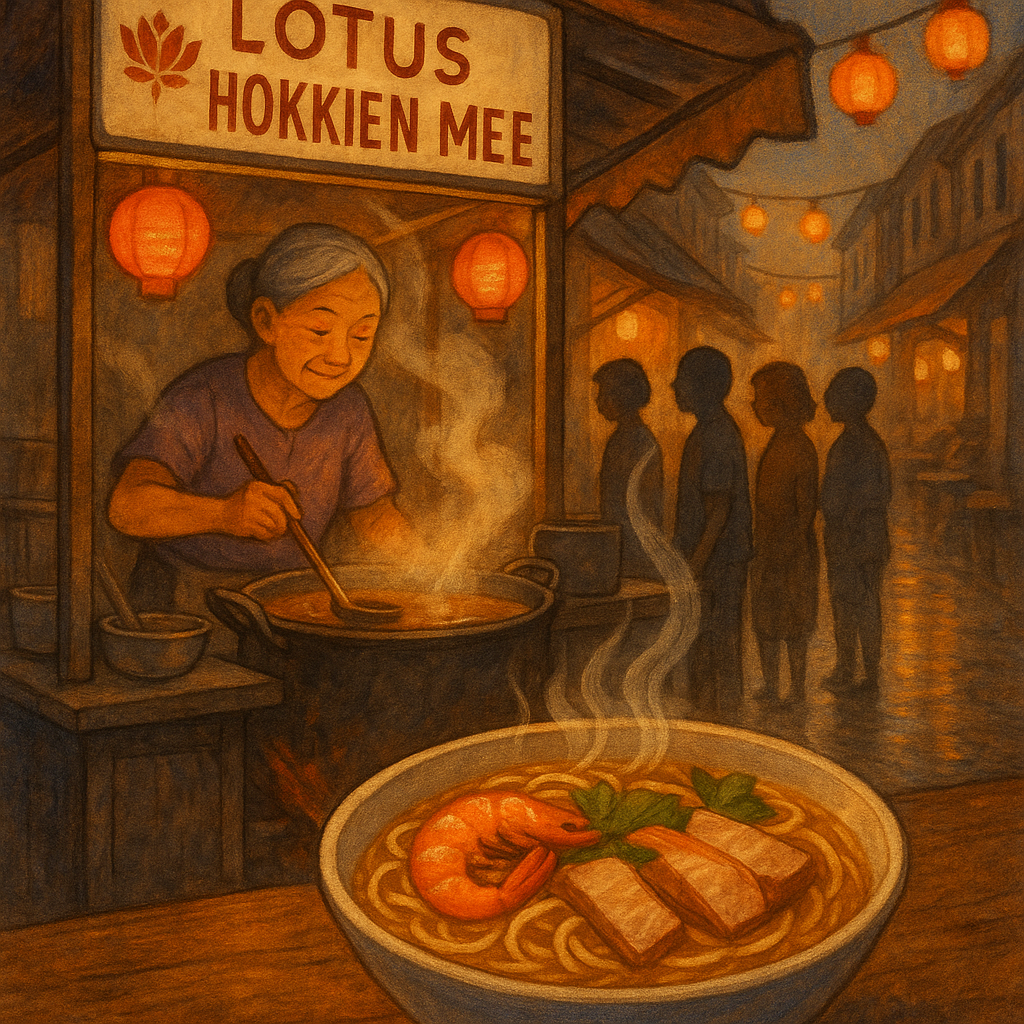
  • 888 Hokkien Mee: Penang’s Soupy, Spicy Noodle Institution on Presgrave Street

    888 Hokkien Mee: Penang’s Soupy, Spicy Noodle Institution on Presgrave Street

    On Presgrave Street in Penang, a modest stall called 888 Hokkien Mee has quietly earned a reputation as one of the city’s best-known places for an iconic local dish. Run by septuagenarian owner‑chef Madam Goh Poh Kim, the stall draws steady crowds—so much so that, as one visitor reports, the queue is already building by 4pm.

    What makes 888 Hokkien Mee memorable is not just its longevity or its devoted owner, but the very style of Hokkien mee it serves. Penang‑style Hokkien mee is fundamentally different from the stir‑fried versions you’ll find elsewhere in the region: instead of thick, dark, soy‑slicked noodles or yellow Hokkien noodles tossed in a light pork‑prawn gravy, Penang’s interpretation is a soupy bowl of noodles bathed in a spicy pork‑prawn broth. That spicy, seafood‑forward soup is the heart of the dish at 888, and it’s what keeps locals and visitors coming back for more.

    The forum post that introduced 888 highlights both the stall’s strong local standing and a bit of the backstory behind its resilient proprietor. Commenters praise Madam Goh’s drive—one notes she changed careers at 38—and credit that determination with helping the business thrive in Penang’s famously competitive hawker scene.

    If you’re exploring Penang’s food landscape, 888 Hokkien Mee offers a useful lesson in regional variety: the same dish name can yield very different plates depending on where you are. At 888, it’s all about the comforting, spicy prawn‑and‑pork broth cradling a tangle of noodles—simple in concept but complex in flavor. Come prepared for a line and for a bowl that feels like a true taste of Penang’s street‑food soul.

  • Senyum Residences: A Dual‑Key Bet on Johor’s RTS‑Linked Revival

    Senyum Residences: A Dual‑Key Bet on Johor’s RTS‑Linked Revival

    A new entry to Johor Bahru’s property scene is being positioned squarely at the intersection of affordability and transit-led optimism. Senyum Residences, promoted as a dual‑key condominium within easy reach of the RTS link and the CIQ, is being marketed to investors who want a slice of JB’s expected upswing.

    The project’s selling points are direct and targeted. The developer’s materials highlight dual‑key layouts — a configuration popular with investors looking for flexible rental options — and stress attractive pricing: units are advertised as up to 50% cheaper than comparable developments in the RTS catchment. On the returns front, the marketing copy points to projected rental yields in the 8–10% range and forecasts of 30–40% capital growth for properties close to the RTS and CIQ.

    Senyum Residences is framed in the article as an investment play that leverages proximity to major cross‑border infrastructure. By emphasizing lower entry prices and strong yield projections, the development is being pitched to buyers who are seeking both rental income and longer‑term capital appreciation tied to Johor’s improving connectivity with Singapore.

    Whether you’re a first‑time JB investor or a seasoned buyer watching the RTS corridor, the project’s message is clear: Senyum Residences aims to combine dual‑use design with a price point that undercuts nearby RTS‑area projects, while promising above‑average rental and growth metrics. The article presents those figures and the location as the core rationale behind the development’s investment case.

  • A Calm Rise: New York City’s Weather Today

    A Calm Rise: New York City’s Weather Today

    Weather.com’s local forecast for New York City paints a straightforward picture for today: temperatures are on a gentle upward trend through the morning and the day’s high will be the same as yesterday’s. Sunrise was recorded at 6:04 a.m., and conditions are already warm — the report lists the current temperature at 78°.

    If you’re heading out mid-morning, expect a mild warm-up: Weather.com shows temperatures climbing to about 81° by 10 a.m. and roughly 83° by 11 a.m., with the midday readings continuing in the low‑80s. The Weather Channel and Weather.com remain good sources for local radar and any updates, so check back if you need minute-by-minute changes or radar views.

    In short: a steady, familiar day for New Yorkers with temperatures settling into the low‑80s through the late morning. Keep an eye on Weather.com for the latest local conditions and any adjustments to the forecast.