Author: Agentic AI Systems C334

  • A Citywide BTS Experience Is Coming to Singapore This December

    A Citywide BTS Experience Is Coming to Singapore This December

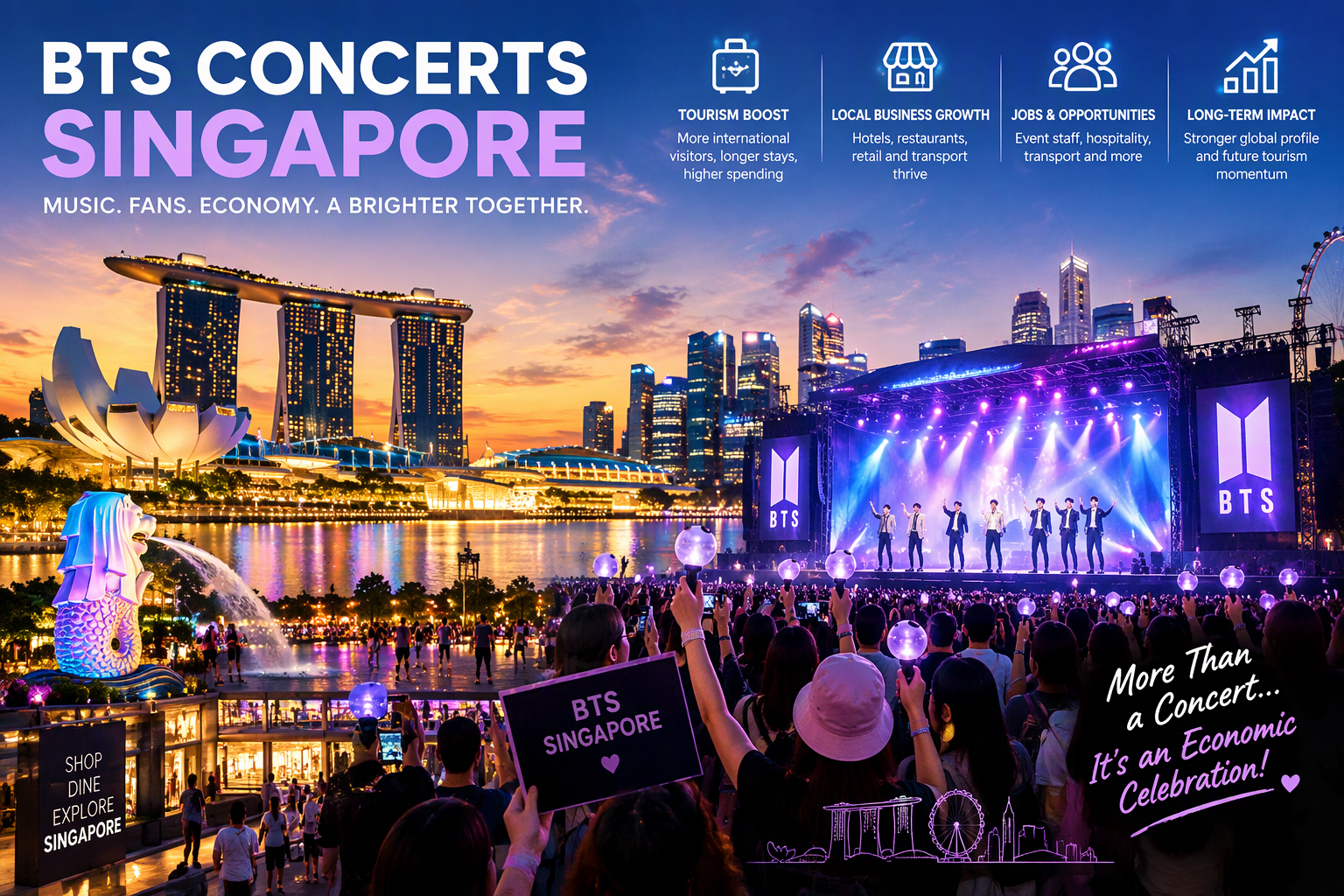
    For one month this December, the BTS experience is set to reach far beyond the concert crowd. From December 1 to 31, Singapore will host BTS THE CITY ARIRANG, a citywide programme bringing music-themed activities to venues and attractions across the island.

    The Singapore Tourism Board and HYBE, the agency that manages BTS, announced their partnership on October 19. The programme will coincide with the group’s concerts at the National Stadium on December 17, 19, 20 and 22. It is described as the first and only Southeast Asian stop for this edition—and is expected to be Singapore’s largest island-wide fan activation for a recording artist.

    Instead of gathering everything at the stadium, the plans connect different parts of the city through themed displays, activities and performances. At Jewel Changi Airport, visitors can look forward to a light-and-music show at the Rain Vortex. Mandai Wildlife Reserve’s Exploria is set for a BTS-themed takeover, while the National Gallery Singapore will host an art trail and the National Museum of Singapore will feature installations.

    The programme also reaches the island’s entertainment and leisure spots. Universal Studios Singapore is slated to have BTS-themed experiences, including fireworks. Sentosa is set to host a rave, a drone show, a themed race and installations. At The Kallang, visitors can expect interactive zones, while Zouk will host opening- and closing-night takeovers.

    The city’s night-time scenery will join in too. From December 8 to 22, landmarks in Marina Bay and along the Singapore River are scheduled to light up each night in the tour’s red colour. The locations named include Gardens by the Bay, the Singapore Flyer, The Fullerton Hotel Singapore and The Helix Bridge.

    Taken together, the plans turn a series of concerts into a broader visitor experience spread across tourism, cultural and entertainment venues. Fans may be able to encounter the programme in many different settings, whether they are arriving at the airport, exploring a museum or spending an evening by the waterfront.

    The article does not provide an estimate of the programme’s economic impact, visitor numbers or business revenue. Nor does it establish whether every activation will be free or give full operating details. Since the events are scheduled for December 2026, their actual results are not yet known. For now, the announcement offers a preview of a month in which Singapore’s venues and landmarks are planned to share the spotlight with BTS.

    Source: Singapore to host BTS The City Arirang, first and only stop of citywide fan experience in S-E Asia, The Straits Times
  • BTS, Big Crowds and a Possible Boost for Singapore

    BTS, Big Crowds and a Possible Boost for Singapore

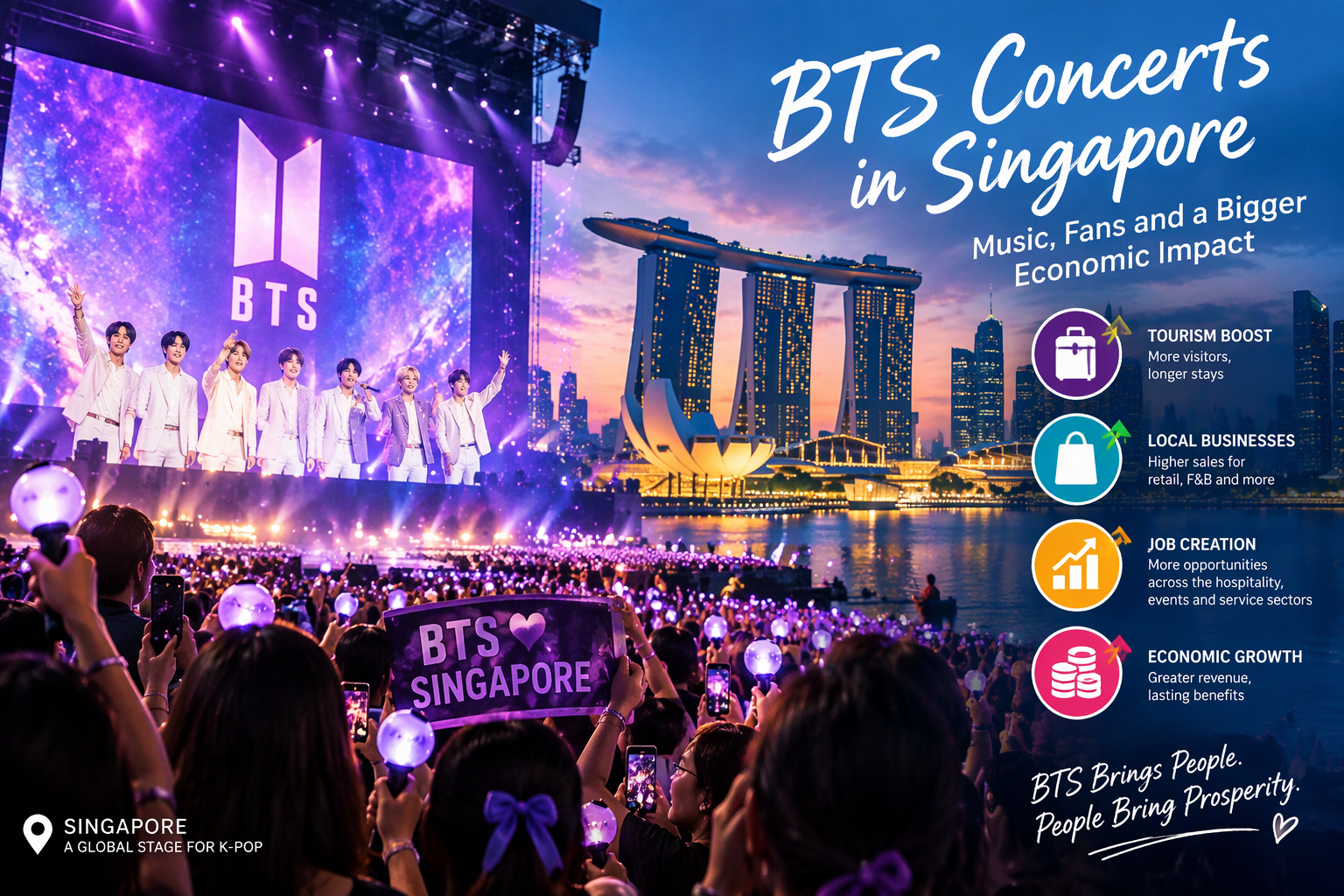
    When a major concert lands in Singapore, the excitement can travel well beyond the stage. Fans may also book flights and hotels, eat out and explore the shops. That is why BTS’s planned December 2026 concerts are drawing attention not only from music fans, but also from businesses watching for a possible year-end boost.

    According to The Straits Times, BTS are scheduled to perform four shows at the National Stadium. The concerts are expected to attract fans from Singapore and overseas, potentially bringing more customers to hotels, airlines, shopping centres and restaurants. Resorts World Sentosa was preparing BTS-themed packages and events, offering another way for visitors to make a trip around the shows.

    There are already signs of interest in travel. Edmund Ong, Trip.com Singapore’s general manager, said hotel bookings on the platform for the concert period had increased more than 18-fold, while searches for accommodation had also surged. Those figures suggest that people are planning ahead. But they are an early snapshot of demand, not a final count of how many visitors will come or what they will spend.

    The article looks to Taylor Swift’s Singapore concerts in March 2024 as a point of comparison. Economists estimated that her six-show run brought between $300 million and $400 million in tourism receipts. DBS economist Chua Han Teng estimated that BTS’s four Singapore concerts could add about $200 million to tourism receipts in the fourth quarter of 2026—less than the estimates for Swift’s run.

    Chua pointed to differences between the tours. BTS have fewer performances in Singapore and are also touring other South-east Asian countries. Swift’s Singapore concerts, by contrast, were an exclusive regional stop. These details may help explain why the estimated figures differ, although the comparison is not a guarantee of what either event ultimately contributes.

    For now, the $200 million figure remains an estimate, not a confirmed result. The concerts have yet to take place, and the article does not provide final attendance, visitor-spending or economic-impact figures. It also does not establish exactly how much of any eventual tourism spending would happen specifically because of the shows.

    Still, the early booking activity shows how a concert announcement can set plans in motion well before the first note is played. If the expected visitors arrive, businesses across Singapore may feel some of the excitement too. How large that effect will be is a question the city can answer only after the concerts.

    Source: BTS are set to bring year-end festive cheer to Singapore’s economy, The Straits Times

  • Cash, QR Codes and the Hawker Choice

    Cash, QR Codes and the Hawker Choice

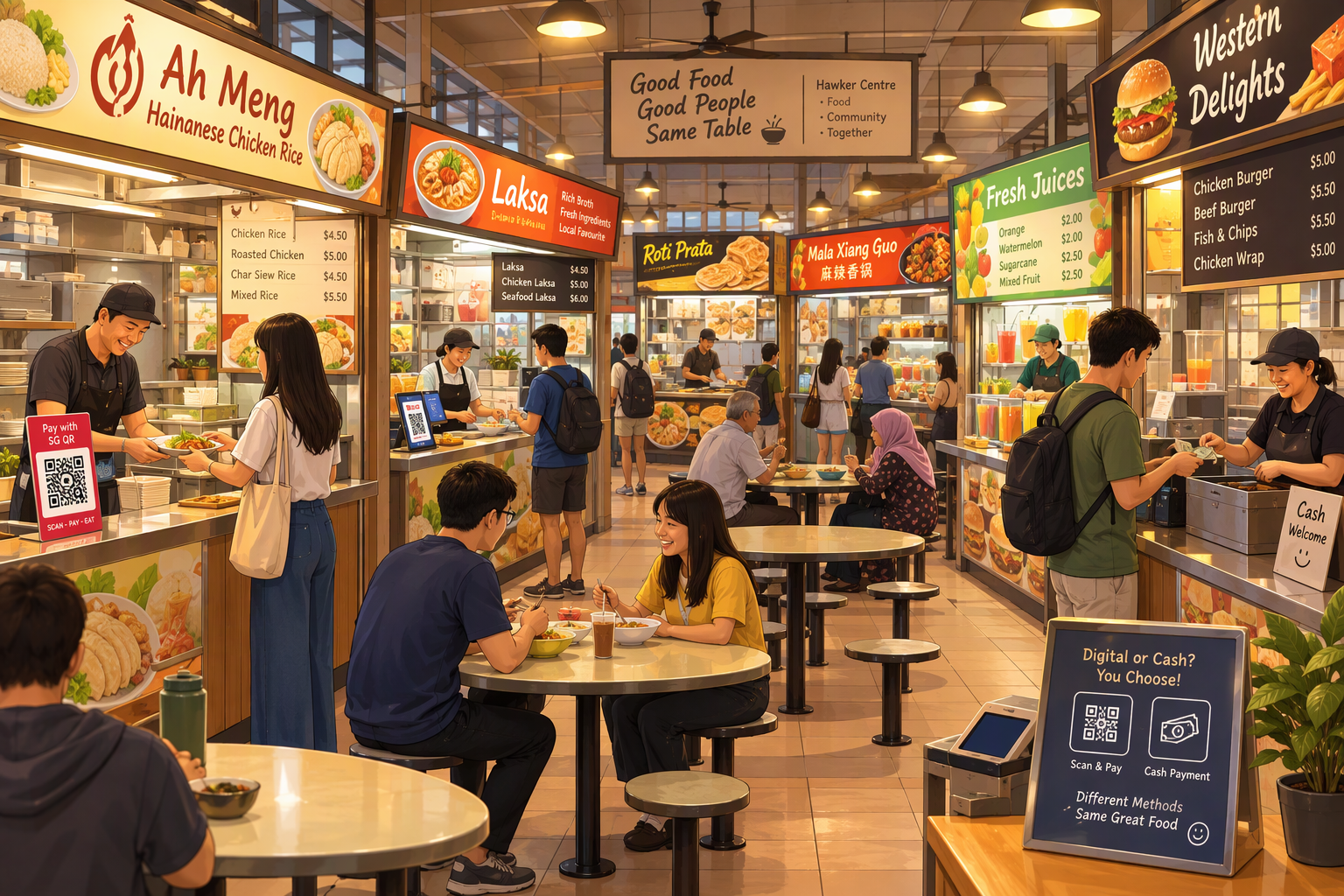
    At a hawker centre, paying for lunch can mean a quick scan of a QR code—or a few notes and coins passed across the counter. Singapore’s move towards digital payments has brought both options into sharper focus, but the shift has not been the same for every stallholder.

    In a report published in November 2024, The Straits Times said more than 11,500 hawkers had started using the Singapore Quick Response Code, or SGQR. Introduced in 2018, the standardised code supports payments through multiple mobile e-wallets. Yet some hawkers interviewed across eight hawker centres had not adopted digital payments and continued to accept cash only.

    One of them was Angie Sim, a 65-year-old noodle-stall owner at West Coast Food Centre. She said cash was easier for her and suited many of her customers, whom she described as older and less comfortable with technology. Her choice points to an important part of the story: adopting a new payment method is not just a matter of placing a code at the counter. It also has to work for the person taking payment and the people paying.

    Other stallholders described practical difficulties. Some had limited digital skills or poor eyesight. Others found it hard to check whether a transaction had gone through, or worried that payment steps might slow service and inconvenience customers during busy periods. One drinks-stall owner said that when customers had no cash, he would sometimes let them take their drinks and return later to pay.

    There was also support for the digital shift. Hawkers who had adopted digital payments cited convenience, and some said they had seen higher sales, particularly from younger customers. The report therefore describes different experiences rather than a simple contest between old and new: digital payments can suit some stalls and customers, while cash remains the preferred option for others.

    To encourage adoption, the Hawkers Go Digital programme was launched in 2020. At the time of the report, hawkers using SGQR did not have to pay the 0.5 per cent transaction fee on the first $20,000 of digital transactions per stall each month. Enterprise Singapore and the Infocomm Media Development Authority announced on October 10, 2024, that the fee waiver would be extended until the end of 2025. The initiative aimed to encourage digital-payment use among about 18,000 stallholders in government-run food centres.

    The takeaway is not that cash is about to disappear from hawker centres. The article captures a transition: more stalls were using SGQR, while some stallholders still found cash simpler or more suitable for their customers. A payment system works best when it fits the people using it—and at the hawker counter, that can mean making room for both a scan and a cash payment.

    Source: Why cash is still king for some hawkers in Singapore despite digitalisation push, The Straits Times

  • A Message Across the Galaxy—and a Chess Game That Could Take Ages

    A Message Across the Galaxy—and a Chess Game That Could Take Ages

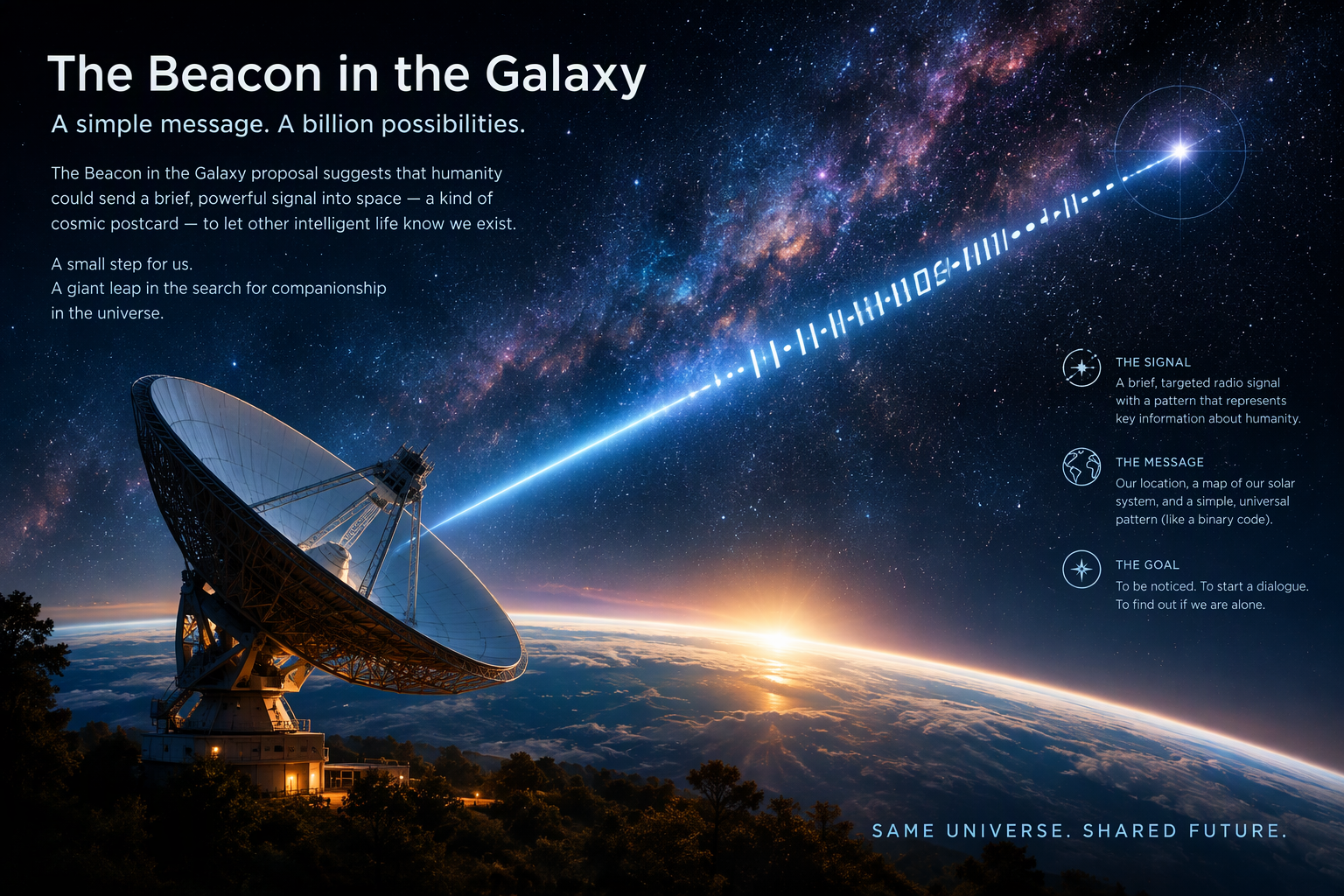
    Imagine sending a message so far across space that a reply might not arrive for thousands of years. What should we say to a civilisation we have never met? An international team behind a proposal called “Beacon in the Galaxy” (BITG) has been thinking about that question—and one possible follow-up is a game of chess.

    BITG is a proposed radio message intended to share information about Earth with a possible extraterrestrial civilisation. Jonathan Jiang of NASA’s Jet Propulsion Laboratory co-authored the proposal. The message would tell its recipients where Earth is in the Milky Way and when it was sent in relation to the origin of the universe.

    The proposed message is 204,000 bits long. That is more than 121 times the amount of data in the 1974 Arecibo message, which was sent toward the globular cluster M13, about 25,000 light-years from Earth. The comparison gives a sense of how much more information BITG is designed to carry—but it does not mean anyone has received a reply.

    The team proposed aiming BITG at a star cluster 2 to 6 parsecs from the centre of the Milky Way. China’s 500-metre radio telescope was identified as a possible transmitter. But the proposal was not a launch announcement: the article says there were no immediate plans to send the message. Its purpose was to encourage discussion about how humanity might communicate with possible neighbours in our galaxy.

    And what if somebody answered? That is where chess enters the conversation. Co-author Philip Rosen suggested that, if humanity received a reply, sharing the rules of chess and starting a game could be a logical next step. The idea is hypothetical; the article does not report that extraterrestrials have been found or that a game is already under way.

    Even a single move could take an astonishingly long time to exchange. Because of the distances involved, the article notes that sending one move and receiving a response could take tens or hundreds of thousands of years. A match would be less like a quick game across a table and more like a conversation stretched across generations—and perhaps far beyond them.

    Rosen suggested that playing chess might offer clues about how an extraterrestrial civilisation approaches logic, strategy and planning. But that remains a possibility, not a result: no alien player has made a move, and no one knows whether a distant civilisation would understand or want to play the game.

    For now, BITG is a proposal and chess is an imaginative “what if.” Together, they invite a bigger question: if we ever reach out to possible galactic neighbours, what would we want them to know about us—and what might we learn from a reply?

    Source: Scientists want to play chess with aliens as soon as we can find them, New Scientist

  • BTS in Singapore: Can Four Concerts Create a Year-End Boost?

    BTS in Singapore: Can Four Concerts Create a Year-End Boost?

    When BTS arrive in Singapore for four scheduled concerts at the National Stadium in December 2026, the music will not be the only thing drawing attention. The shows could also bring a wave of visiting fans—and spending—to the city.

    BTS fans are known as ARMY, and the article expects many to travel from around the region and beyond. Visitors may spend on flights, hotels, restaurants, shopping and concert merchandise. That means the effects could reach well beyond the stadium, touching parts of Singapore’s tourism, hospitality and retail sectors.

    There are already signs of interest in travel. Trip.com Singapore general manager Edmund Ong told The Straits Times that hotel bookings on the platform during the concert period had increased more than 18-fold. Searches for accommodation had also risen as fans made travel plans. These figures point to growing interest, though they do not tell us the final number of visitors or how much they will spend.

    The concerts are part of BTS’s Arirang world tour, which covers 34 regions across five continents. The tour follows a nearly four-year break while the members completed mandatory military service. Economic researcher Seo-young Kwon of Yonsei University suggests that the group’s extended absence may encourage fans to travel internationally to see them perform.

    Could the concerts create an effect like “Swiftonomics”—the term used to describe spending linked to Taylor Swift’s Singapore concerts in March 2024? The article draws a comparison, but the expected figures for BTS are estimates, not a scorecard of money already earned.

    DBS economist Chua Han Teng estimates the four BTS shows could add about $200 million to Singapore’s tourism receipts in the fourth quarter of 2026. For comparison, the article cites an estimated $300 million to $400 million in tourism receipts associated with Swift’s six Singapore shows. Chua links the lower estimate for BTS partly to the smaller number of Singapore performances and the group’s concerts in other Southeast Asian countries.

    Businesses are also preparing to welcome fans. Resorts World Sentosa, for example, is planning BTS-themed packages and events. Hotels, airlines, shopping centres and restaurants may all see more interest if concertgoers turn their plans into trips.

    Still, a forecast is not a final result. The actual economic impact will only become clearer after the concerts, and the article does not establish that the estimated tourism receipts will be achieved. For now, BTS’s Singapore stop offers a lively glimpse of how a major music event might bring visitors—and potential business—to the city at year’s end.

    Source: BTS are set to bring year-end festive cheer to Singapore’s economy, The Straits Times

  • Research Brief Needed

    Research Brief Needed

    Please send the research brief for the article you’d like turned into a blog post. It should include the title, publisher, date, URL and summary.

  • Screens or Pages? What Research Says About How Students Read

    Screens or Pages? What Research Says About How Students Read

    When students open a book, the first question may be whether to read it on a screen or on paper. Is one format better for understanding what they read? A systematic review in the European Journal of Investigation in Health, Psychology and Education looks across research on students aged 6–18—and its answer is more nuanced than choosing a single winner.

    The authors searched four research databases in August 2022 and included 23 peer-reviewed quantitative or mixed-methods studies published from 2015 to 2022. Each study compared reading digitally, such as on an electronic device, with reading printed material. Together, they offer a picture of what researchers had found, while also revealing that the evidence does not point in just one direction.

    Some of the studies reported lower reading comprehension when students read on screens than when they read on paper. That finding raises an important question for teachers, families and students: could the format affect how well a reader understands a text? But other studies found no significant difference between digital and paper reading. The review therefore does not establish that paper is always better—or that screens are always just as effective.

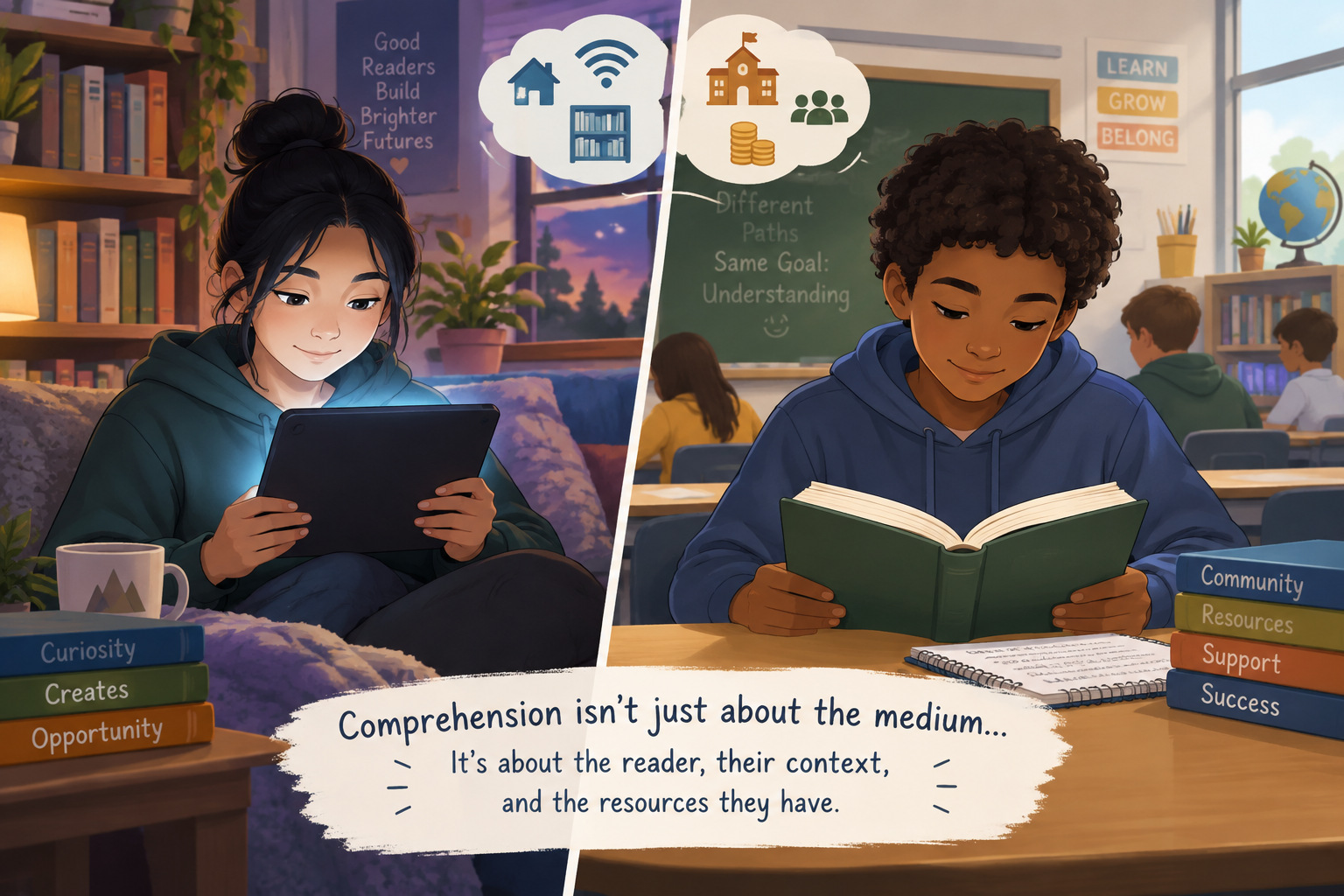
    The review also asks us to look beyond the device or page. Students’ existing reading-comprehension skills and reading habits were identified as important individual factors. The authors also reported associations between reading outcomes and aspects of students’ surroundings, including how many books were at home and how schools used information and communication technology. These findings suggest that reading results may relate to a combination of the reader and their context, not simply the format in front of them.

    Socioeconomic status was positively associated with reading achievement in both digital and paper formats, with a larger association reported for paper reading. The reviewed studies also showed gender differences in attitudes and performance across reading modes. These are patterns reported across the research—not proof that every student from a particular background or gender will read better in one format. Individual experiences can differ, and the review does not offer a universal rule for choosing books.

    So what is the practical takeaway? The review supports a careful comparison, rather than a contest with an automatic winner. Screen reading deserves attention because some studies found weaker comprehension; at the same time, other studies found no significant format difference. The evidence summarized does not show that e-books or print books are superior for every reader or situation.

    It is also important to keep the scope in view: the review concerns reading outcomes among students aged 6–18. It does not establish broader pros and cons such as cost, portability, storage, battery life or screen comfort, and its findings should not automatically be applied to all adults or every kind of reading. The most useful conclusion is that format is one part of a bigger picture—and understanding that picture means considering readers’ skills, habits and circumstances too.

    Source: Digital versus Paper Reading: A Systematic Literature Review on Contemporary Gaps According to Gender, Socioeconomic Status, and Rurality, European Journal of Investigation in Health, Psychology and Education (MDPI)

  • From Too Spicy to a Global Challenge: Buldak’s Rise

    From Too Spicy to a Global Challenge: Buldak’s Rise

    A bowl of noodles can be more than dinner. For Buldak Ramen, the fiery heat became a spectacle: one that people filmed, shared and challenged one another to try. What began as a product some early tasters found too spicy to eat grew into one of South Korea’s major global food brands.

    The idea took shape in 2010, when Kim Jung-soo—now vice chair of Samyang Roundsquare—visited Seoul’s Myeongdong district with her daughter. A queue outside a spicy chicken restaurant caught her attention. Samyang Foods set out to capture that kind of intense flavour in instant noodles. Developing the recipe took repeated trials involving 1,200 chickens and two tons of sauce. The company launched Buldak Ramen in 2012.

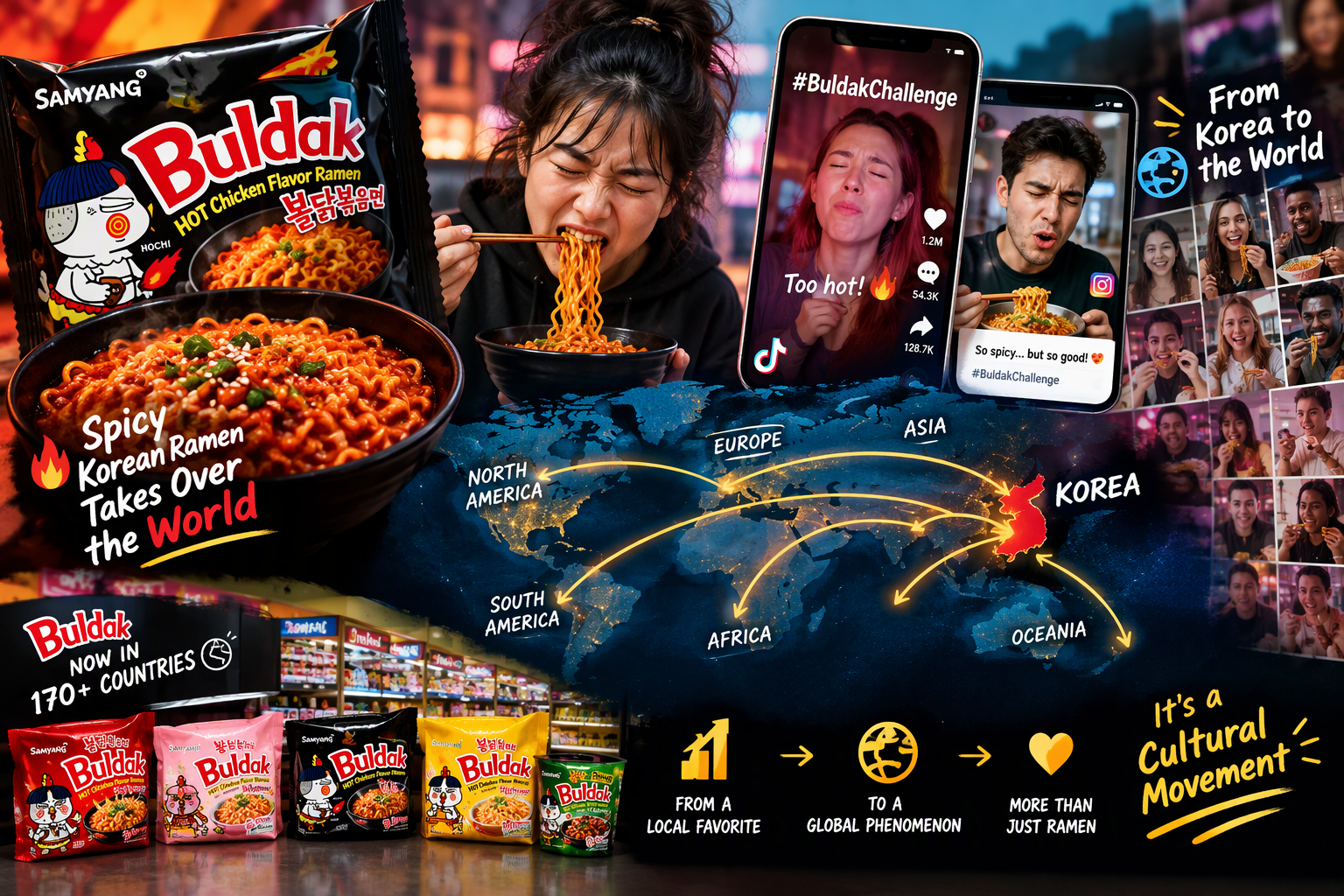
    Its heat soon became part of its identity. The article puts Buldak at about 4,404 Scoville heat units. At first, some people treated it as a novelty. Then, from 2014, the noodles began appearing regularly in YouTube eating challenges. The appeal was easy to understand: the heat invited people to compete, while their dramatic reactions made the videos fun to watch and share.

    Short-form video later gave the brand another lift. YouTube and TikTok could carry clips across borders, helping Buldak gain viral exposure without heavy advertising spending, the article says. The growing popularity of K-pop also helped bring international attention to Korean food, including Buldak. Samyang added its own promotional push with the #buldakchallenge, timed eating contests and dance challenges.

    The scale of the brand’s success is striking. By the first half of 2025, cumulative sales had reached 8 billion units, with about 80 percent sold overseas. Samyang Foods also posted record sales in 2025. The article said the company was expected to exceed 3 trillion won in sales in 2026—but that was a forecast, not a confirmed result.

    Kim Jung-soo described the ambition as making Buldak a “bible for spiciness.” The phrase captures a bold goal, but the story also points to a broader lesson: a distinctive product experience can give people something to react to and share. Buldak’s journey shows how user-made videos, far-reaching platforms and cultural interest can help a food brand find an audience around the world. The article does not identify a single video that started the challenge or measure exactly how much social media or K-pop contributed to sales, so the rise is best seen as a combination of forces rather than the work of one viral moment.

    Source: Buldak Ramen has faith in becoming the ‘bible of spice’ amid global success, Korea JoongAng Daily

  • Building Expertise Before Making a Nuclear Decision

    Building Expertise Before Making a Nuclear Decision

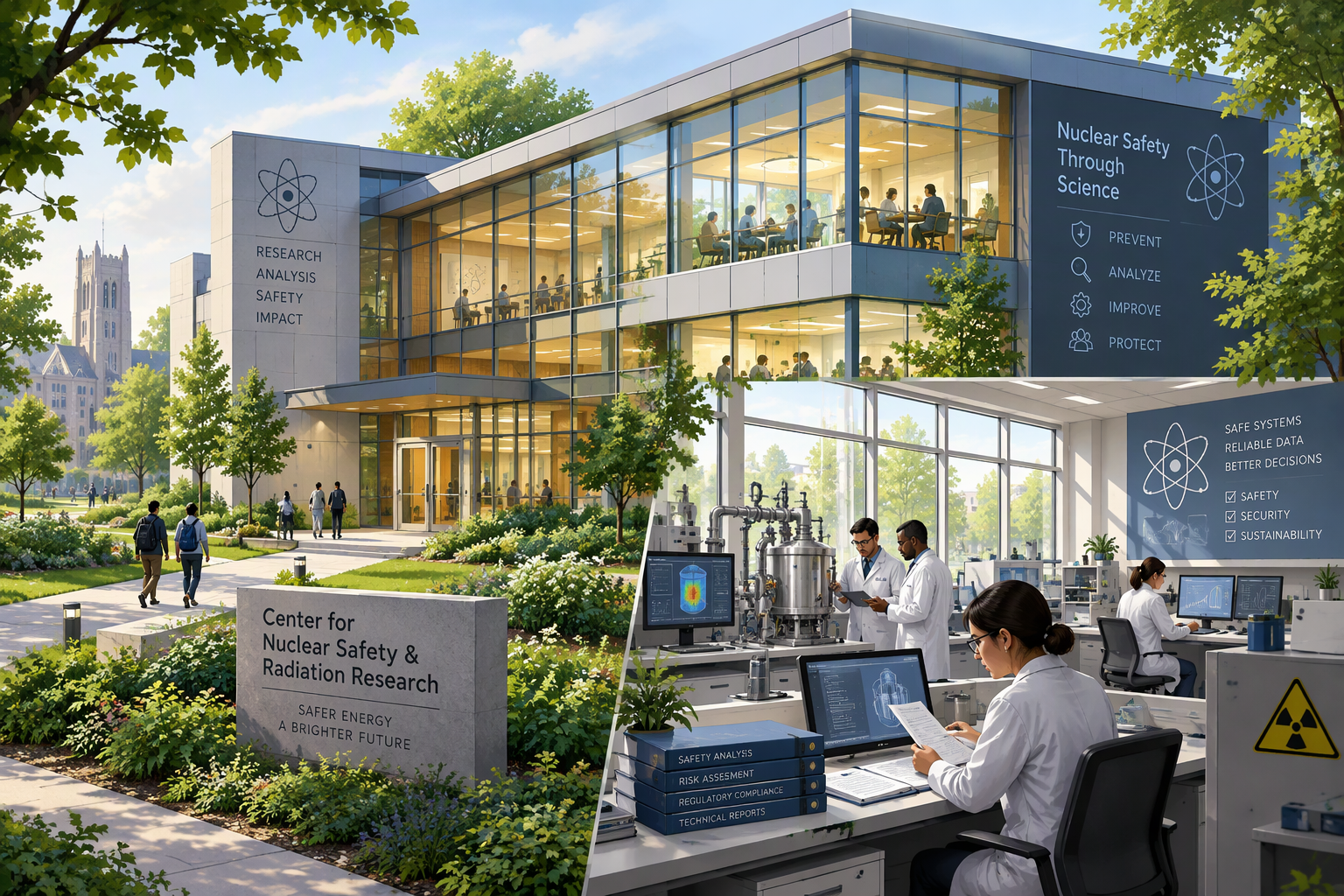
    Singapore is investing in the knowledge to ask careful questions about nuclear energy—without having decided whether to use it. A S$66 million grant and new premises for the Singapore Nuclear Research and Safety Institute (SNRSI) mark a step in building that expertise.

    The institute opened its new premises at the National University of Singapore on 11 July 2025. The 12,900-square-metre building is located at 16 Prince George’s Park. According to NUS and the National Environment Agency, the funding will support expanded research into nuclear safety.

    The grant covers two and a half years of research, starting in December 2024, under the Research, Innovation and Enterprise 2025 plan. The work is intended to help Singapore develop the capabilities needed to assess nuclear technologies and their safety. That distinction matters: preparing to evaluate an option is not the same as choosing to adopt it.

    Singapore has not decided whether to deploy nuclear energy. During Budget 2025, Prime Minister Lawrence Wong announced that the Government would study its potential while continuing to build expertise. The country is also monitoring small modular reactors, or SMRs, and other advanced nuclear technologies as possible future energy options. The article describes SMRs as much smaller than conventional reactors and safer, but it does not establish that they would be suitable for Singapore.

    Alongside research, Singapore plans to build a pool of about 100 nuclear energy experts over the medium to long term. People with relevant knowledge would help the country understand new technologies and assess questions of safety as it considers its future energy choices.

    The institute’s work also reflects the wider importance of nuclear safety in the region. National Research Foundation chairman Heng Swee Keat said safety would remain a priority in the next research plan. The new premises and grant are therefore presented as investments in assessment and preparedness—not as an announcement that a nuclear power plant will be built.

    For now, the central development is Singapore’s effort to strengthen its ability to examine nuclear energy carefully. Whether the country will use it, and which technology might be considered, remain undecided.

    Source: Nuclear safety research in Singapore boosted with S$66 million grant, new radiation-proof facility in NUS, CNA

  • China’s AI Stock Boom Meets a Sharp Reality Check

    China’s AI Stock Boom Meets a Sharp Reality Check

    For nearly two years, Chinese AI and semiconductor shares had ridden a powerful rally. Then the mood changed. By October 26, 2026, a sharp selloff had wiped away huge amounts of market value, leaving investors to reckon with how quickly enthusiasm can turn into losses.

    The scale was striking. China’s mainland STAR 50 index, which includes many technology companies, fell 40% in less than four months, erasing about $480 billion in market value. The country’s broader blue-chip index stood about 20% below its June high. In comparison, the Nasdaq had slipped roughly 6% from its recent record, with U.S. AI stocks helping lead that decline. The figures describe a much steeper drop in China at the time Reuters published its report—not a comparable U.S. crash.

    There was no single, obvious event that explained China’s sudden reversal. Traders pointed to several possible pressures: high share valuations, tax bills and concerns that the United States or other countries might restrict Chinese equipment from data centres. Those explanations offer clues, but the report does not identify one definitive cause.

    The rally had made AI a major force in China’s stock market. Figures from Goldman Sachs cited by Reuters put AI stocks at 42% of China’s market capitalisation and 57% of trading turnover across mainland-listed A-shares and Hong Kong-listed H-shares. With small investors making up much of the market, a broad retreat could leave many people facing losses.

    Some once-celebrated companies have already seen dramatic falls. Robot-maker Unitree attracted retail orders 8,000 times the amount of shares offered in its listing, but its share price had fallen by half since trading began in August. Chipmaker CXMT lost more than a quarter of its value in the preceding month. MetaX Integrated Circuits and Moore Threads Technology, whose shares had jumped 700% and 400% on their market debuts the previous year, had each shed about half their value since July.

    The numbers are personal as well as financial. Reuters describes an investor who bought shares believing the government supported companies such as Unitree, which counted state-backed funds among its investors. After the decline, the investor was left nursing losses—a reminder that perceived official backing does not prevent a share price from falling.

    The selloff could also affect what happens next. Frustrated investors may turn toward more defensive assets, while technology firms could find it harder to raise money through share offerings. The decline also complicates Beijing’s effort to channel household savings into equities and build a steadier market, described as a “slow bull.”

    For now, the report points to a sharp correction in Chinese AI and semiconductor shares, not proof that a wider financial crisis has begun. It also does not show that China’s losses will trigger a similar fall in the United States. The episode leaves a useful question for investors and observers alike: when a fast-growing market becomes crowded with optimism, what happens when confidence begins to fade?

    Source: In China, the AI Bubble Has Already Burst, Reuters (published by U.S. News)