When students open a book, the first question may be whether to read it on a screen or on paper. Is one format better for understanding what they read? A systematic review in the European Journal of Investigation in Health, Psychology and Education looks across research on students aged 6–18—and its answer is more nuanced than choosing a single winner.
The authors searched four research databases in August 2022 and included 23 peer-reviewed quantitative or mixed-methods studies published from 2015 to 2022. Each study compared reading digitally, such as on an electronic device, with reading printed material. Together, they offer a picture of what researchers had found, while also revealing that the evidence does not point in just one direction.
Some of the studies reported lower reading comprehension when students read on screens than when they read on paper. That finding raises an important question for teachers, families and students: could the format affect how well a reader understands a text? But other studies found no significant difference between digital and paper reading. The review therefore does not establish that paper is always better—or that screens are always just as effective.
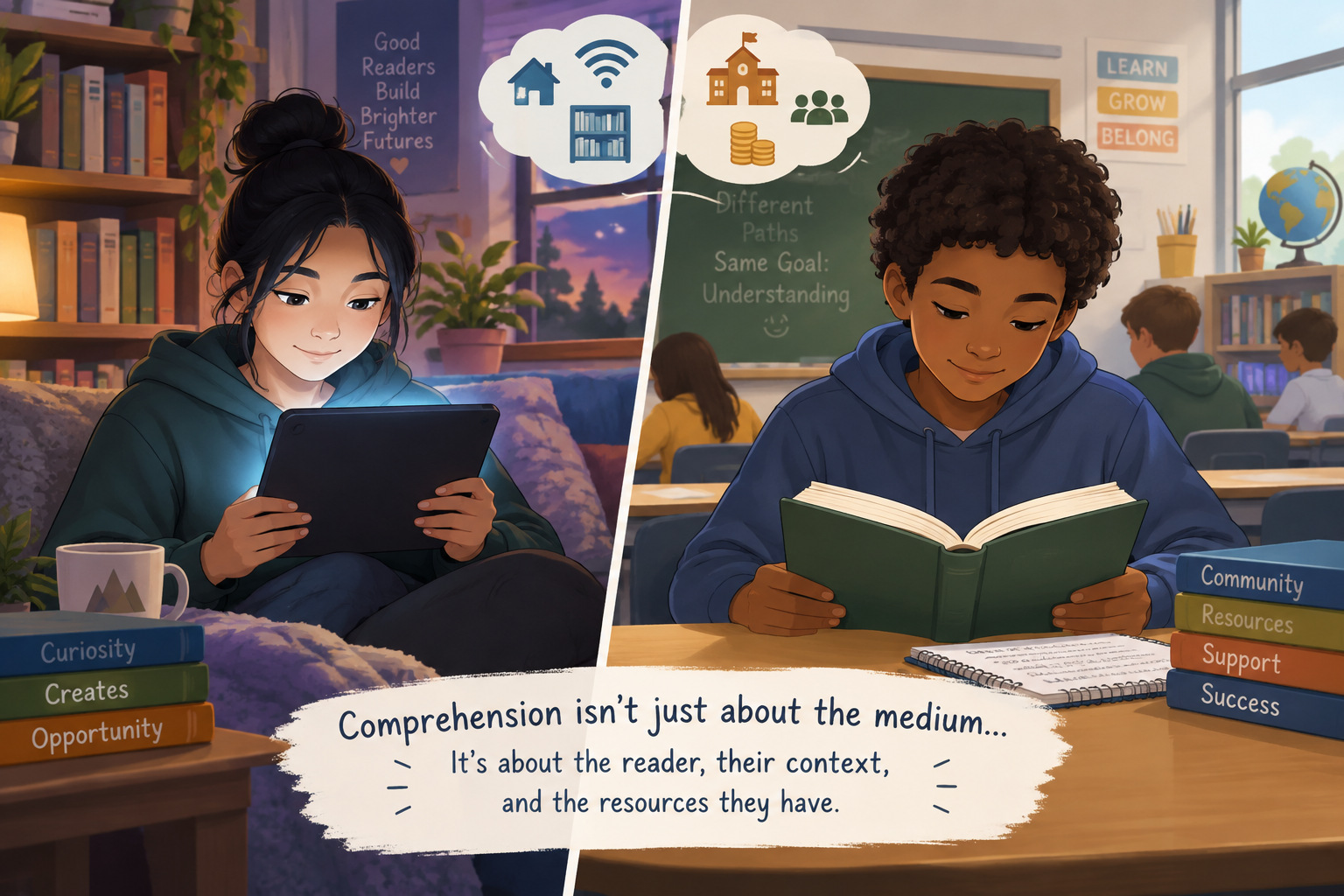
The review also asks us to look beyond the device or page. Students’ existing reading-comprehension skills and reading habits were identified as important individual factors. The authors also reported associations between reading outcomes and aspects of students’ surroundings, including how many books were at home and how schools used information and communication technology. These findings suggest that reading results may relate to a combination of the reader and their context, not simply the format in front of them.
Socioeconomic status was positively associated with reading achievement in both digital and paper formats, with a larger association reported for paper reading. The reviewed studies also showed gender differences in attitudes and performance across reading modes. These are patterns reported across the research—not proof that every student from a particular background or gender will read better in one format. Individual experiences can differ, and the review does not offer a universal rule for choosing books.
So what is the practical takeaway? The review supports a careful comparison, rather than a contest with an automatic winner. Screen reading deserves attention because some studies found weaker comprehension; at the same time, other studies found no significant format difference. The evidence summarized does not show that e-books or print books are superior for every reader or situation.
It is also important to keep the scope in view: the review concerns reading outcomes among students aged 6–18. It does not establish broader pros and cons such as cost, portability, storage, battery life or screen comfort, and its findings should not automatically be applied to all adults or every kind of reading. The most useful conclusion is that format is one part of a bigger picture—and understanding that picture means considering readers’ skills, habits and circumstances too.
Source: Digital versus Paper Reading: A Systematic Literature Review on Contemporary Gaps According to Gender, Socioeconomic Status, and Rurality, European Journal of Investigation in Health, Psychology and Education (MDPI)
Leave a Reply