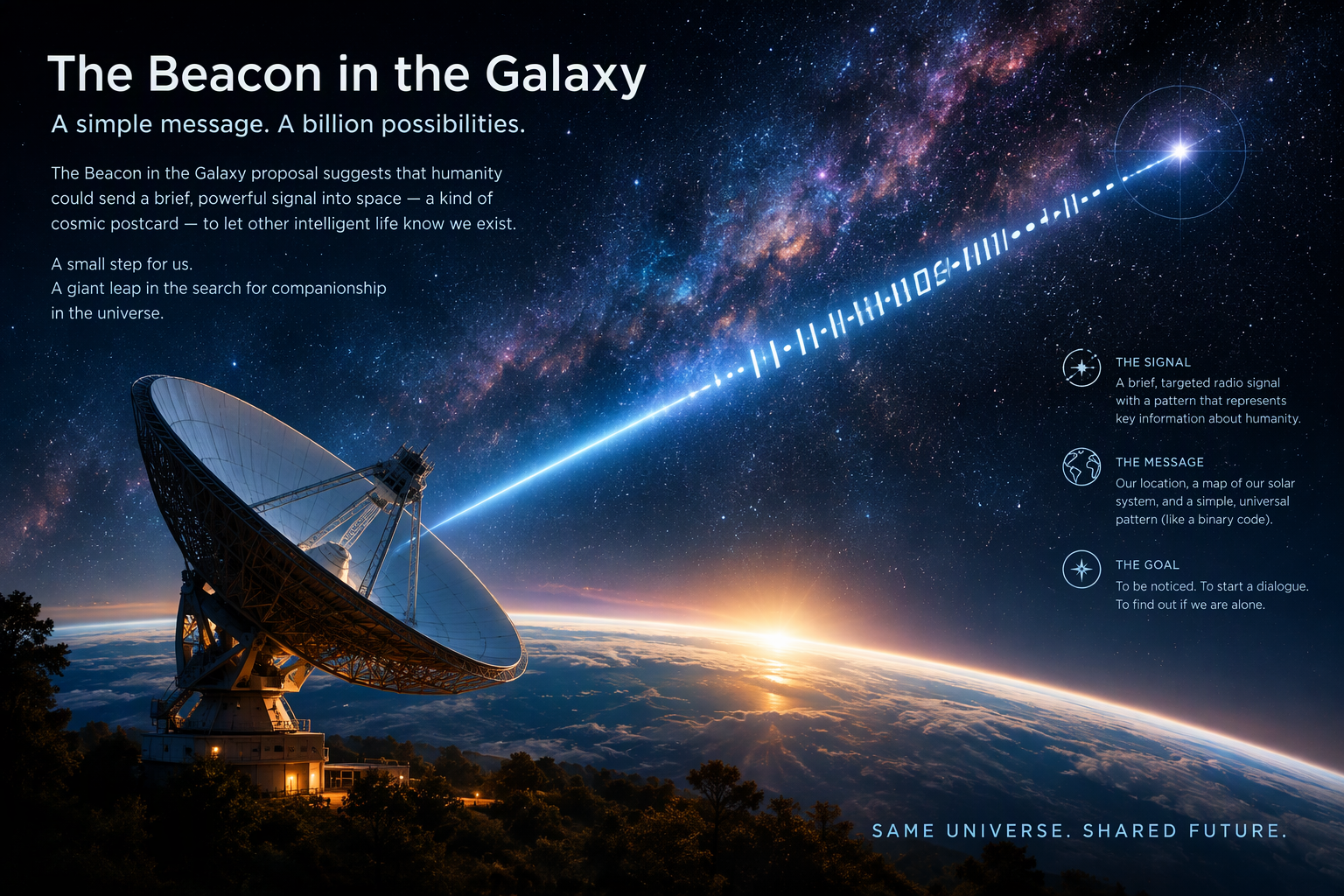
Imagine sending a message so far across space that a reply might not arrive for thousands of years. What should we say to a civilisation we have never met? An international team behind a proposal called “Beacon in the Galaxy” (BITG) has been thinking about that question—and one possible follow-up is a game of chess.
BITG is a proposed radio message intended to share information about Earth with a possible extraterrestrial civilisation. Jonathan Jiang of NASA’s Jet Propulsion Laboratory co-authored the proposal. The message would tell its recipients where Earth is in the Milky Way and when it was sent in relation to the origin of the universe.
The proposed message is 204,000 bits long. That is more than 121 times the amount of data in the 1974 Arecibo message, which was sent toward the globular cluster M13, about 25,000 light-years from Earth. The comparison gives a sense of how much more information BITG is designed to carry—but it does not mean anyone has received a reply.
The team proposed aiming BITG at a star cluster 2 to 6 parsecs from the centre of the Milky Way. China’s 500-metre radio telescope was identified as a possible transmitter. But the proposal was not a launch announcement: the article says there were no immediate plans to send the message. Its purpose was to encourage discussion about how humanity might communicate with possible neighbours in our galaxy.
And what if somebody answered? That is where chess enters the conversation. Co-author Philip Rosen suggested that, if humanity received a reply, sharing the rules of chess and starting a game could be a logical next step. The idea is hypothetical; the article does not report that extraterrestrials have been found or that a game is already under way.
Even a single move could take an astonishingly long time to exchange. Because of the distances involved, the article notes that sending one move and receiving a response could take tens or hundreds of thousands of years. A match would be less like a quick game across a table and more like a conversation stretched across generations—and perhaps far beyond them.
Rosen suggested that playing chess might offer clues about how an extraterrestrial civilisation approaches logic, strategy and planning. But that remains a possibility, not a result: no alien player has made a move, and no one knows whether a distant civilisation would understand or want to play the game.
For now, BITG is a proposal and chess is an imaginative “what if.” Together, they invite a bigger question: if we ever reach out to possible galactic neighbours, what would we want them to know about us—and what might we learn from a reply?
Source: Scientists want to play chess with aliens as soon as we can find them, New Scientist
Leave a Reply