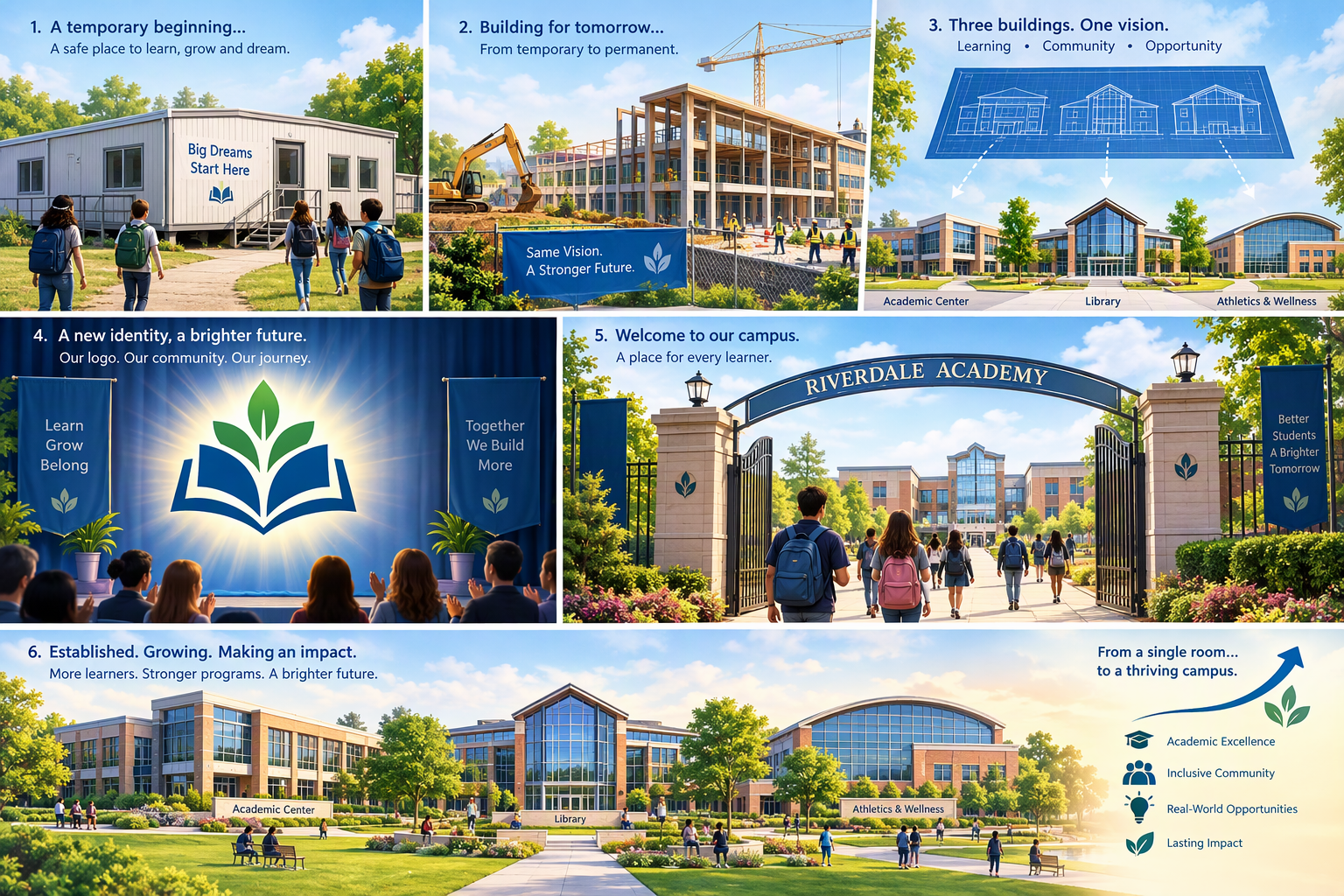
A new institution does not take shape all at once. Republic Polytechnic’s early milestones, recorded from 2002 to 2006, show its beginnings at a temporary campus, the arrival of its first students and the gradual expansion of its schools and facilities.
In 2002, RP began operations at a temporary campus in Tanglin. The institution was officially established a month later. Its identity was taking shape too: a logo designed by Raymond Lee was chosen from 600 entries in a competition. These early steps gave the new polytechnic both a place to begin and a visual mark of its own.
The next year brought the start of classes. RP’s pioneer cohort numbered 843 students, spread across three schools: Applied Science, Engineering, and Information and Communications Technology, now called the School of Infocomm. For those students, Tanglin was the setting for the institution’s first classes. At the same time, a groundbreaking ceremony marked the next stage in RP’s physical development: a campus at Woodlands.
In 2003, RP also achieved ISO 9001, ISO 14001 and ISO 18001 certifications. The milestone record lists these alongside the beginnings of teaching and the Woodlands campus project, capturing several strands of the polytechnic’s early development in a single year.
By 2005, RP’s academic offerings had broadened with the launch of the Schools of Technology for the Arts and Sports, Health and Leisure. The campus story also advanced: the Republic Polytechnic Centre building was officially opened on 19 November 2005 by Tharman Shanmugaratnam, then Minister for Education.
Taken together, these milestones trace a period of change: RP moved from starting operations at Tanglin to welcoming its first cohort, planning for Woodlands and adding new schools and facilities. The record offers a snapshot of that early growth—not a complete account of the institution’s later history. Still, the sequence from 2002 to 2005 shows how a polytechnic’s foundations can be built through classrooms, programmes, a campus and an emerging identity.
Source: 2002–2006, Republic Polytechnic
Leave a Reply