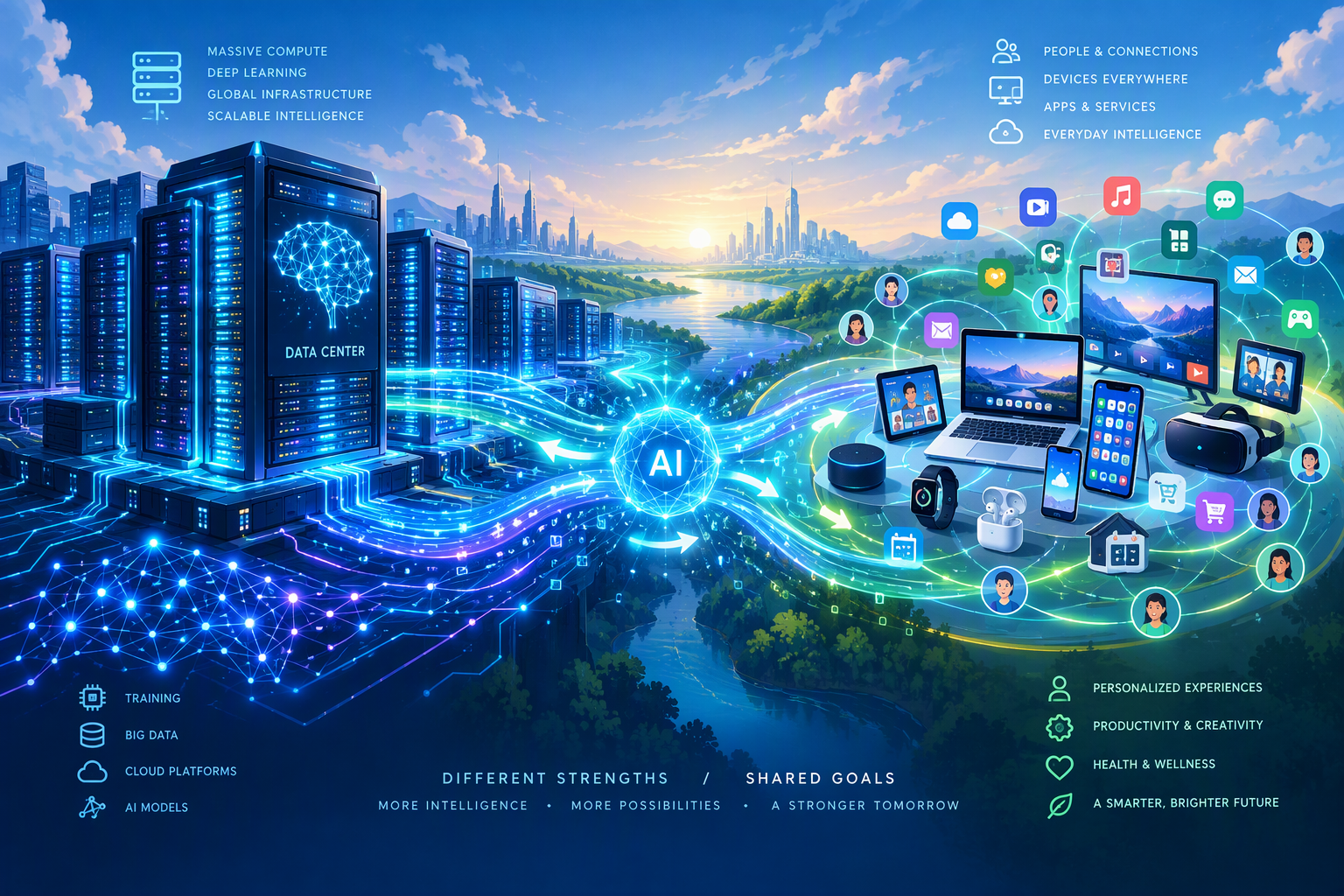
When most people think of competition in the tech industry, they picture head-to-head product battles: Coca-Cola versus Pepsi, Uber versus Lyft, or Intel versus AMD. But as a new article from *California Management Review* argues, the most consequential rivalry shaping the future of technology is not a direct product war at all. It is a clash of sprawling, interconnected systems — and the two titans at the center are NVIDIA and Apple.
Published on October 1, 2026, the article titled “Capabilities, Supermodularity, and Competition: Insights into the Future Fortunes of NVIDIA vs Apple” reframes the relationship between these two California giants. They are not simply competing to sell better chips. Rather, they are competing over which company’s collection of connected assets — hardware, software, developer ecosystems, and customer relationships — will capture the lion’s share of value as artificial intelligence spreads through every corner of the economy. ([cmr.berkeley.edu](https://cmr.berkeley.edu/2026/10/capabilities-supermodularity-and-competition-insights-into-the-future-fortunes-of-nvidia-vs-apple/))
## Two Very Different Empires
At first glance, NVIDIA and Apple barely seem like rivals. NVIDIA’s core business is supplying AI infrastructure to data centers, cloud providers, and enterprises. Its chips power the large language models and generative AI systems that have become central to modern computing. Apple, by contrast, sells premium consumer devices — iPhones, iPads, Macs — along with software, services, and an increasingly important ecosystem of wearables and subscriptions.
Yet the authors argue that focusing on these surface-level differences misses the deeper strategic picture. The real contest is about which system — NVIDIA’s AI-compute stack or Apple’s consumer-device ecosystem — will become the dominant platform through which AI delivers value to users. ([cmr.berkeley.edu](https://cmr.berkeley.edu/2026/10/capabilities-supermodularity-and-competition-insights-into-the-future-fortunes-of-nvidia-vs-apple/))
## The Power of Complementary Assets
The article applies the “Profiting From Innovation” framework to explain why this matters. A chip’s value, the authors point out, is never just about the silicon. It depends heavily on the capabilities surrounding it: software libraries, developer relationships, manufacturing access, distribution channels, and customer connections. These complementary assets can make or break a technology’s commercial success.
NVIDIA’s real advantage, the article argues, is not simply that it makes powerful GPUs. It is that it has built an entire system around those chips — most notably CUDA, its parallel computing platform and software ecosystem, along with deep developer adoption, optimized libraries, and carefully cultivated supply-chain relationships. Competitors like AMD, which makes competitive GPUs, and Intel, which is investing heavily in AI accelerators, have struggled to replicate this ecosystem. As the article notes, competing hardware alone is not enough. ([cmr.berkeley.edu](https://cmr.berkeley.edu/2026/10/capabilities-supermodularity-and-competition-insights-into-the-future-fortunes-of-nvidia-vs-apple/))
## Apple’s Countermove
Apple’s competitive position rests on a very different but equally powerful set of assets. The company commands a massive, loyal user base, an integrated hardware-software ecosystem, and deep relationships with app developers and content creators. These are formidable complementary assets in their own right.
But the article also highlights a fascinating area of emerging overlap: Apple is developing its own AI server chip for inference in its data centers. This chip is intended to reduce Apple’s reliance on NVIDIA hardware for cloud processing tied to Apple Intelligence and future Siri capabilities. It is a quiet but significant move — a signal that Apple sees the AI infrastructure layer as strategically important, even if its primary business remains consumer-facing. ([cmr.berkeley.edu](https://cmr.berkeley.edu/2026/10/capabilities-supermodularity-and-competition-insights-into-the-future-fortunes-of-nvidia-vs-apple/))
## Systems, Not Silos
Ultimately, the article’s central insight is that the most important technology competition of the coming decade will not be fought on a single battlefield. It will be a contest between two comprehensive systems, each with its own strengths, its own customer base, and its own vision for how AI should integrate into daily life.
NVIDIA’s system is optimized for the data center — for training massive models and running inference at scale for enterprises and cloud providers. Apple’s system is optimized for the individual — for delivering AI-powered experiences directly to consumers through devices they already own and trust.
As AI continues to diffuse through the economy, the question is not which company makes the better chip. It is which connected system of capabilities will capture more of the value that AI creates. And that, the article suggests, is a much more interesting — and uncertain — contest than any simple product comparison could capture. ([cmr.berkeley.edu](https://cmr.berkeley.edu/2026/10/capabilities-supermodularity-and-competition-insights-into-the-future-fortunes-of-nvidia-vs-apple/))
Leave a Reply