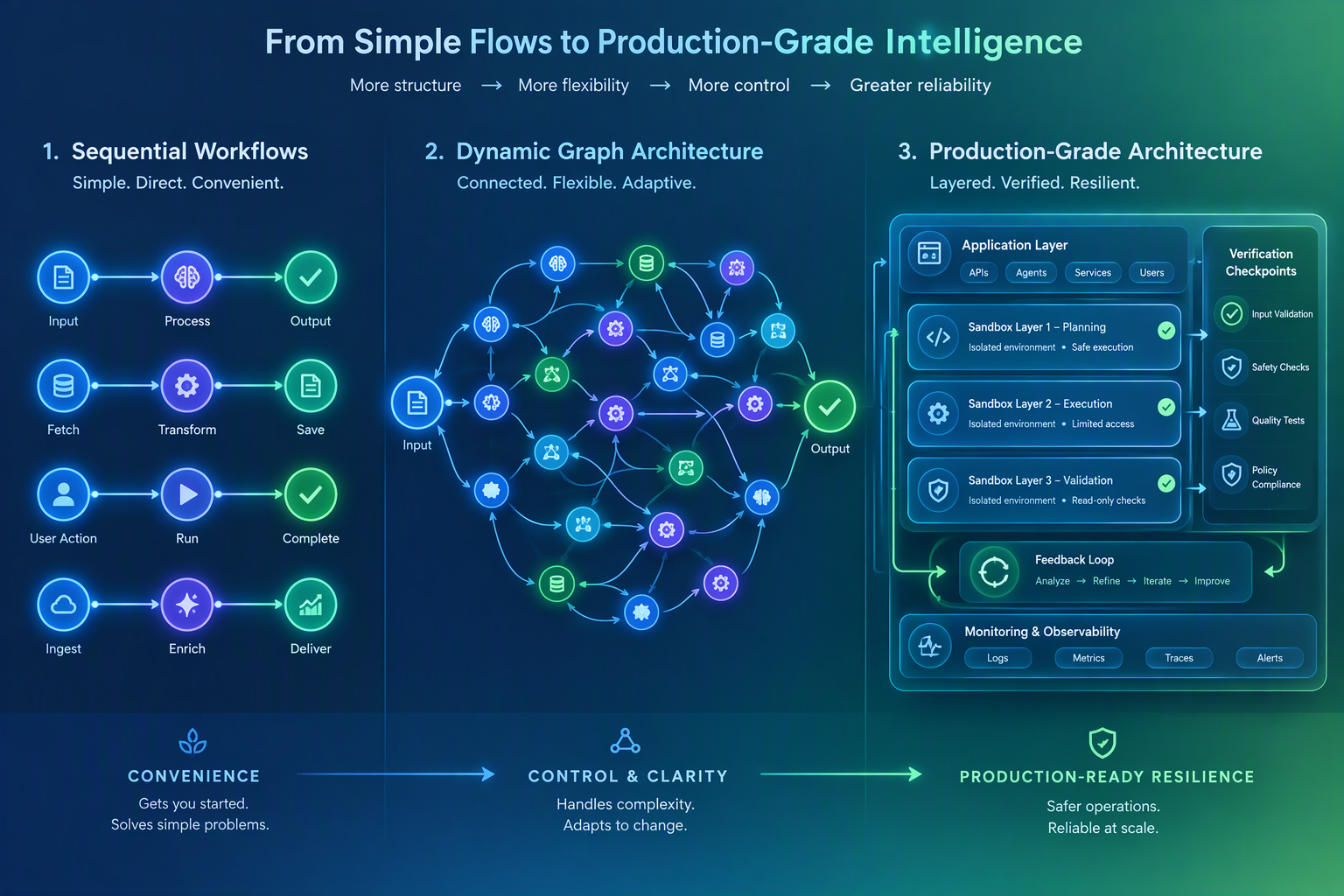
In the article “The Evolution of Agentic Harnesses: From Chains to Graph to Code” (InfoQ, October 26 2026), a clear architectural journey unfolds—one that mirrors the maturing ambitions of agentic AI systems. At its core are three structural paradigms: chains, graphs, and code harnesses.
First, chains are the simplest of the three. They string prompts together in a single, linear sequence—quick to implement and easily tuned for narrowly scoped tasks. The article underscores their vulnerability: a misstep early in the chain can cascade, undermining the entire workflow.
Graphs deliver a more expressive structure. With nodes, edges, branching paths, and parallel execution, they excel in complex, multistep scenarios. Not only can these harnesses adapt dynamically to different paths, they also support better state tracking and recovery when something goes wrong.
At the most sophisticated level, code harnesses treat AI execution as a first-class, programmable construct. By incorporating sandboxed environments and iterative refinement loops, they enable tighter control, verifiability, and correction of model outputs—mitigating the risk of relying on untrusted or unexpected AI behavior.
The article doesn’t posit that every agent should default to the most advanced paradigm. Instead, it offers engineering wisdom:
• Treat all model outputs as inherently untrusted, and place rigorous validation or verification around their use.
• Separate planning from execution—allowing clear, auditable reasoning before action.
• Build visibility into every step (observability) to diagnose issues and ensure reliability.
• Start with the least complex architecture that satisfies your requirements (be that speed, cost, or trustworthiness).
Viewed as a spectrum, chains represent ad hoc convenience, graphs offer structured robustness, and code harnesses embody production-grade resilience. The progression reflects how real-world demands—reliability, error handling, observability, and correctness—drive the adoption of more formal and controlled agent architectures.
This evolution doesn’t imply a rigid linear path: there are no benchmarks here showing chains always giving way to graphs, or graphs superseding code harnesses across the board. Rather, InfoQ presents a design philosophy—choose the right tool, at the right time, balancing simplicity with the rigors of production-quality engineering.
In the grand arc from chains to graphs to code, we see the maturing of AI agent design: a shift from quick-and-dirty prompt workflows toward modular, verifiable, maintainable, and robust systems. For practitioners charting a course through this landscape, the article offers both a map and a compass—not a mandate, but a mindset for building trustworthy intelligent systems.
Leave a Reply