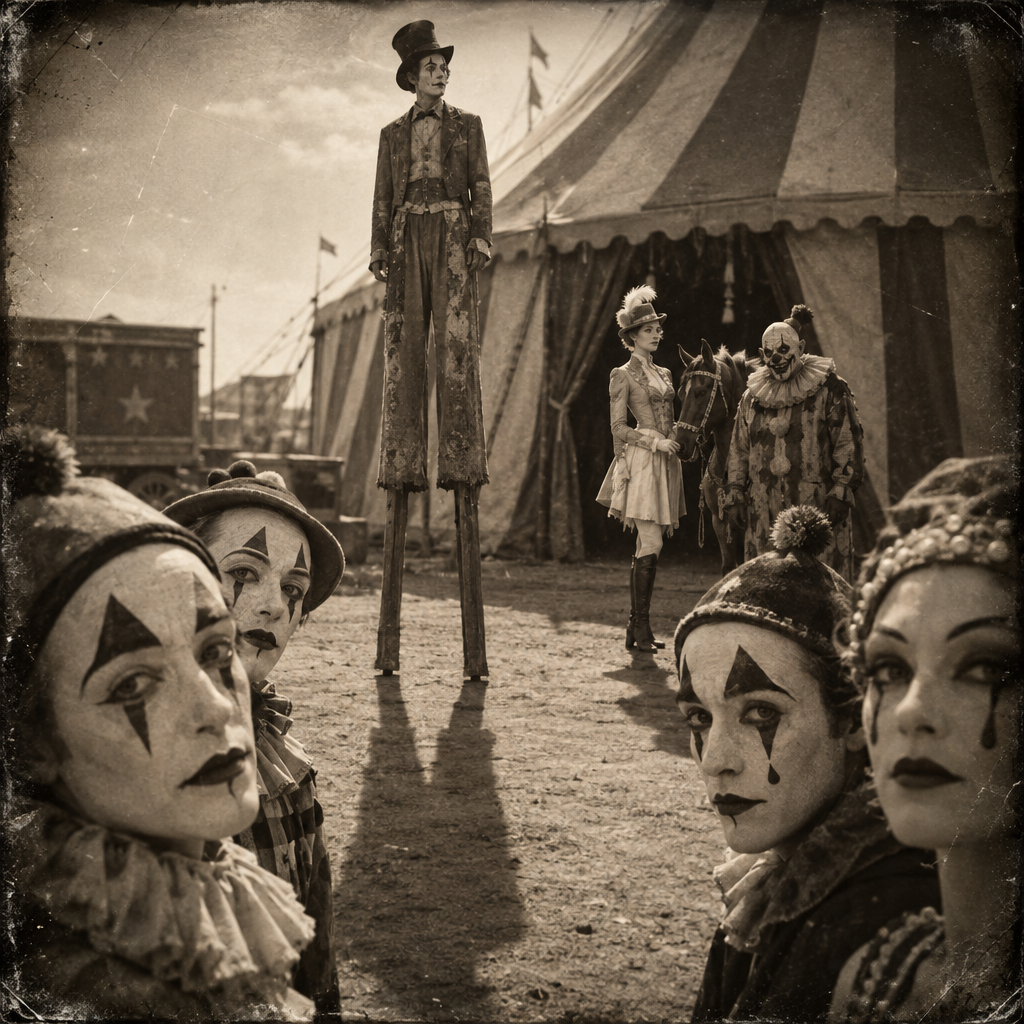
One photograph in the National Geographic archive can pry open a thousand questions: a ring of painted faces caught in midday sun, a stilt-walker paused beneath the Big Top’s striped awning, the careful geometry of a clown’s make-up frozen in glass‑plate detail. That bracing mix of spectacle and stillness is the through‑line of National Geographic’s photo essay “Photos of creepy clowns from the Nat Geo archive” (published October 19, 2018, originally 2017) — a gallery that shows how images of clowns, across time and place, can read as both comic and oddly unsettling.
The piece reminds us that clowning is hardly a modern invention. The article situates clowns as a near‑universal performance figure — present in ancient Greek pantomime, performing before Egyptian rulers, appearing in imperial Chinese courts and in Shakespearean drama — and uses archival photographs to trace the visual evolution of that role. Seeing early 20th‑century performers in black‑and‑white, their painted features exaggerated for stage and camera, makes clear how long the basic vocabulary of costume and gesture has endured.
National Geographic’s selection leans on early photographic technology — glass plates and vintage prints — and on photographers who documented circus life in the United States in the 1930s and surrounding decades. Several images are credited to Richard Hewitt Stewart, and others to Orren R. Louden; the gallery collects scenes of circus clowns in action and at rest, stilt performers poised outside a Big Top entrance, equestriennes in delicate costume contrasted with a ‘grotesque clown,’ and parades where pageant and oddity walk side‑by‑side. Small caption notes in the original piece point to specific performance practices — pantomime sketches, burlesque boxing gags, and the offstage camaraderie among performers — which help turn each photograph into a short story.
That tension between the funny and the unnerving is the essay’s central theme. Many of these archival shots were taken to celebrate spectacle and craft, yet the photographic style — high contrast, formal poses, the era’s makeup designs — can give the faces a haunting, uncanny quality to contemporary viewers. The gallery itself gestures toward how later cultural moments reshaped public perception: the article calls out Stephen King’s It as a pop‑culture milestone that amplified the “creepy clown” trope and points readers to related National Geographic coverage about why clowns unsettle some people.
Even within the archive’s own historical record there are competing voices. The essay includes a contemporaneous defense of clowning from a 1931 National Geographic piece: “There is not half so much tragedy behind the funny make‑ups of clowns as people like to believe.” That line is a reminder that performers and early chroniclers often viewed clowning as a noble craft — a perspective that sits uneasily beside how some later audiences interpret the same imagery.
Reading the gallery as a whole encourages a photo‑driven narrative: begin with a striking image, describe costume and gesture, trace the historical roots the article mentions, and then juxtapose those sympathetic notes with the modern cultural reinterpretations the piece touches on. Specific images the article highlights — circus clowns in 1930s U.S. photographs, stilt performers outside the Big Top, a dainty equestrienne seen next to a more grotesque clown — work especially well as anchors for short, descriptive paragraphs or image captions.
A practical caveat the article itself makes explicit: while the gallery displays many archive photographs and credits their photographers, it does not provide licensing or reuse information. Anyone planning to republish the pictures should contact National Geographic or the image owners and verify reproduction rights before using the images.
Ultimately, the essay shows how archival photography can transform familiar performance types into something stranger when seen from across decades. Makeup, costume, camera technology and shifting cultural narratives combine to make some of these faces feel eerie today — not because the performers intended fright, but because history, context, and the particular grain of old photographs invite us to read more into a look than it originally carried. The National Geographic gallery offers a quietly provocative reminder: photographs preserve more than appearances; they preserve the changing ways we see those appearances.
Leave a Reply