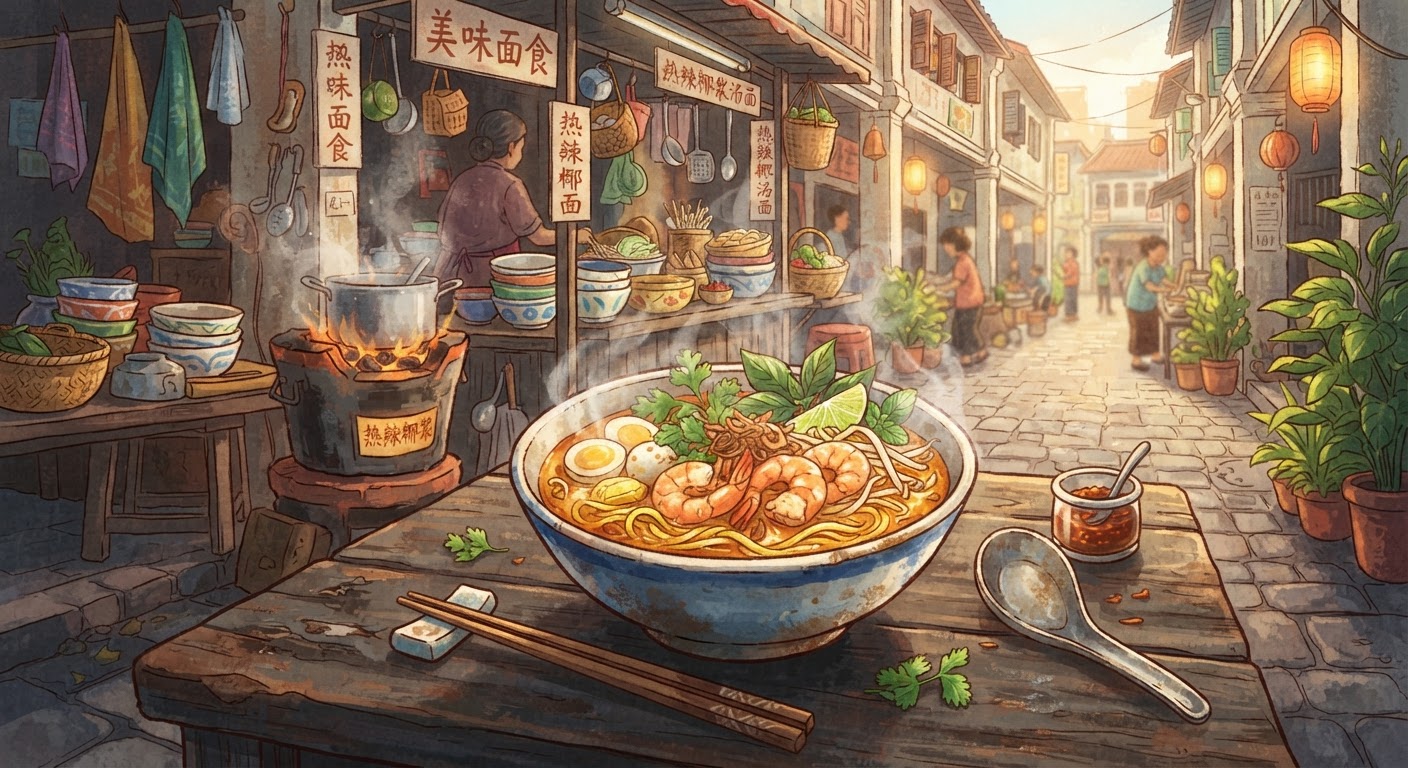
If you find yourself in Singapore’s Katong district, you are likely to be lured by the irresistible, spicy aroma of coconut-based broth. Katong Laksa isn’t just a meal; it is a cultural icon with a story as rich and layered as its famous gravy. \n\nAt the heart of this dish is a fascinating history that blends Chinese and Malay influences. The dish evolved from the local Peranakan community in the seaside precinct of Katong. While the origin of the word “laksa” remains a point of debate—potentially stemming from the Sanskrit word for “many” or the Persian word for “noodles”—the story of how the dish became a local legend is centered on one man: Ng Juat Swee.\n\nKnown by the nickname “Janggut” (Malay for “beard”) because of a distinctive mole on his chin, Ng began selling his laksa from a pushcart along Marine Parade in the late 1940s. He introduced a simple yet revolutionary change: he cut the thick rice vermicelli noodles into shorter strands. This small modification meant that the entire dish could be enjoyed with just a spoon, freeing diners from the need for chopsticks. \n\nAn authentic bowl of Katong Laksa is defined by its rich, coconut milk-based gravy. Flavored with a complex *rempah* of lemongrass, galangal, turmeric, and chili, it is further elevated by the umami punch of dried shrimp (*hae bee*). Traditionally, this broth was kept bubbling over a charcoal fire to impart a subtle, smoky depth. Topped with cockles, fishcake, and prawns, and garnished with fragrant *daun kesum* (laksa leaves), it is a masterpiece of balance.\n\nAs the dish grew in popularity, it sparked the legendary “Laksa Wars,” with various stalls throughout Katong vying for the title of the “original.” While Janggut Laksa continues to carry the torch of Ng’s 1950s lineage, others like 328 Katong Laksa have gained worldwide acclaim—notably when founder Nancy Koh famously defeated celebrity chef Gordon Ramsay in the 2013 “Hawker Heroes” challenge.\n\nToday, whether you visit a Michelin-recognized stall or a local neighborhood favorite, the experience remains the same. The bowl of soup with the spoon-friendly noodles has moved from its humble beginnings on a beach to the center of Singapore’s culinary identity, proving that a little innovation can leave a lasting legacy.
The Spoon-Friendly Legend: Exploring the History of Katong Laksa
Leave a Reply