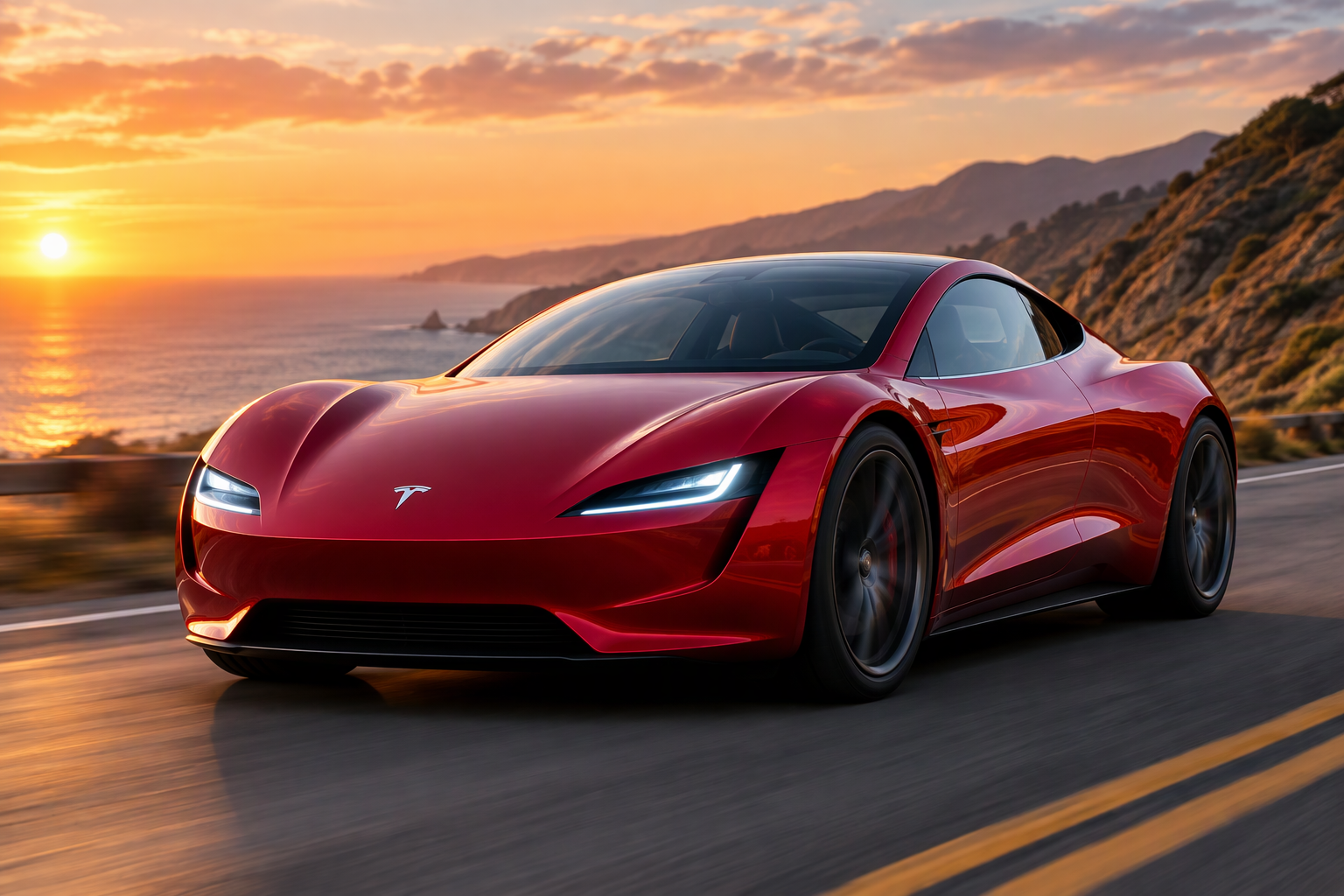
A car races up a curved ramp, travels upside down, then launches into the air, turns 180 degrees and lands on its wheels. That was the eye-catching moment at Tesla’s Roadster unveiling on October 15, 2026, at a SpaceX test facility in Waco, Texas.
The demonstration was livestreamed, and the airborne stunt used high-pressure gas boosters, according to CBS News. Tesla CEO Elon Musk called the Roadster a “flying” car and said “ultra high-pressure air tanks” would propel it into the air. He described the project as a collaboration between Tesla and SpaceX.
But a dramatic stunt is not the same as proof that a car can fly in ordinary use. The article does not independently verify the Roadster’s flight capability, and it does not give final specifications explaining how the planned system would work beyond the demonstration. Musk said production was expected in 2028, while also cautioning that the project’s success was not guaranteed.
The Roadster’s versions and reservations add another layer to the story. Tesla had not announced prices. Its website offered reservations for a non-flying Roadster in exchange for a $5,000 deposit. A limited-edition Thrust model was promised, but reservations were not available for it. The Rocket model, described as having a “full flight system,” was to be offered by invitation only.
There is also an important distinction between a vehicle that performs an airborne stunt and one that can be driven on public roads. The planned flying model had not been approved for public-road use. The article says it was unclear which government body would oversee the vehicle, leaving its regulatory pathway unsettled.
A senior U.S. Transportation Department official told CBS News they were skeptical that the Roadster would actually be able to take off, while acknowledging there was no clear answer. That uncertainty matters: the demonstration may be memorable, but questions about capability and oversight remain open.
There are business questions, too. Analyst Dan Ives told CBS News that the Roadster was unlikely to become a major source of production volume or revenue for Tesla. So the car may be better understood, for now, as an ambitious project than as a product whose practical role is already clear.
The Roadster’s ramp-to-air routine gave viewers something extraordinary to watch. What it did not settle was whether the vehicle can fly beyond a controlled demonstration, when it might be produced, what it will cost, or how it could be regulated. Those answers will determine whether Musk’s “flying” Roadster becomes more than a spectacular promise.
Source: With Tesla Roadster debut, Elon Musk shows “flying cars are real”, CBS News
Leave a Reply