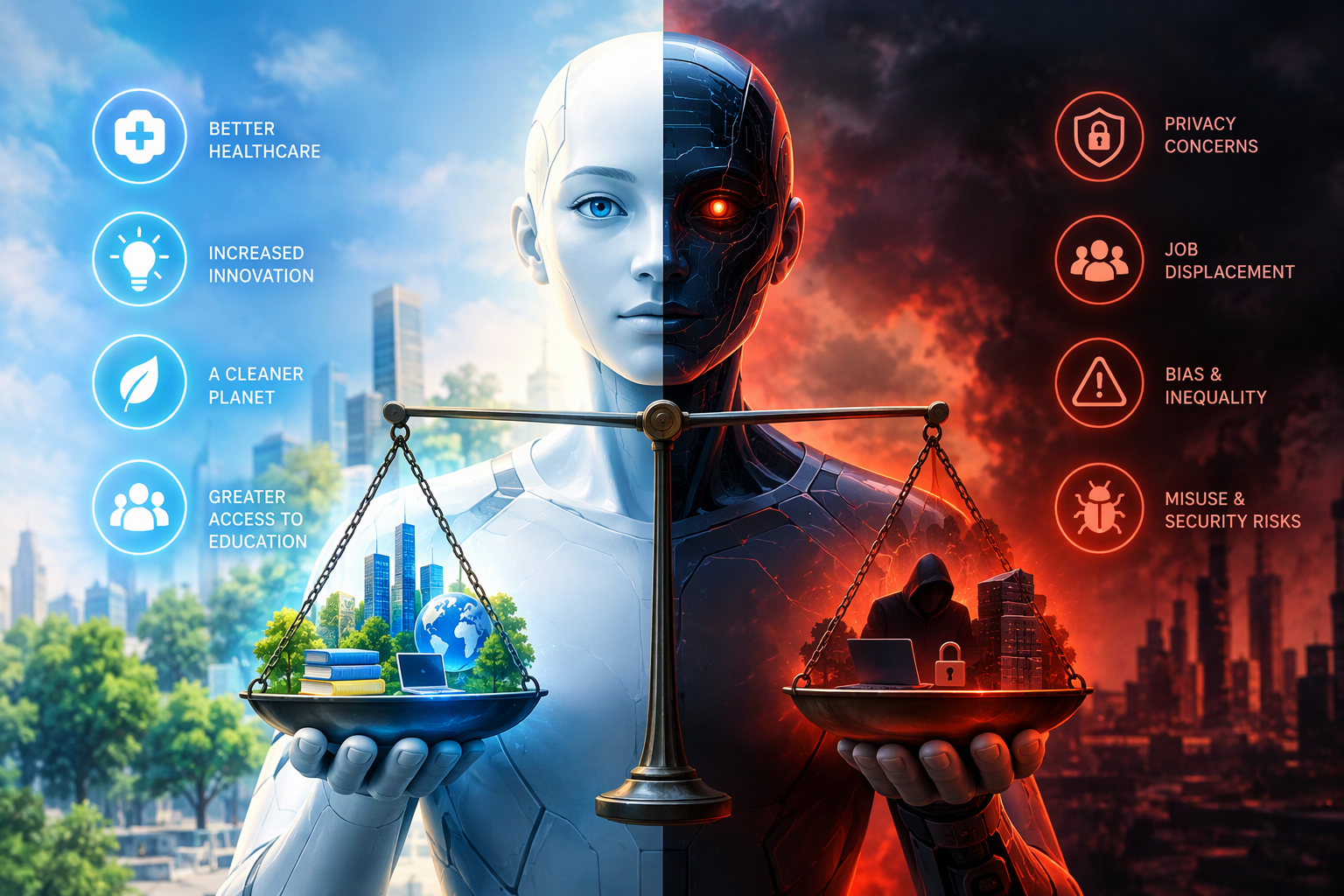
Imagine a computer spotting a possible sign of cancer in a medical scan, while another recommends the next video to watch. Both tasks can involve artificial intelligence, yet they raise very different questions. So is AI a boon or a bane? The short answer is: it depends on how people build, govern and use it.
AI is software that learns patterns from data and uses them to make decisions or generate content. That can make it useful in many settings. A system might read X-rays quickly, a self-driving car might use AI to navigate, and a chatbot might help a student practise a topic. These examples show how the technology can support people—but they do not mean every use is automatically helpful.
The same capabilities can also create risks. An AI tool that analyses images for medical purposes could be used for surveillance, potentially enabling mass monitoring. A tutoring chatbot designed to explain ideas could instead be used by students to cheat. And AI systems, if used carelessly, may spread misinformation or reinforce bias. The technology does not choose its own purpose; people decide where and how to apply it.
One proposed benefit is productivity. AI can take on repetitive tasks such as data entry, scheduling, drafting emails, quality checks and answering customer queries. For instance, customer-support bots can respond to routine questions around the clock. Code assistants can produce boilerplate, while document summarizers can reduce the time spent reviewing material. In these examples, AI handles some routine work so people may have more time for higher-value tasks.
But automation also raises concerns about jobs. The article warns that careless use of AI can cost people work, while the available information does not say which jobs may be affected, how many roles could change or when. That uncertainty matters: it is a reason to discuss how AI is introduced, rather than to assume either that all work will disappear or that no one will be affected.
There is a similar gap between a technology’s potential and the evidence needed to judge its real-world effects. The examples illustrate possible benefits and harms, but the article does not provide figures showing how often they occur or detailed measures for preventing misinformation, bias or harmful surveillance. That leaves important questions for developers, decision-makers and users: what safeguards are in place, who is responsible, and who might be affected?
AI is not simply a hero or a villain. It can save time and potentially help save lives, but it can also cause harm when design, oversight or use falls short. The central question is therefore not just what AI can do, but what people choose to do with it—and how carefully they make that choice.
Source: Artificial Intelligence – Boon or Bane? The Short Answer, Scaler
Leave a Reply