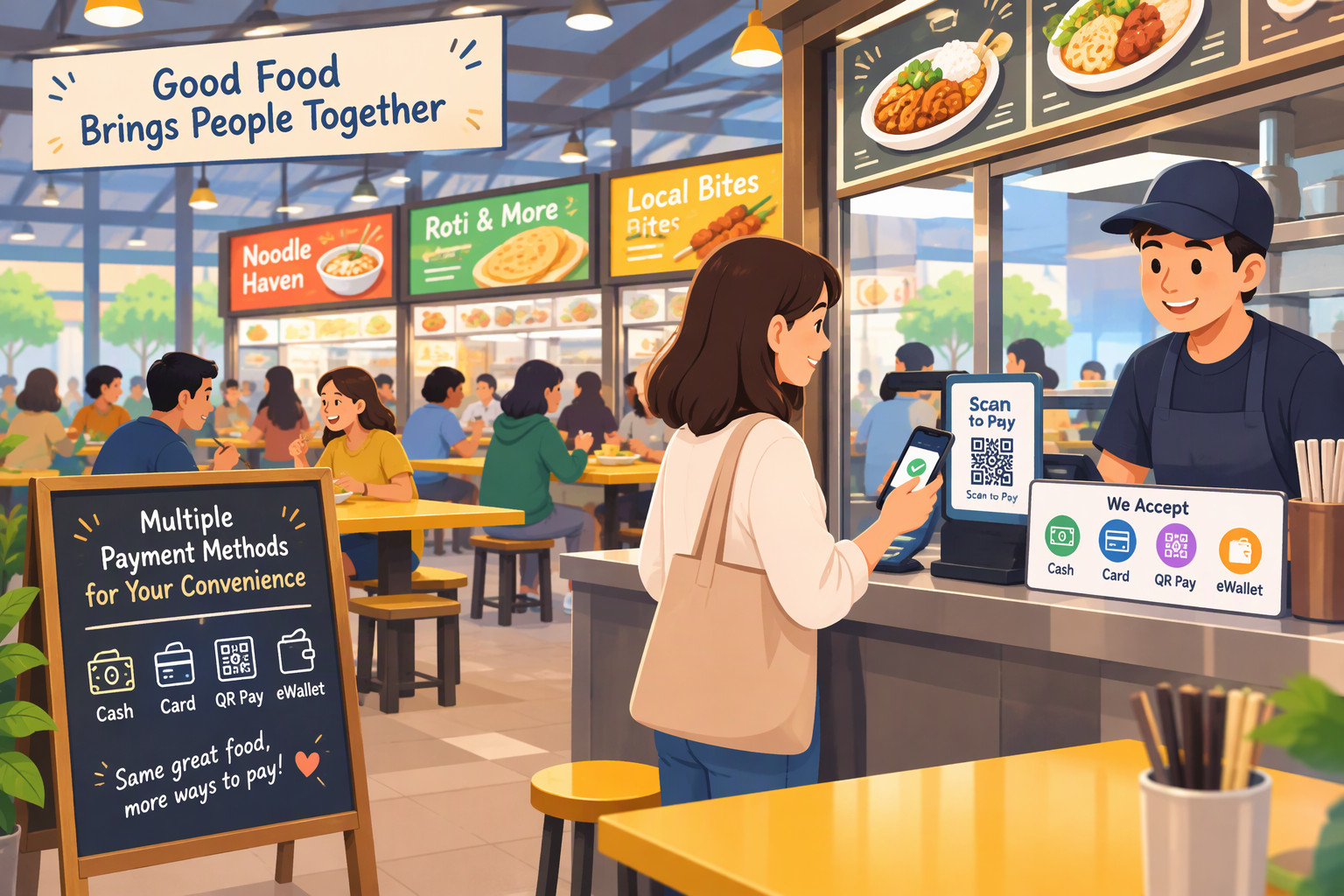
At a hawker stall, a quick lunch can involve a very modern choice: scan a QR code, or hand over cash. Across Singapore’s food centres, digital payments have become more visible—but, as The Straits Times reported in November 2024, cash remains the easier option for some stallholders and customers.
The difference can be seen from one stall to the next. Some counters display QR codes for customers to scan, while others continue to take cash only. At a noodle stall in West Coast Food Centre, hawker Angie Sim and her partner preferred cash. Sim said it was easier for them and suited many of their older customers, who were less comfortable with digital payments and usually carried cash.
The reasons are not all the same. The Straits Times spoke with stallholders at eight hawker centres who still accepted only cash. Some described limited confidence with digital payments or poor eyesight. Others found it difficult to check whether a payment had gone through, or worried that customers might struggle with their devices. For a busy stall, a payment method needs to work for both the people serving food and the people ordering it.
That helps explain why the move to digital payments is not simply a matter of putting a QR code on the counter. A stallholder who cannot easily confirm a transaction may feel more comfortable handling notes and coins. And customers who are not used to paying by phone may prefer a familiar way to settle the bill. These are practical concerns, not proof that every hawker opposes cashless payments.
Digital payment options had nevertheless spread widely by the time of the report. More than 11,500 hawkers had adopted SGQR, a standardised QR code launched in 2018 to support payments from multiple mobile wallets. The article also described the Hawkers Go Digital programme, under which the 0.5 per cent transaction fee was waived on a stall’s first S$20,000 in monthly transactions. At the time, the waiver had been extended to the end of 2025, as part of an effort to encourage digital payments among about 18,000 stallholders in government-run food centres.
Together, these details show a change in progress, rather than a single moment when every stall switches over. QR payments were available at many hawker stalls, while some continued to rely on cash because of the habits and needs of the people behind and in front of the counter. For customers, it is a reminder that a QR code may be convenient—but carrying cash can still be useful when visiting a hawker centre.
Source: Why cash is still king for some hawkers in Singapore despite digitalisation push, The Straits Times
Leave a Reply