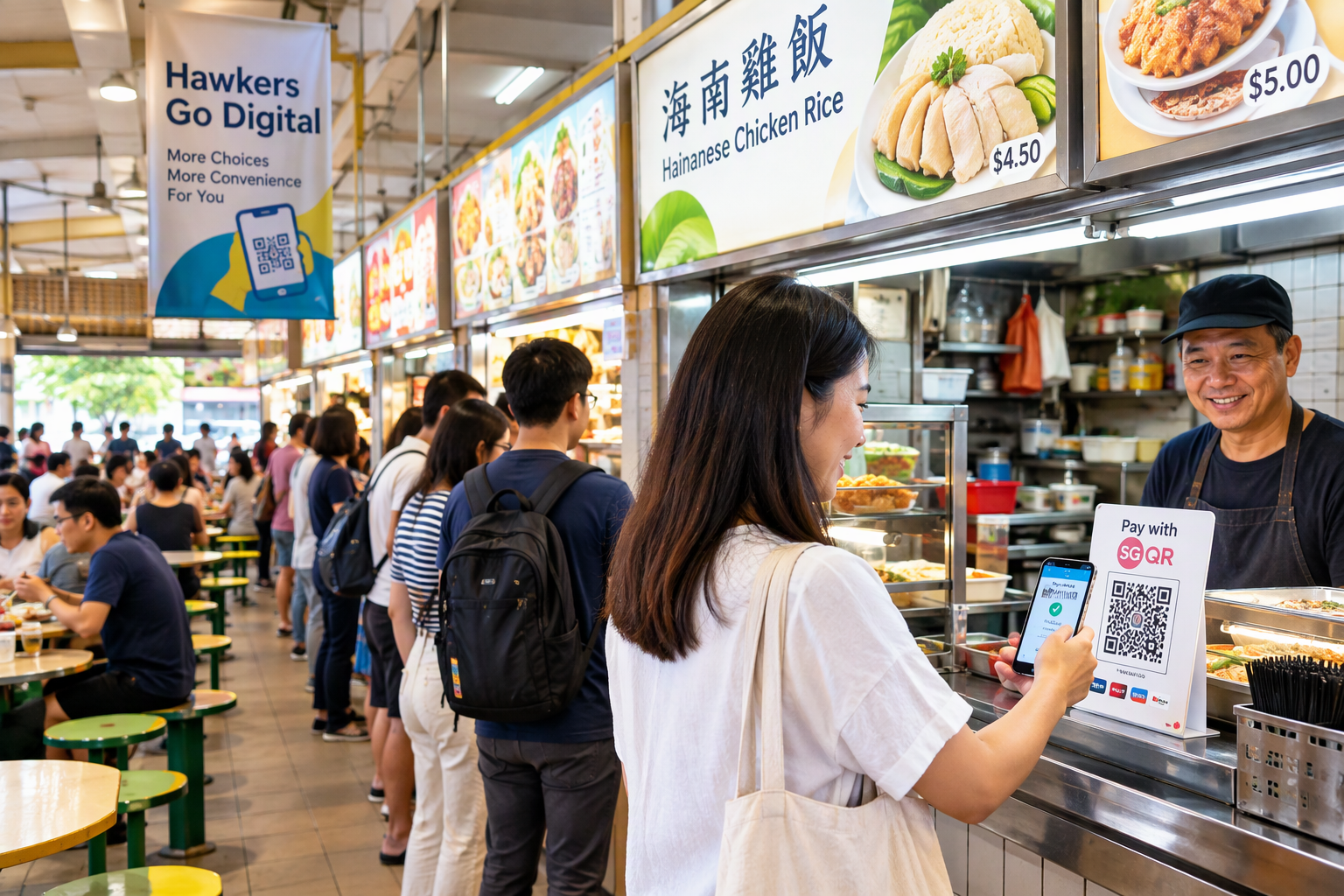
At a hawker centre, the lunch queue moves quickly: order, pay, and find a seat. By October 2024, more than 11,500 hawkers had adopted cashless payments through Singapore’s Hawkers Go Digital programme. But the story was not that every stall had gone cashless. The programme was still working towards its target of about 18,000 stallholders in government-run food centres.
Introduced in 2018 by Enterprise Singapore and the Infocomm Media Development Authority, Hawkers Go Digital encourages stalls to accept QR-code payments through the Singapore Quick Response Code, or SGQR, platform. Customers can use digital payment options, while hawkers have another way to receive payment alongside the choices they already offer.
One challenge for stallholders is the transaction fee. Under the programme, a 0.5 per cent fee on digital transactions was subsidised for the first $20,000 of transactions per stall each month. That support was extended to the end of 2025, giving food-and-beverage stallholders more time to adjust to paying the fees themselves. The extension came amid rising operating costs and was intended to encourage continued adoption of e-payments.
The subsidy’s end date had shifted before. The programme was originally due to end on December 31, 2023. In October 2023, the date was moved to the end of 2024; the further extension to the end of 2025 was reported in October 2024.
The figures in the article suggest that programme-related digital payments were growing. In August 2024, their monthly value reached $60 million, compared with $45 million in August 2023. The number of transactions also increased, from 5.4 million to 7.6 million over the same period.
Senior Minister of State Low Yen Ling described the scheme as part of the government’s efforts to help hawkers thrive in the digital age. The figures show a rise in payments made through the programme, while the adoption count gives a sense of how many hawkers had taken it up. They do not mean that all hawker stalls had stopped accepting cash: the article does not say how many continued to do so.
The extension offered participating hawkers more time to get used to digital payments and the fees that could come with them. For customers, QR codes had become a more visible part of paying at participating stalls. And for the programme, the next stretch was about encouraging more hawkers to join—without suggesting that the shift was complete.
Source: Subsidy for hawkers to adopt digital payments extended to end-2025, The Straits Times
Leave a Reply