Lead: HealthLink BC’s “Milestones for 7‑Year‑Olds” gives a concise, clinically reviewed checklist of typical physical, cognitive, social/emotional, language, and motor skills for most 7‑year‑old children (current as of March 1, 2023).
Intro
Seven is firmly a school‑age year — not toddlerhood. HealthLink BC frames the age‑7 milestones as part of a predictable but individually variable sequence of development across five domains: physical growth, thinking/reasoning (cognitive), emotional & social, language, and sensory & motor. Children may be advanced in one area and still catching up in another; the page stresses that each child follows their own pace.
Physical growth
• Height and weight: Typical growth for a 7‑year‑old is about 6 cm (2.5 in) taller and about 3 kg (7 lb) heavier over a year.
• Teeth: Children commonly lose about four baby (primary) teeth per year as permanent teeth replace them.
Cognitive (thinking & reasoning)
• Sense of time: Most 7‑year‑olds develop a solid sense of time — they understand seconds, minutes, hours, days, weeks, months, seasons and, for some, years.
• Learning style: Children begin to show a preferred learning style (for example, hands‑on versus quieter practice).
• Problem solving and math: They can use concrete objects to solve simple math problems (counting beads, for example) and typically reason about one factor at a time.
Emotional & social development
• Empathy: Many children become more aware of other people’s feelings.
• New anxieties: Some earlier fears fade, but new anxieties — especially about the unknown (such as a new school) — can be pronounced. Concern about adults’ approval and peer opinion is common.
• Friendships and play: Friendships often form with same‑gender peers. Children may play in larger groups sometimes but still need and enjoy solitary time.
Language development
• Speech: In comfortable settings children tend to talk a lot and generally pronounce words correctly (for example, most no longer substitute “fr” for “thr” in words such as “through”).
• Reading and spelling: Reading skills are improving, though some children still find vowel sounds difficult to decode and basic spelling errors are common.
Sensory & motor development
• Gross motor: Coordination for larger movements improves — activities like swimming and climbing become smoother.
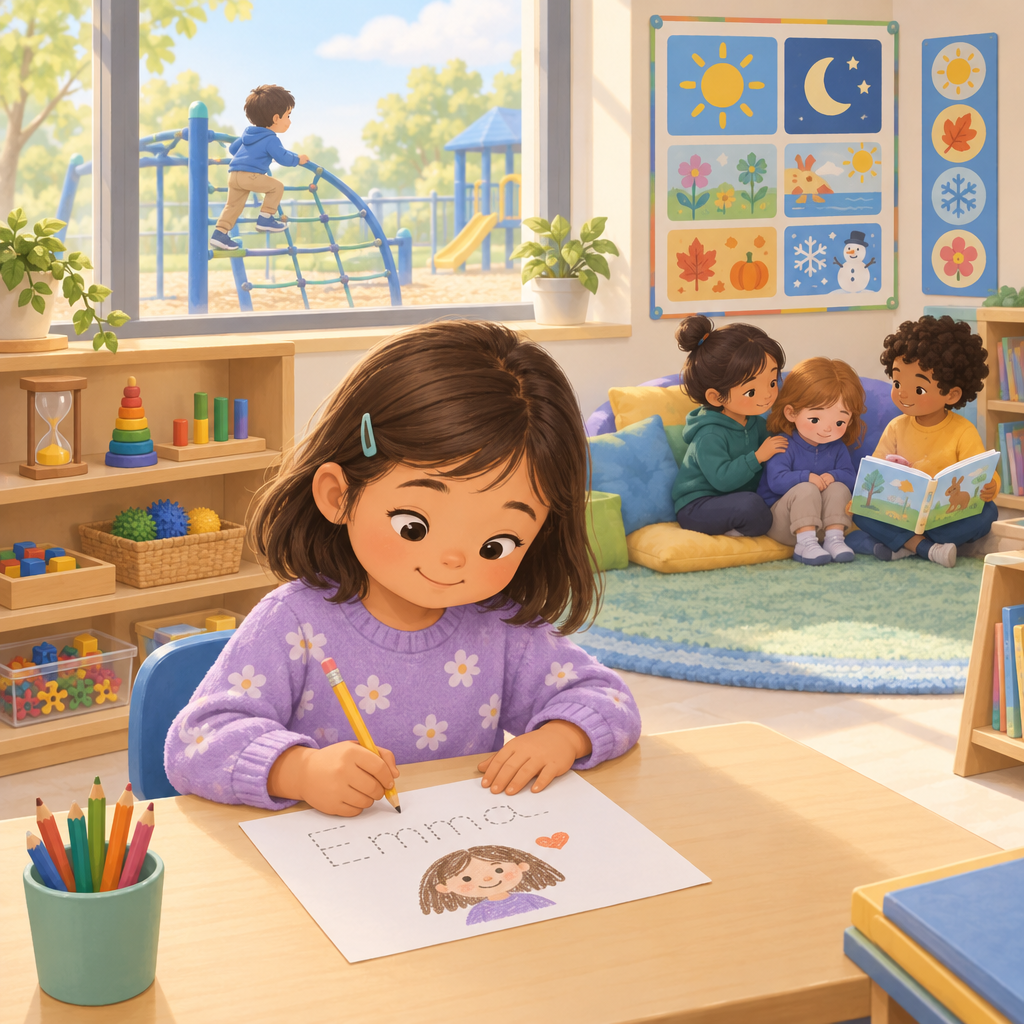
• Fine motor: By age 7 many children can use safety scissors easily, draw a person with about 12 parts, and use a pencil to write their name.
Practical takeaways
HealthLink BC emphasizes individual variation. These milestones describe what is typical for many 7‑year‑olds, not a strict checklist every child must meet. If a child is far off typical expectations, showing a sudden loss of skills, or if parents or teachers are concerned, the page points to following up with school or a health professional for assessment and guidance.
What this page does NOT cover
The HealthLink BC page does not treat a 7‑year‑old as a toddler; it discusses school‑age development. It also does not address topics such as photographing or sharing images of children, legal or ethical issues around images of minors, or detailed parenting programs or step‑by‑step interventions — it offers descriptive milestones rather than prescriptive curricula.
Closing
For the official checklist, authorship and medical review details, and the full, clinically reviewed text (current as of March 1, 2023), see the HealthLink BC page “Milestones for 7‑Year‑Olds.” (Healthwise Staff; medical review credited to physicians in pediatrics/family medicine/developmental pediatrics.)
Leave a Reply