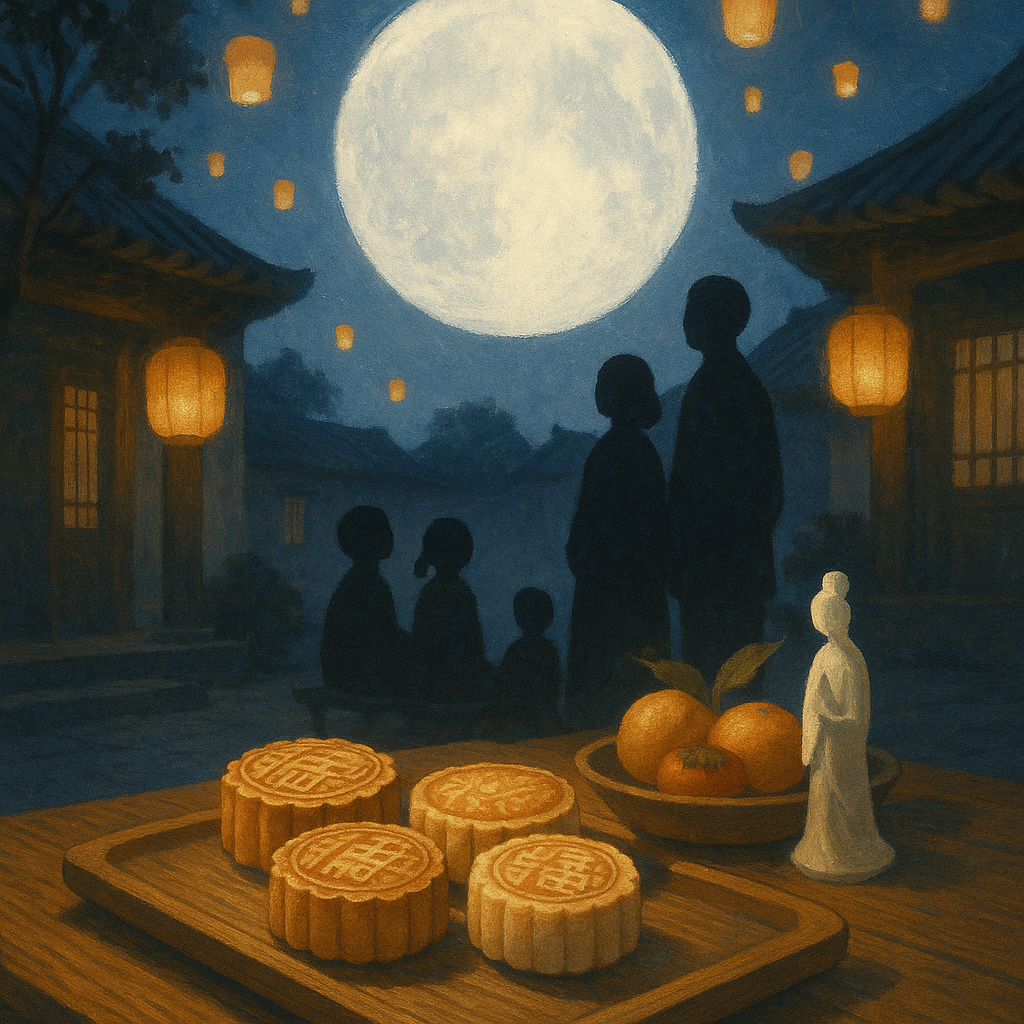
Every autumn, when the moon swells full and round on the 15th day of the eighth lunar month, families across China and much of East and Southeast Asia gather beneath the same silver light to eat, give thanks and look up together. The Mid‑Autumn Festival — also called the Moon Festival or Mooncake Festival — is a harvest‑time celebration of reunion, moon‑gazing and gratitude. At the centre of it all sits the mooncake: a small, round pastry that stands for completeness, good fortune and the ties that bind.
The customs that surround the festival are as much about people as they are about food. Families sit down for reunion dinners and share mooncakes; they practice shangyue, or moon‑appreciation, lighting lanterns and parading them through neighbourhoods; and many households make offerings to ancestors, the Lord of Soil and Ground, and the Moon Goddess. Regional variations add colour — lion and dragon dances in some places, the spectacular fire‑dragon dance in Hong Kong, Taiwanese barbecue nights, and seasonal fruits such as pomelo, persimmon and peach brought to the table.
As with many long‑lived festivals, myth and history intertwine. One beloved legend tells of the archer Hou Yi and his wife Chang’e: after Hou Yi shot down nine of ten suns to save the earth, Chang’e swallowed an elixir and ascended to the moon to keep the powerful potion away from her husband, becoming the Moon Goddess and giving the moon its human story. The article also recounts two anecdotal imperial tales from the Tang dynasty — Emperor Taizong allegedly giving round cakes to ministers after a victory, and Emperor Xizong distributing cakes to successful exam candidates — and presents them as courtly stories rather than settled history.
The most widely told origin tale ties mooncakes to rebellion. According to the story highlighted in the article, Han rebels in the 14th century hid secret messages inside mooncakes — notes such as “Uprising on the 15th night of the eighth month” — to coordinate an insurrection against Mongol (Yuan) rule. That tale, which links mooncakes to the founding of the Ming dynasty under Zhu Yuanzhang, is the best‑known dramatic explanation for why a pastry might once have carried clandestine instructions. The piece, however, treats these origin stories as anecdotal: it points out that the festival’s roots are ancient and agricultural (dating back more than 3,000 years) and that no single, definitive origin can be proven from the tales alone.
Mooncakes themselves are as diverse as the regions that make them. Their round shape has come to symbolize reunion and harmony, and the modern mooncake industry is large — the article cites a recent valuation of more than $2.3 billion — even as it notes that the piece does not provide a geographic or year‑by‑year breakdown of that figure. Traditional and contemporary varieties range widely: Cantonese mooncakes with thin, lard‑based crusts and dense lotus‑seed or red‑bean paste often include salted egg yolks; Shanghai versions have a crisp crust and date filling; Teochew and Hokkien styles favour red‑bean, sesame or candied winter‑melon with tangerine peel; Yunnan produces savory ham‑and‑honey cakes; Suzhou offers meat‑filled versions with pork and shrimp; and snow‑skin and other non‑baked innovations reflect modern experimentation. Today many mooncakes are stamped with auspicious words — “harmony,” “prosperity,” “peace” — rather than secret messages.
Making mooncakes is an art as much as a recipe. The article describes the work as time‑consuming and technically demanding: dough hydration, filling texture and baking technique all matter. Chefs quoted in the piece stress moisture control, balanced sweetness and quality ingredients; some professional kitchens produce tens of thousands of mooncakes annually for hotels and retailers. The article even includes an approachable, step‑by‑step “easy” mooncake recipe, bridging tradition and home cooking.
The Mid‑Autumn Festival is not unique to China: related full‑moon or autumn foods appear across the region. The piece points to Korean songpyeon (noting an editor’s clarification that songpyeon and Chinese mooncakes are distinct), Vietnamese banh trung thu and Japan’s tsukimi dango as neighboring moon‑viewing treats that share the season but remain their own culinary traditions.
What emerges from the article is a portrait of a festival and a pastry that carry multiple meanings at once — agricultural rite, mythic romance, a whispered note of rebellion and a centerpiece of modern family life and commerce. Whether you encounter mooncakes as a luxury hotel box, a street stall offering a regional variety or in a simple home kitchen following the easy recipe included in the story, they remain a delicious, round reminder of reunion under the same moon.
Leave a Reply