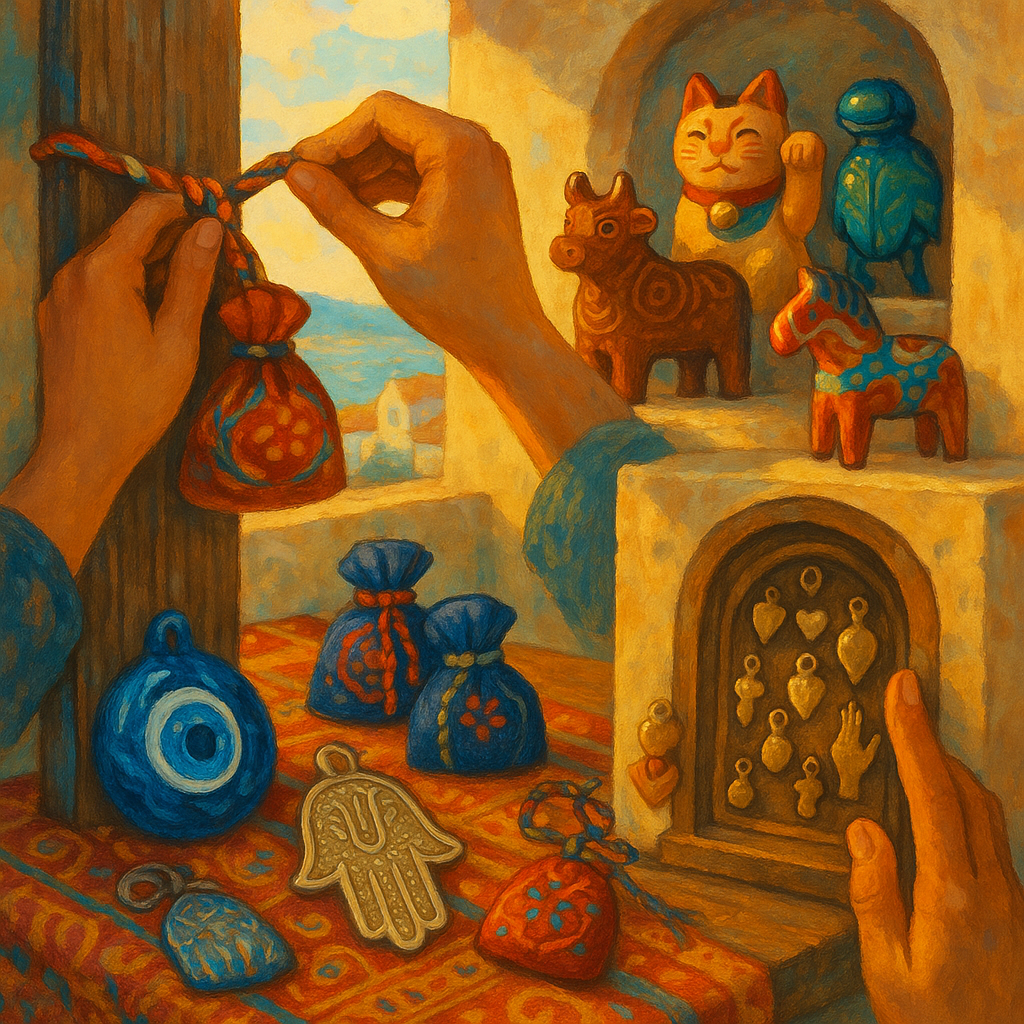
We all want a little help when life feels uncertain. As Eve Conant’s National Geographic piece (“How good luck charms reflect world cultures,” June 9, 2020) shows, cultures everywhere answer that need with objects, animals, gestures and rituals meant to bring fortune or keep misfortune at bay. These talismans — from blue glass eyes in Mediterranean bazaars to tiny brocade pouches sold at Japanese shrines — are less about proving a supernatural outcome than about giving people a sense of protection, identity, and calm.
Apotropaic objects: warding off the bad
Many of the world’s most recognisable charms act as shields. The evil eye or nazar — the blue‑and‑white glass bead found across the Mediterranean and Middle East — is meant to avert envy’s destructive gaze, a motif whose roots the article traces back millennia. The hamsa (Hand of Fatima or Hand of Miriam), a palm‑shaped amulet widespread from Morocco to the Levant and along Silk Road routes, serves a similar protective role and appears in metalwork, textiles and jewelry. In Latin America, milagros — small metal “miracles” shaped like body parts, animals or objects — are often attached to corazones (sacred hearts) in churches and homes to request or thank for healing and protection.
Totemic animals and symbolic objects
Animals are another common language of luck. Conant highlights regional favourites — from the Torito de Pucará ceramic bulls on Andean rooftops that are meant to protect family life, to Thailand’s elephant motifs, ancient Egyptian scarabs, and Sweden’s painted dala horses. In Japan, maneki‑neko (the beckoning cat) is a shopkeeper’s charm for customers and prosperity; it sits alongside omamori, the religious brocade pouches sold at Shinto shrines and Buddhist temples that contain prayers and are treated with devotional seriousness rather than purely as souvenirs.
Rituals and behaviours as charms
Good luck isn’t always an object. Conant points out how words and actions function as charms in their own right — saying “rabbit” on the first morning of a month in England, spilling water behind someone leaving for a trip in Serbia, donning red underwear and popping 12 grapes at New Year’s in Spain, or knocking on wood and spitting over the shoulder in parts of Russia. These performative acts show that talismanic practice can be social and behavioral, not just material.
How charms travel and change
Trade, migration and cultural contact explain a lot of the overlap we see in lucky objects. Conant notes that motifs like the hamsa and evil‑eye designs spread along trade routes such as the Silk Road, which helps account for similar forms showing up across distinct regions. Today many of these objects also circulate as souvenirs, exported and reinterpreted for tourists; the article contrasts deeply religious items (for example, omamori bought at a shrine) with lighter commercial versions (such as mass‑produced maneki‑neko figurines).
Why people still turn to charms
The piece brings in psychological perspective to explain why charms persist. Psychologist Richard Wiseman’s research is mentioned to show that people carrying a favoured charm sometimes perform better on tasks — not because the charm alters objective outcomes but because it can lower anxiety and boost confidence. Conant also cites voices like collector Maryam Montague to illustrate how charms carry personal and cultural meaning beyond their market value. During crises — the COVID‑19 pandemic being a recent example — people even improvised amulets and invoked familiar talismanic practices, underscoring charms’ role in human coping.
A respectful, pragmatic takeaway
Conant’s article is a cultural tour rather than an exhaustive catalogue or a historical treatise: it selects representative examples to show how widespread and varied talismanic practices are, and it is careful to say there’s no scientific proof charms change fate. What the piece does offer is a useful guide for travellers, collectors and curious readers: look for context before you buy, respect the line between devotional objects and souvenirs, and appreciate that a small object often carries large stories — of trade, faith, family and psychological comfort.
If you’re planning a trip or just enjoy cultural curiosities, consider using these categories — apotropaic objects, animal/totemic symbols, religious items, and ritual behaviours — as a way to notice the world’s many answers to uncertainty. As Conant’s National Geographic article shows, lucky charms aren’t magic that rewrites outcomes; they’re a human way of carrying meaning and calm into an uncertain world.
Leave a Reply