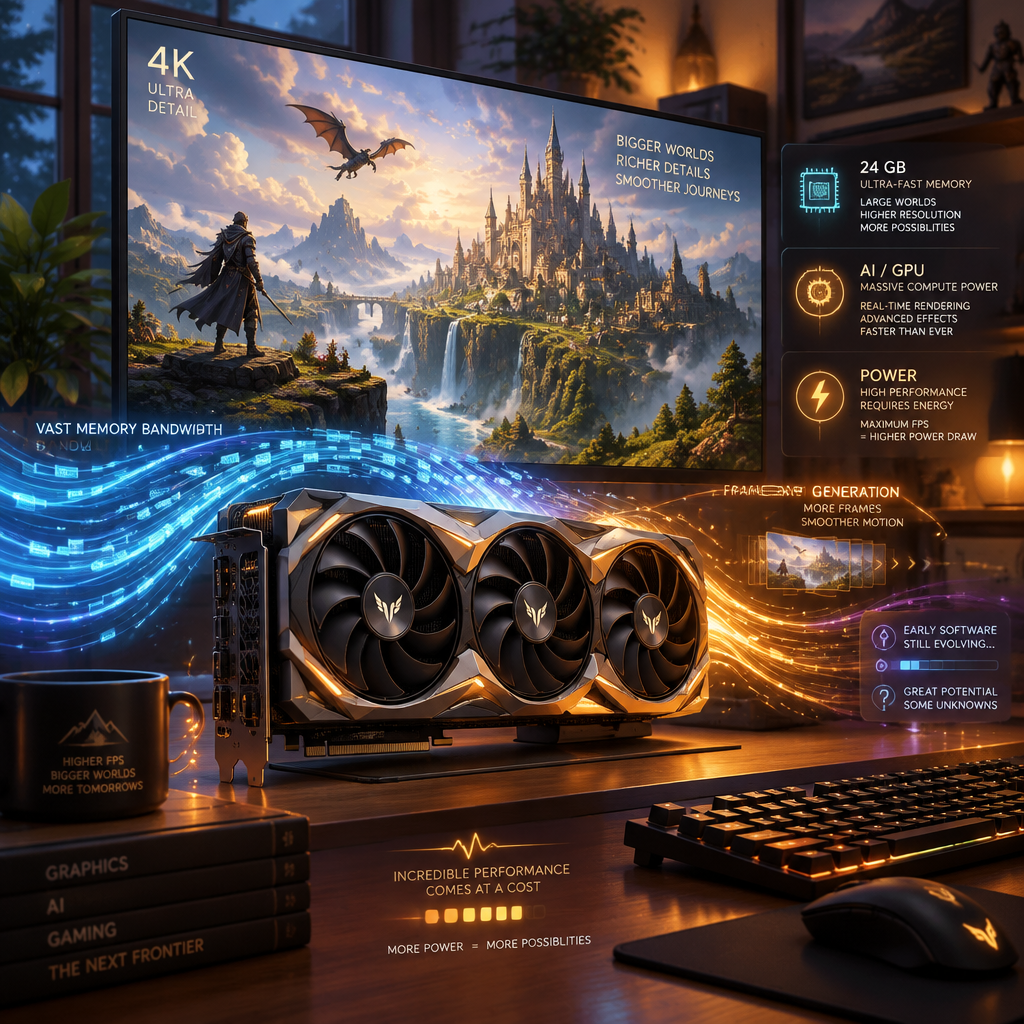
Nvidia’s GeForce RTX 5090 Founders Edition arrives as the flagship of its Blackwell generation, bringing 32GB of GDDR7 memory, a 512-bit bus and a 575W total board-power rating. At its listed launch price of $1,999, it makes a bold promise: top-tier performance, especially for 4K gaming.
In Tom’s Hardware’s 16-game rasterization tests, the RTX 5090 averaged 25% faster than the RTX 4090 at 4K Ultra. The lead shrank as resolution fell—13% at 1440p Ultra and just 3% at 1080p Ultra—while the cards tied at 1080p Medium. The results point to 4K as the more fitting target for a GPU of this scale.
But the launch picture was not flawless. Some results were inconsistent, and in certain tests the RTX 5090 trailed its predecessor. The review linked this in part to early driver and optimization issues, adding a note of uncertainty to an otherwise clear performance lead.
The card’s appeal also comes with trade-offs: a high price and substantial power draw. And while DLSS 4 Multi Frame Generation can raise the frame rate shown on screen, those generated frames are not the same as frames rendered natively by the game; input is not sampled at the same rate as the displayed output.
Tom’s Hardware’s verdict is that the RTX 5090 is usually the fastest card in its tests, with substantial memory-capacity and bandwidth gains over the RTX 4090. Yet its launch-era review also urges caution around driver issues and uncertain availability. Its benchmark results reflect the publication’s test conditions at launch—not a guarantee for every game or system, nor a guide to later prices, availability or driver performance.