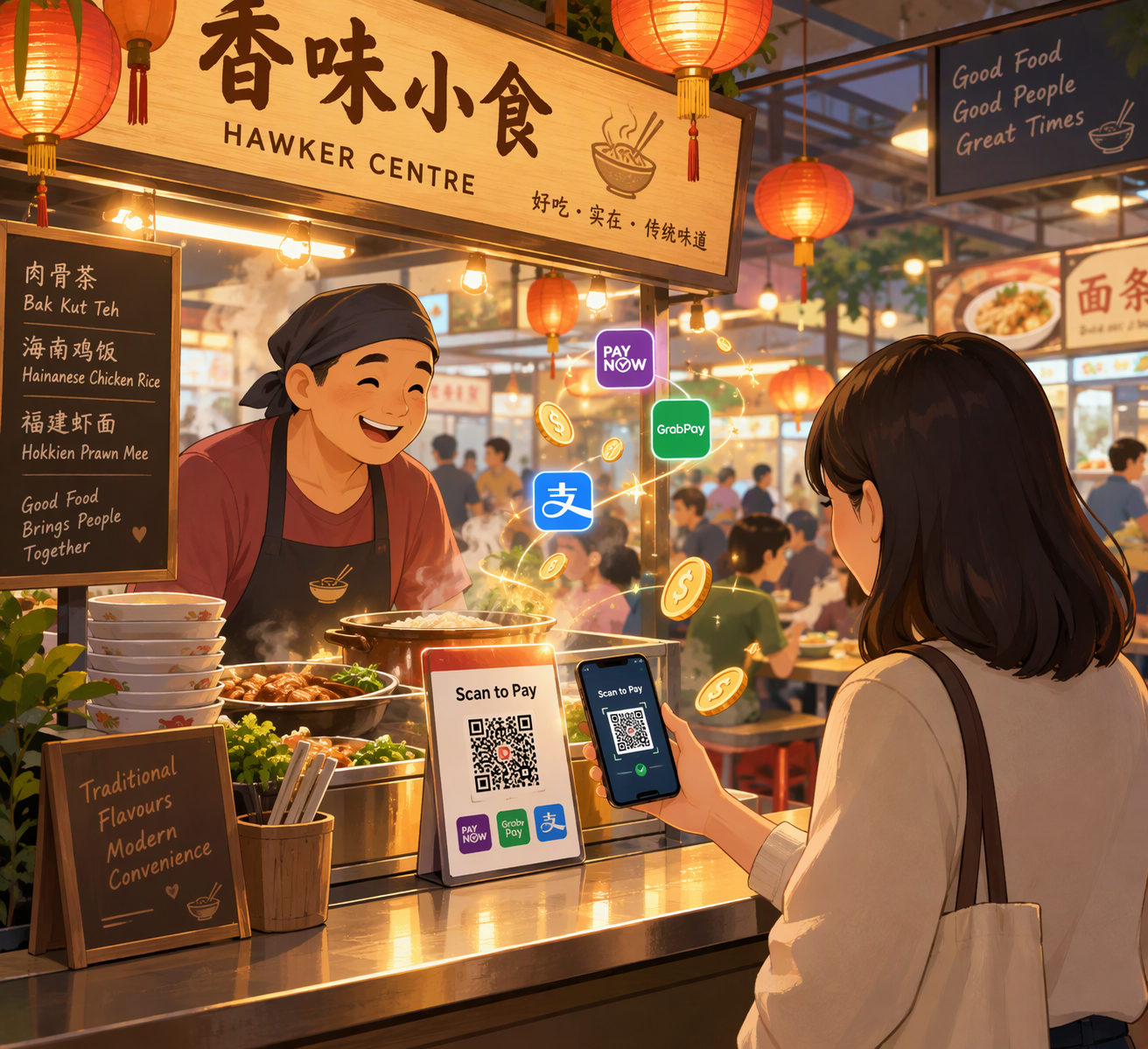
A customer reaches the payment counter, scans a QR code and pays in moments. For many hawkers, that convenience is still worth offering—even now that a government subsidy covering some SGQR fees has ended.
The subsidy ended on June 30, 2026. While it was in place, hawkers using SGQR could have the 0.5% transaction fee waived on up to S$20,000 of monthly SGQR transactions. Now, hawkers using the service are responsible for that fee, prompting some to reconsider how they accept digital payments.
In visits to several hawker centres, 8world found that most hawkers interviewed continued using SGQR. Some said the convenience of handling payments made the fee acceptable. Others have adjusted their approach. A noodle-stall operator at Hong Lim Market and Food Centre, who had used SGQR for about two years, switched to personal PayNow or PayLah QR codes after the subsidy ended. She said the fee would cut into her profits because her selling prices had not changed.
For some stalls at well-known centres, the choice may also depend on who is paying. Some hawkers said they would offer SGQR to tourists, while directing local customers to personal PayNow or PayLah codes. That reflects one feature of SGQR: it accepts 16 payment applications, including UOB TMRW and WeChat Pay, along with other cross-border payment methods.
NETS told 8world that the number of hawkers continuing to use SGQR, as well as transaction activity, remained broadly at previous levels. It also reported that hawker-centre SGQR payment volume rose by a double-digit percentage year on year from January to July 2026. The article does not say that the subsidy’s end caused this increase.
Enterprise Singapore and the Infocomm Media Development Authority said the subsidy ended as scheduled because digital payments had become commonly accepted and mature among hawkers and consumers, and the programme had achieved its objective. For stallholders, the change means balancing the cost of accepting payments with the convenience and payment options SGQR offers.
This is a snapshot from interviews at several centres, not a nationwide count of stalls. It does not mean every hawker has adopted digital payments, or that hawker centres have stopped accepting cash. Instead, it shows hawkers making different choices as they manage the cost of digital transactions.
Source: 摊主乐学数码计划SGQR补贴结束 小贩须付手续费 多数继续使用, 8world
Leave a Reply