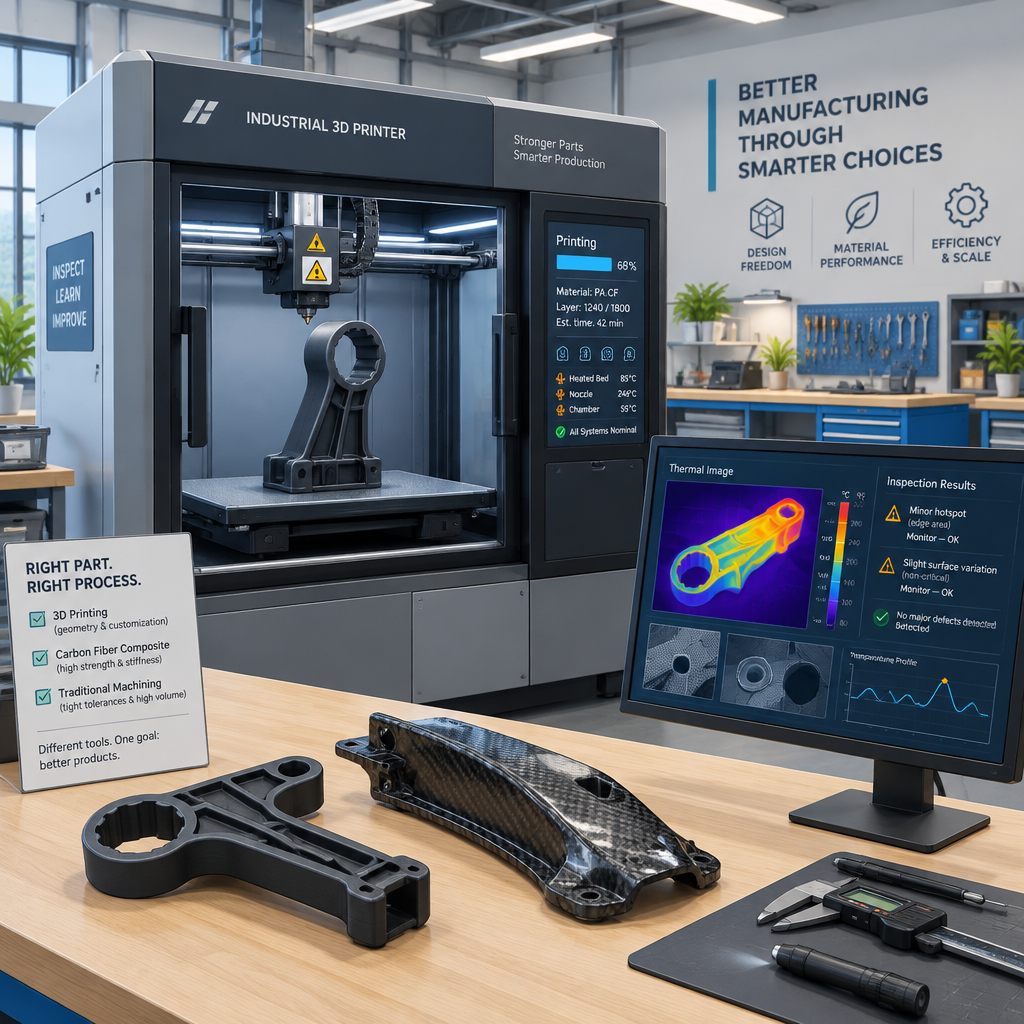
Industrial 3D printing is beginning to reach beyond the prototype bench. In its look at trends shaping manufacturing in 2027, CADimensions describes a shift toward selected production work, factory-floor support, and functional parts—while emphasizing that additive manufacturing is not the right answer for every job.
One opening is **production at lower volumes**. Bridge manufacturing, on-demand runs, and some end-use parts may suit 3D printing when designs change often, tooling takes too long, or conventional production is less practical. But for high-volume products with stable designs, injection molding can remain efficient.
A second trend is **larger-format tooling made in-house**. Printers can produce fixtures, gauges, and other manufacturing aids, potentially reducing waits for machining or outside suppliers. The article reports that Toyota Production Engineering and Rivian are evaluating Stratasys’s F870 for tooling, manufacturing aids, and advanced prototypes. It also notes that results from those early evaluations had not yet been published.
The article also points to **AI-assisted print monitoring**. Formlabs’ Fuse X1 monitoring system uses computer vision and real-time thermal imaging to flag potential defects. According to the article, it can stop processing an affected part while other parts in the build continue. Automated monitoring, however, is not a substitute for material testing, inspection, or process validation.
**More accessible prototyping** could help engineering teams test ideas sooner and iterate faster. One example cited is Radio Flyer’s development of a full-size cargo e-bike prototype: the article says the process went from about two months using earlier methods, to two weeks with Form 4L technology, and then to two days using the Fuse X1.
Finally, **advanced materials** are expanding the possibilities for functional parts. The article highlights carbon-fiber-filled Nylon 12CF and resin formulations designed to behave more like familiar plastics. But a promising material still needs application-specific qualification and testing before it is used in a functional component.
The practical takeaway is to start with a manufacturing problem, not the novelty of the technology. Production delays, total cost, material requirements, production volume, and the need for post-processing and inspection all matter when deciding whether additive manufacturing fits. CADimensions’ examples involve products from Formlabs and Stratasys, and should be read as the article’s reporting—not as independent comparative testing.
Leave a Reply