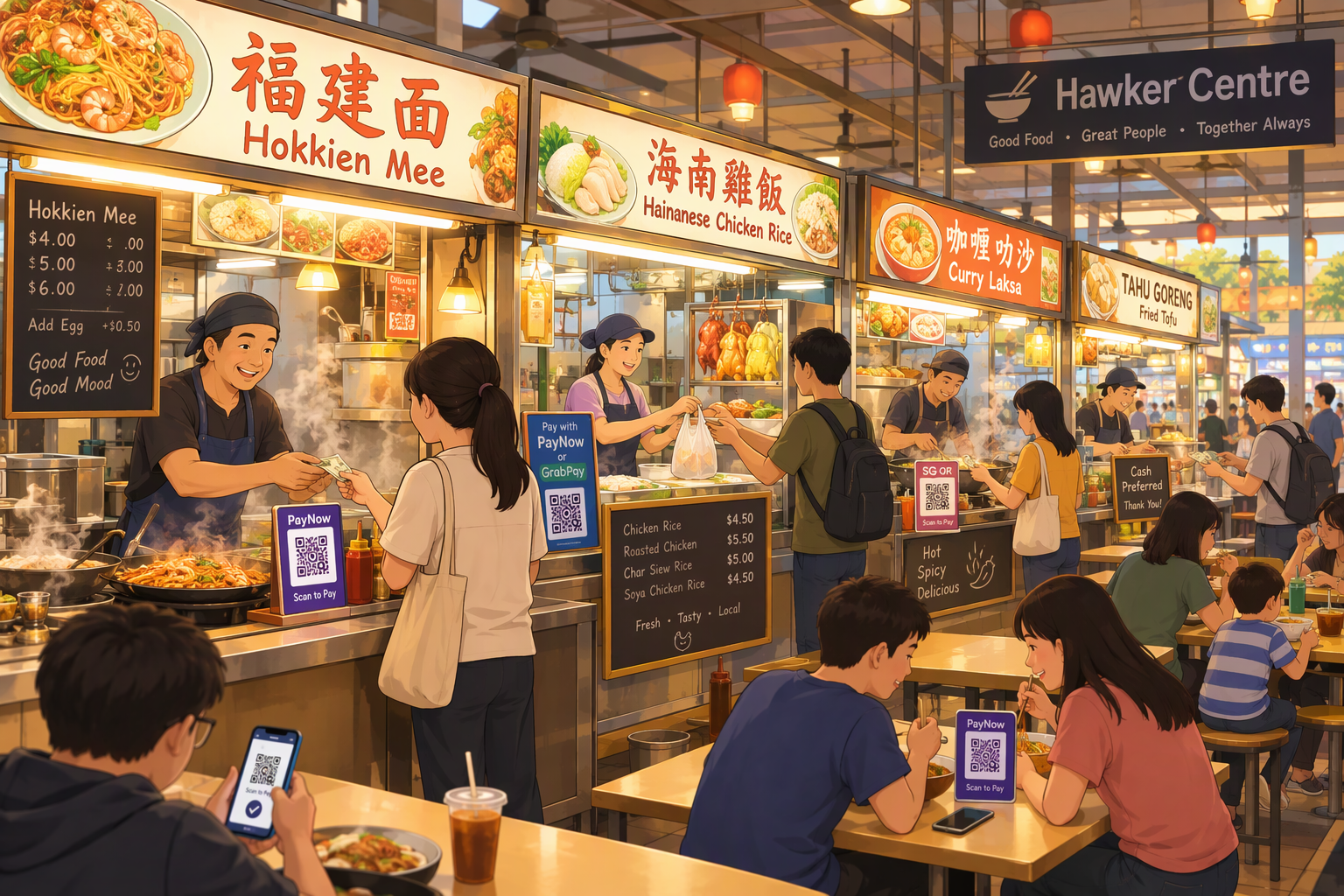
At a hawker stall, a meal may be ready in seconds—but paying for it can happen in different ways. Some customers tap a phone or scan a QR code. Others reach for cash. In Singapore’s hawker centres, both methods remain part of everyday life, even as efforts continue to encourage digital payments.
The Straits Times reported that more than 11,500 hawkers had started using SGQR, a standardised QR code launched in 2018 to make it easier to accept payments through multiple mobile e-wallets. The government’s Hawkers Go Digital programme began in 2020 to encourage stallholders in government-run food centres to adopt digital payments. Its stated goal was to bring these options to about 18,000 stallholders. At the time of the article, agencies had said a transaction-fee waiver would last until the end of 2025, covering the 0.5 per cent fee on a stall’s first $20,000 of monthly e-payment transactions.
But a QR code is not the right fit for every stallholder. At West Coast Food Centre, 65-year-old noodle-stall owner Angie Sim continued to accept cash. She said it felt easier and more convenient, especially because many of her customers were older and accustomed to carrying cash.
The article describes other concerns raised by stallholders across eight hawker centres who had not adopted digital payments. Some found the platforms difficult to use; others mentioned poor eyesight or the challenge of checking whether a payment had gone through. A drinks-stall owner in his 70s at ABC Brickworks Market & Food Centre said it could be hard to remember the steps and verify payments during busy periods. At times, he served customers without cash and allowed them to return to pay later. A drinks-stall owner in his 60s at Albert Centre Market and Food Centre called the need to check each transaction troublesome. A vegetarian-stall owner at Alexandra Village Food Centre worried that customers might say they had paid when a transaction had not succeeded.
For other hawkers, QR payments have made parts of the working day easier. Madeline Chen, 46, who runs a braised-pork stall at Chinatown Complex Market & Food Centre, said digital payments reduced the hassle of handling cash when business was busy. Some regular customers photographed her SGQR code and paid before collecting their food.
At Bendemeer Market & Food Centre, 70-year-old prawn-noodle seller Lim Yaw Fook said his sales had increased by about 20 per cent since he began using SGQR in 2020. He linked the increase to more younger customers visiting his stall. He also said some customers from China preferred SGQR because it worked with China-based apps Alipay and WeChat Pay. The article also notes that some hawkers receive digital payments through a personal PayNow QR code or mobile number instead of SGQR.
These accounts show a gradual change, not a single rule for every stall. Digital payments can suit hawkers and customers who value their convenience, while cash remains a practical choice for others. In a hawker centre, making room for both ways to pay may be part of how tradition and changing habits share the same table.
Source: Why cash is still king for some hawkers in Singapore despite digitalisation push, The Straits Times
Leave a Reply