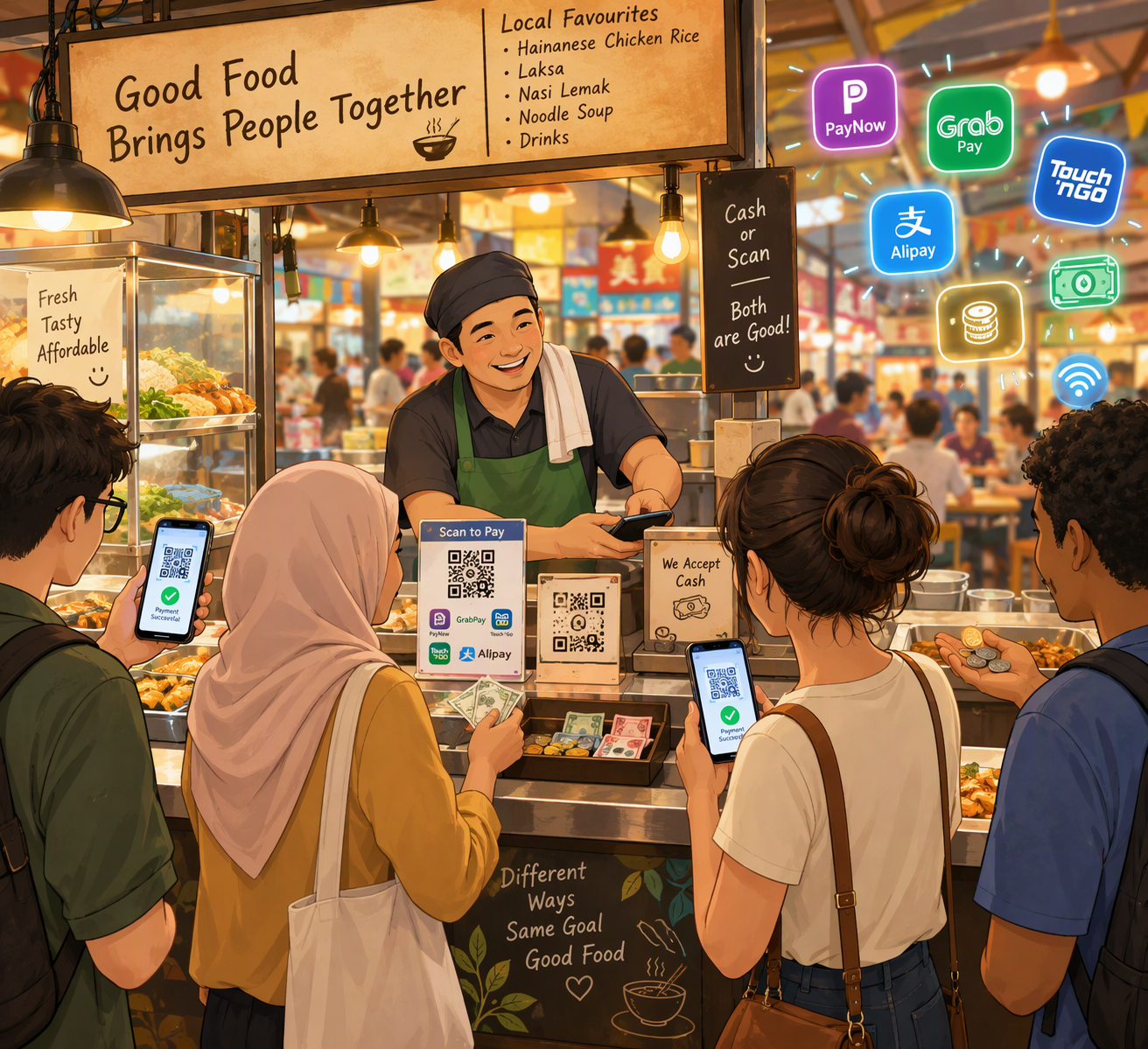
At a busy hawker stall, paying can take just a moment—but that moment may look different to different people. One customer scans a code on a phone; another reaches for notes and coins. A November 2024 report by The Straits Times captures this everyday contrast: digital payments were spreading, but cash remained the easier choice for some hawkers and their customers.
The move towards e-payments had gathered pace. More than 11,500 hawkers had adopted the Singapore Quick Response Code, or SGQR, a standardised code introduced in 2018 to make it simpler to pay using different mobile e-wallets. The Hawkers Go Digital programme, which began in 2020, also waived a 0.5 per cent transaction fee on a stall’s first $20,000 in monthly e-payment transactions. At the time of the report, Enterprise Singapore and the Infocomm Media Development Authority said the waiver would continue until the end of 2025. The article described a plan to bring about 18,000 stallholders in government-run food centres onto digital payments.
But adopting a payment system is not simply a matter of putting up a QR code. For some stallholders, it means learning unfamiliar steps, checking whether each payment has succeeded and doing so while serving customers. The Straits Times spoke with cash-preferring stallholders across eight hawker centres, and their reasons varied. Some found digital platforms difficult to use; others mentioned poor eyesight, uncertainty about confirming payments or concern about inconveniencing customers.
At West Coast Food Centre, noodle-stall owner Angie Sim, 65, said cash was easier and more convenient for her. Many of her customers were older, less familiar with technology and usually carried cash. A drinks-stall owner in his 70s at ABC Brickworks Market & Food Centre said he struggled to remember how to navigate digital platforms and had difficulty verifying payments during peak periods. If a customer had no cash, he sometimes served them and allowed them to return to pay later.
Other worries were about whether a payment had actually gone through. A drinks-stall owner in his 60s at Albert Centre Market and Food Centre described checking every e-payment as troublesome. At Alexandra Village Food Centre, a 60-year-old vegetarian-food stall owner worried that a customer might say they had paid when the transaction had not succeeded.
Yet the report also shows why digital payments appeal to some hawkers. Madeline Chen, who ran a braised-pork stall at Chinatown Complex Market & Food Centre, found e-payment reduced the hassle of handling cash, especially when she was busy. Some regular customers scanned her SGQR code before collecting their food.
There is no single payment method that suits every stallholder or customer. The article describes a gradual shift, not a fully cashless hawker scene: in November 2024, digital options were useful for some, while cash still felt more straightforward for others. At the hawker centre, making room for both can help keep the focus where it belongs—on serving the next meal.
Source: Why cash is still king for some hawkers in Singapore despite digitalisation push, The Straits Times
Leave a Reply