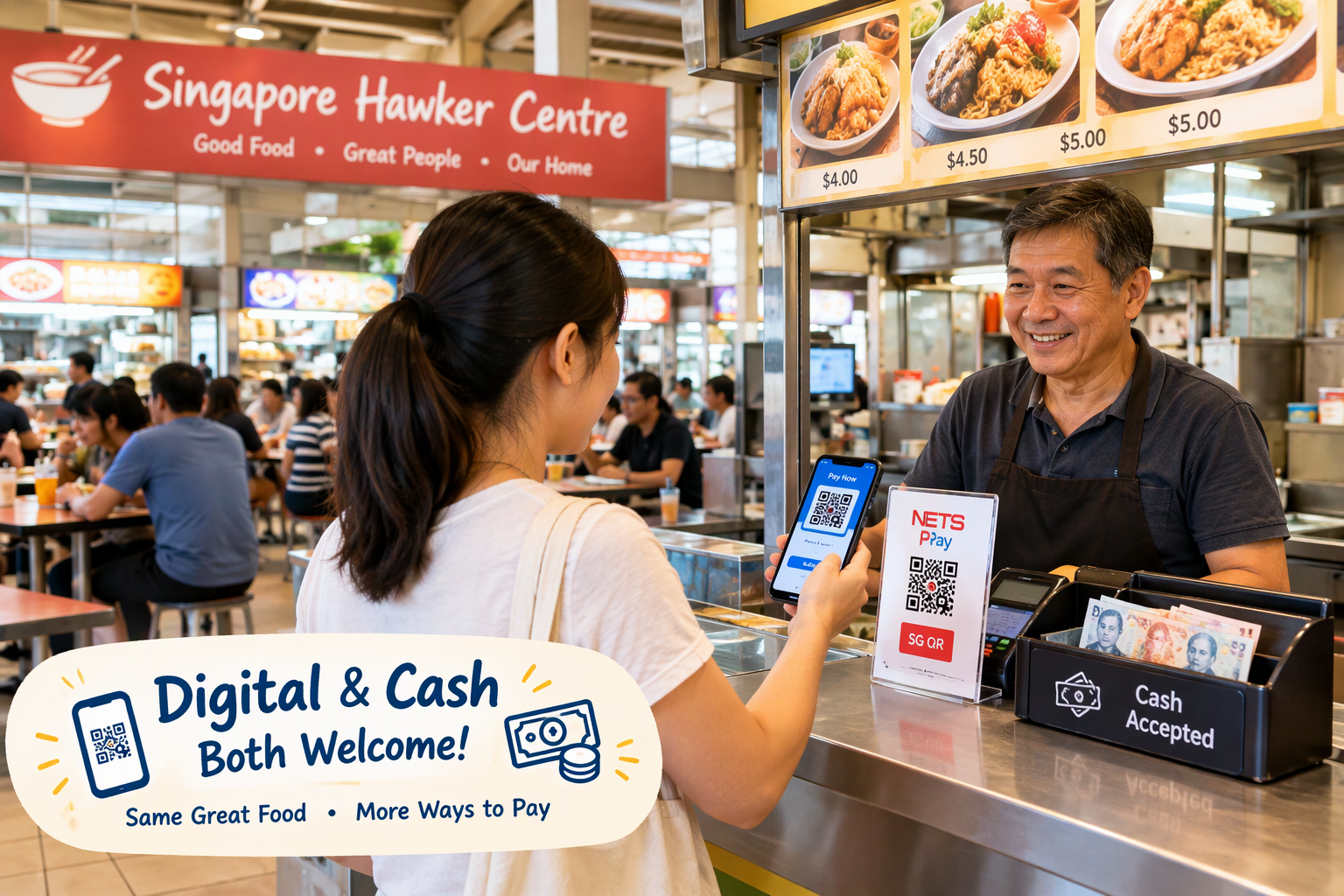
At a hawker centre, the choice of how to pay can be as simple as a tap or scan—or a few notes and coins passed across the counter. QR codes are becoming a familiar sight in Singapore, but not every stall has made the same change. For some hawkers, cash remains the option that feels easiest to manage.
The Straits Times reported that more than 11,500 hawkers had started using SGQR, a standardised QR code introduced in 2018. It allows customers to make payments through different mobile e-wallets using one code. At stalls displaying SGQR, a quick scan can make paying convenient. Yet a digital option does not mean cash has disappeared from the hawker-centre experience.
At West Coast Food Centre, 65-year-old noodle-stall owner Angie Sim said she found cash easier and more convenient. She also felt it suited many of her older customers, some of whom were less comfortable with technology. Her view reflects a practical concern: a payment method has to work for both the person serving and the person buying.
Hawkers interviewed across eight food centres described other challenges. Some had limited confidence with digital tools or poor eyesight. Others worried that unfamiliar devices might slow things down or inconvenience customers. A drinks-stall owner in his 70s at ABC Brickworks Market & Food Centre said digital platforms were difficult to remember. During busy periods, he also found it hard to check whether a payment had gone through. At Albert Centre Market and Food Centre, another drinks-stall owner described verifying e-payments as troublesome.
These examples show that adopting a QR code can involve more than displaying it at the stall. Hawkers need to feel confident using the system, especially when customers are waiting and orders are coming in. For someone who is used to cash, keeping track of a digital transaction may seem like an extra task rather than a shortcut.
The Government has also tried to encourage the shift. The Hawkers Go Digital programme began in 2020. For hawkers who joined and used SGQR, it waived the 0.5 per cent transaction fee on the first $20,000 of monthly transactions. On October 10, 2024, Enterprise Singapore and the Infocomm Media Development Authority announced that the waiver would continue until the end of 2025. The stated aim was to encourage digital-payment adoption among the 18,000 stallholders in government-run food centres.
The picture is one of gradual change, not a single switch from cash to cashless. QR payments are increasingly visible, while some hawkers continue to prefer cash for reasons that differ from stall to stall. Their experiences remind us that digitalisation is not only about introducing a new way to pay; it is also about whether people can use it comfortably in the middle of a busy day. At the hawker centre, the most useful payment option may still depend on the hawker, the customer and the moment.
Source: Why cash is still king for some hawkers in Singapore despite digitalisation push, The Straits Times
Leave a Reply