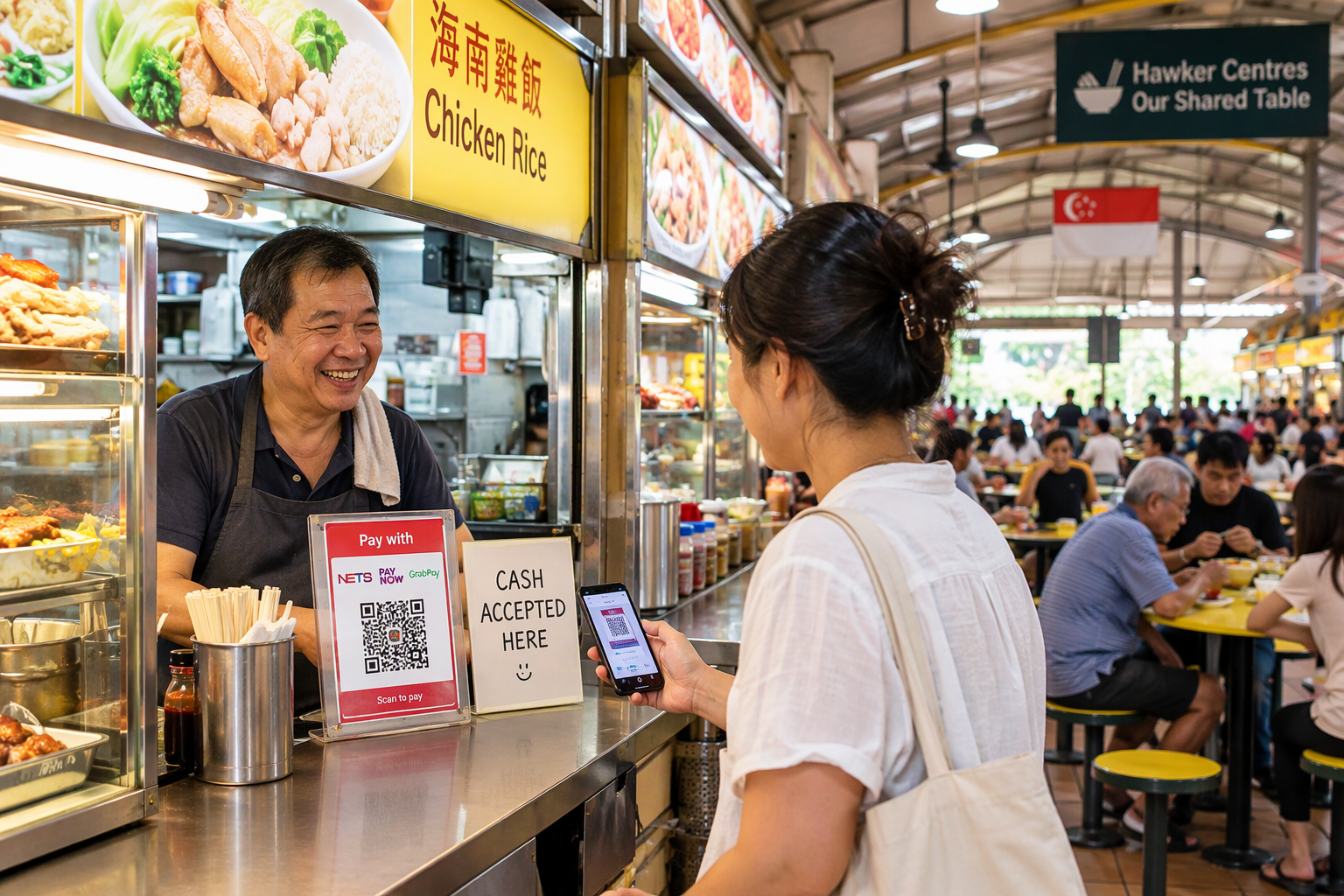
At West Coast Food Centre, a small “Cash Only” sign tells customers how to pay before they even reach Angie Sim’s noodle stall. Nearby, QR codes mark a different kind of change: digital payments are becoming more visible across Singapore’s hawker centres. Yet, as a November 2024 report by The Straits Times shows, the transition is not the same as every stall going cashless.
Sim, 65, has worked at the centre with her stall partner for more than 20 years. She says cash is easier and more convenient for her, and suits many of her older customers, who may be less comfortable with technology and often carry cash. For her stall, sticking with notes and coins is a practical choice—not a statement that digital payments have no place.
The newspaper spoke to stallholders across eight hawker centres who continued to resist digital payments. Their reasons were varied but familiar: some had limited digital literacy or poor eyesight; others found payment platforms difficult to navigate. Some worried that handling a device or checking a transaction would slow service or inconvenience customers, especially when the stall was busy.
One drinks-stall owner in his 70s at ABC Brickworks Market & Food Centre said he struggled to remember how to use digital platforms and verify payments during busy periods. Still, he said he would serve customers who had no cash and let them return to pay later. At Albert Centre Market and Food Centre, a drinks-stall owner in his 60s described e-payment as troublesome because he needed to check whether each transaction had gone through.
At the same time, digital payment options have spread. The article reported that more than 11,500 hawkers had adopted SGQR, a standardised QR code launched in 2018 to make payments from multiple mobile wallets easier. In 2020, the Hawkers Go Digital programme began encouraging digital payments among roughly 18,000 stallholders in government-run food centres. Participating hawkers did not have to pay the 0.5 per cent transaction fee on the first $20,000 of monthly transactions.
On October 10, 2024, Enterprise Singapore and the Infocomm Media Development Authority announced that this fee waiver would be extended to the end of 2025. The support helps make digital payments more accessible to participating hawkers, but it does not mean every stall has adopted them.
That distinction matters. QR codes may be increasingly common, and the programme has encouraged more hawkers to accept digital payments, but cash remains part of the picture. The article does not say that cash will be discontinued, that going cashless is compulsory, or that all stalls have switched. Instead, it captures a change still in progress—one shaped not only by technology and policy, but also by what stallholders and their customers find workable in everyday life.
Source: Why cash is still king for some hawkers in Singapore despite digitalisation push, The Straits Times
Leave a Reply