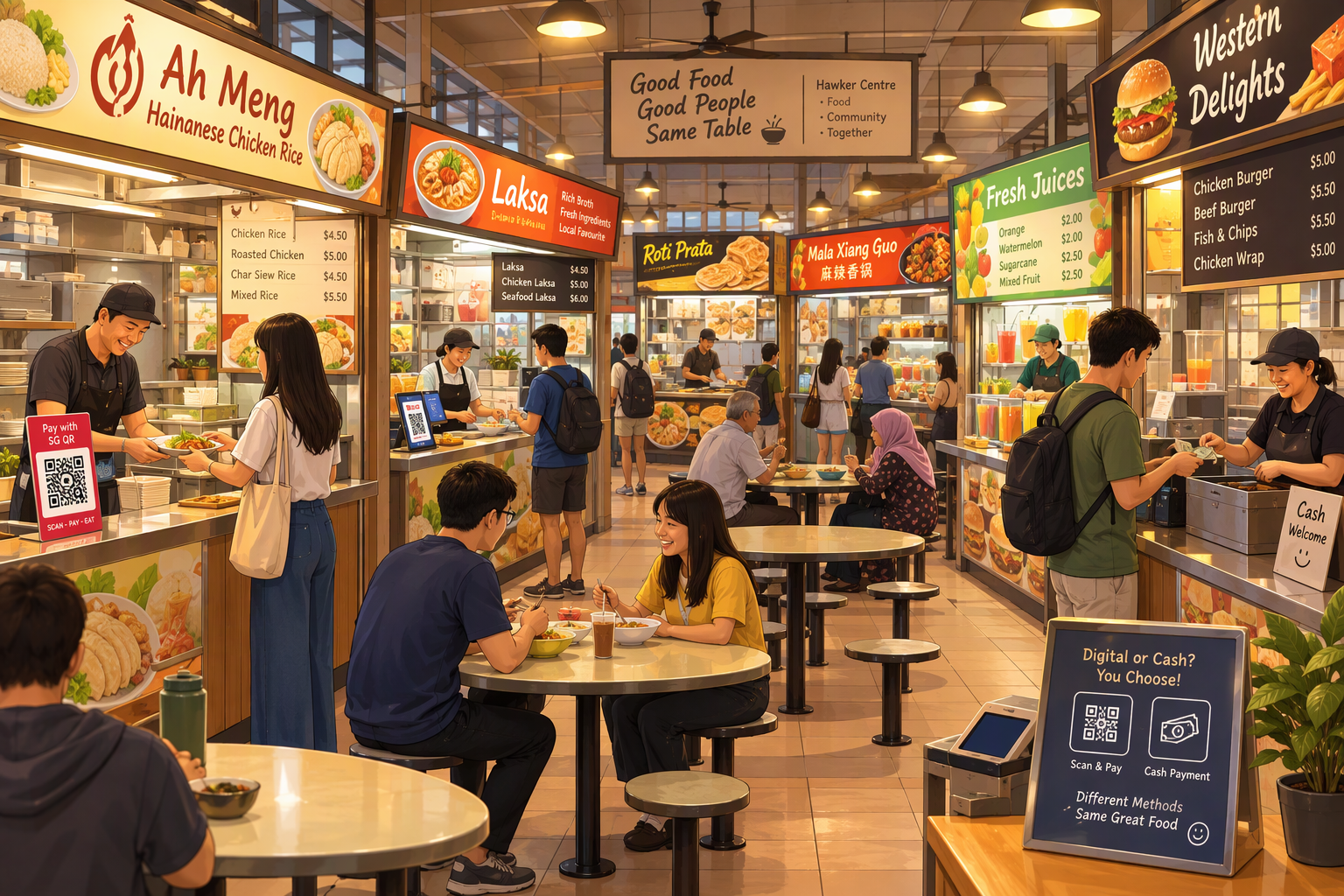
At a hawker centre, paying for lunch can mean a quick scan of a QR code—or a few notes and coins passed across the counter. Singapore’s move towards digital payments has brought both options into sharper focus, but the shift has not been the same for every stallholder.
In a report published in November 2024, The Straits Times said more than 11,500 hawkers had started using the Singapore Quick Response Code, or SGQR. Introduced in 2018, the standardised code supports payments through multiple mobile e-wallets. Yet some hawkers interviewed across eight hawker centres had not adopted digital payments and continued to accept cash only.
One of them was Angie Sim, a 65-year-old noodle-stall owner at West Coast Food Centre. She said cash was easier for her and suited many of her customers, whom she described as older and less comfortable with technology. Her choice points to an important part of the story: adopting a new payment method is not just a matter of placing a code at the counter. It also has to work for the person taking payment and the people paying.
Other stallholders described practical difficulties. Some had limited digital skills or poor eyesight. Others found it hard to check whether a transaction had gone through, or worried that payment steps might slow service and inconvenience customers during busy periods. One drinks-stall owner said that when customers had no cash, he would sometimes let them take their drinks and return later to pay.
There was also support for the digital shift. Hawkers who had adopted digital payments cited convenience, and some said they had seen higher sales, particularly from younger customers. The report therefore describes different experiences rather than a simple contest between old and new: digital payments can suit some stalls and customers, while cash remains the preferred option for others.
To encourage adoption, the Hawkers Go Digital programme was launched in 2020. At the time of the report, hawkers using SGQR did not have to pay the 0.5 per cent transaction fee on the first $20,000 of digital transactions per stall each month. Enterprise Singapore and the Infocomm Media Development Authority announced on October 10, 2024, that the fee waiver would be extended until the end of 2025. The initiative aimed to encourage digital-payment use among about 18,000 stallholders in government-run food centres.
The takeaway is not that cash is about to disappear from hawker centres. The article captures a transition: more stalls were using SGQR, while some stallholders still found cash simpler or more suitable for their customers. A payment system works best when it fits the people using it—and at the hawker counter, that can mean making room for both a scan and a cash payment.
Source: Why cash is still king for some hawkers in Singapore despite digitalisation push, The Straits Times
Leave a Reply