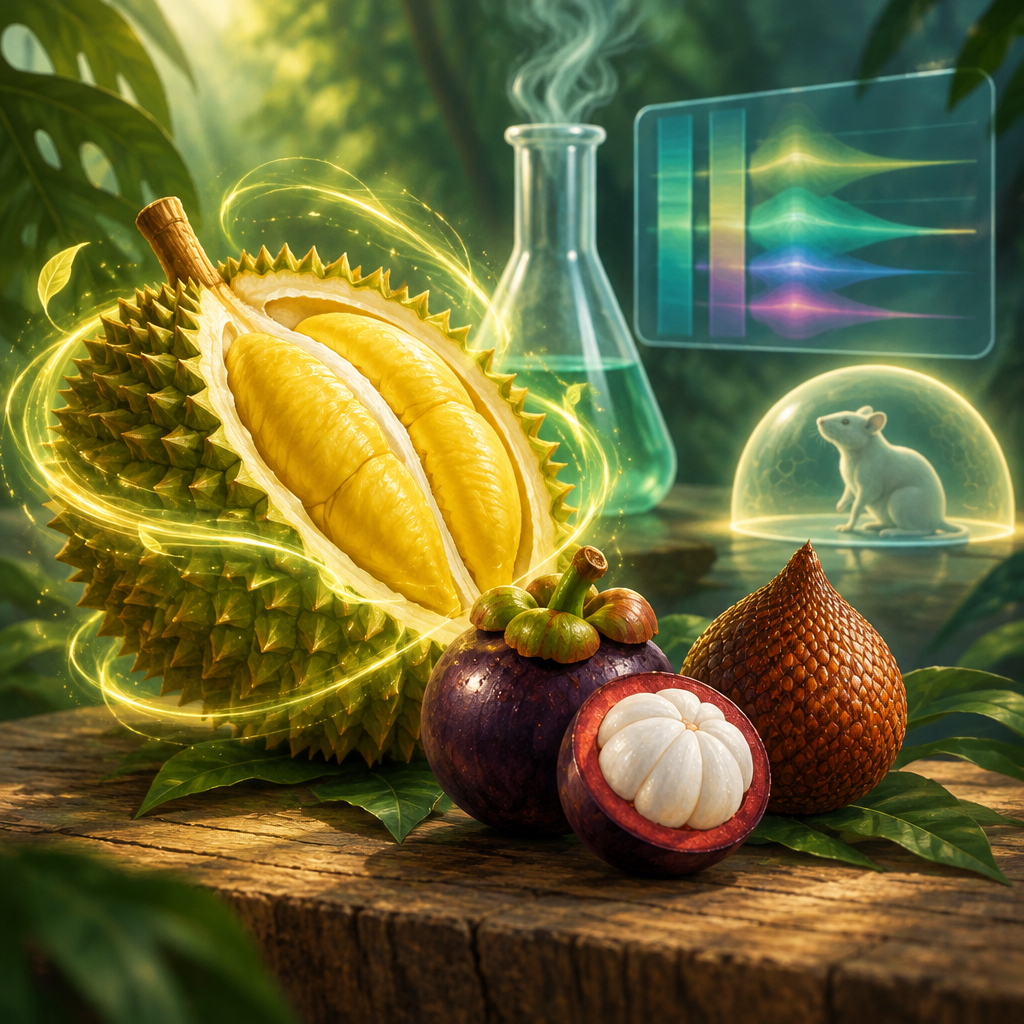
Tropical fruits often carry myth and mystery as much as flavour. A 2007 comparative study in the Journal of Agricultural and Food Chemistry set out to replace some of that folklore with hard measurements by testing three Southeast Asian fruits — durian (Durio zibethinus), mangosteen (Garcinia mangostana) and snake fruit (Salacca edulis) — using laboratory antioxidant assays and a short-term feeding experiment in rats.
What the researchers measured
The team ran a suite of chemical analyses: dietary fiber, minerals and trace metals; total polyphenols (reported as mg gallic acid equivalents per 100 g fresh weight); flavonoid content (in catechin equivalents); phenolic profiling by HPLC with diode-array detection; and antioxidant activity using two common in vitro assays (DPPH and ABTS, reported as µM trolox equivalents per 100 g fresh weight). They also carried out a small in vivo experiment: male Wistar rats were fed either a basal diet, a cholesterol-supplemented diet, or cholesterol diets that were supplemented with 5% (by diet) of one of the three fruits, and plasma lipids and antioxidant status were monitored.
Key laboratory (in vitro) findings
– Dietary fiber, mineral and trace metal levels were broadly comparable across all three fruits.
– Antioxidant-related compounds and activity differed between the fruits, with strong correlations between measured bioactive compound levels and antioxidant activity (reported R2 ≈ 0.99).
– Durian showed the highest antioxidant activity in these assays. Reported values were: DPPH ≈ 228.2 ± 13.4 µM TE/100 g FW and ABTS ≈ 2016.3 ± 81.1 µM TE/100 g FW. By comparison, snake fruit measured about 110.4 (DPPH) and 1507.5 (ABTS), while mangosteen measured about 79.1 (DPPH) and 1268.6 (ABTS) µM TE/100 g FW.
– HPLC/DAD profiling identified quercetin in durian at roughly 1214.23 ± 116.7 µg per 100 g fresh weight; this quercetin level was reported to be about three times the amount of caffeic acid and roughly double the amounts of p‑coumaric and cinnamic acids in durian.
What happened in the rats (in vivo)
When the researchers fed rats a cholesterol-enriched diet, adding 5% of one of the fruits to that diet attenuated the cholesterol-induced rise in plasma lipids and limited the decrease in plasma antioxidant activity compared with the cholesterol-only group. The protective effect was most pronounced with durian, with snake fruit and mangosteen showing smaller but detectable benefits in this short-term animal model.
Authors’ interpretation and the cautious headline
The paper’s overall conclusion was that all three fruits have comparably high nutritional value, and that durian showed the strongest in vitro antioxidant activity and the clearest protective signal in the short-term rat feeding study. The authors suggest that including these tropical fruits — especially durian — could be useful in diets aimed at disease prevention, while noting that the evidence here comes from laboratory assays and an animal model.
Important limits you should not overstate
This study does not establish clinical benefits in humans. The in vivo data are from a short-term rat experiment, so human physiology, effective doses, long-term effects and safety were not examined. The antioxidant assays (DPPH, ABTS) are laboratory measures and do not automatically translate into the same effects in people. The paper also did not compare different cultivars, ripeness stages or growing regions in detail; phytochemical content can vary for those reasons, but that variability was not addressed by this single experiment.
Angles for a balanced blog piece
A strong blog can use the cultural “king (durian) vs queen (mangosteen)” motif while staying faithful to the paper’s findings: durian scored highest on the lab antioxidant tests and contained measurable quercetin, and the 5% durian-supplemented diet gave the clearest protective signal in rats fed extra cholesterol. Equally important is to emphasise the study type and limits — promising findings, not proof of human benefit. As tasteful context (not from this paper): writers may choose to pair these facts with sensory descriptions, culinary uses or discussions of cultivar variation, but those are background topics the study itself did not investigate.
Bottom line
In controlled lab assays and a short-term rat feeding trial, durian emerged as the fruit with the strongest antioxidant signals and the most pronounced protective effect against diet-induced changes in plasma biomarkers. Mangosteen and snake fruit also showed antioxidant compounds and modest protective effects. These are useful pieces of evidence for researchers and writers, but they are not clinical proof for humans — only a single 2007 study combining laboratory chemistry and an animal model.
Leave a Reply