Between 2004 and 2015, six of Indonesia’s largest dry‑season fire events left a deep and measurable mark on the region’s economy, climate and public health. A Nature Communications study that quantifies those impacts finds the combined economic losses from those six events totaled about US$93.9 billion — a reminder that landscape fires are not only an environmental problem but a major socioeconomic shock.
The worst single year in the series was 2015. That season’s fires cost roughly US$28 billion — about 3.3% of Indonesia’s GDP for that year. The study breaks that figure into three main channels: land‑cover damage (about one‑third of the total), imputed CO2‑related climate damages (roughly 40%), and long‑term health costs (around 26%). In dollar terms, health‑related losses from the 2015 fires were estimated at US$7.3 billion in total — with Indonesia bearing about US$5.7 billion of that, Malaysia about US$1.3 billion, and Singapore roughly US$0.3 billion.
Other major fire years in the 2004–2015 sample produced annual losses between about US$9.1 billion and US$20.4 billion, equivalent to roughly 1.1–2.4% of Indonesian GDP in those years. Those headline numbers show how episodic fires can accelerate into large, economy‑scale events when they occur on peatlands and close to populated or agricultural areas.
How did the authors arrive at these figures? They combined a peat‑specific fire emissions inventory (FINNpeatSM) with atmospheric modelling to estimate PM2.5 and CO2 emissions from fires, then overlaid gridded population data to estimate exposure. Health impacts were calculated as excess mortality and DALYs (disability‑adjusted life years) attributable to fire‑borne PM2.5 and then monetized to estimate health damages. CO2/climate costs were imputed by applying an average CO2 price drawn from the European carbon market (2009–2020 average) to fire CO2 emissions. Land‑cover damages were valued by combining burned area with net‑present‑value estimates for the affected land uses. To make year‑to‑year comparisons driven by fire magnitude and location rather than changes in valuation, the study holds unit valuations (NPV, DALY price, CO2 unit price) constant across years.
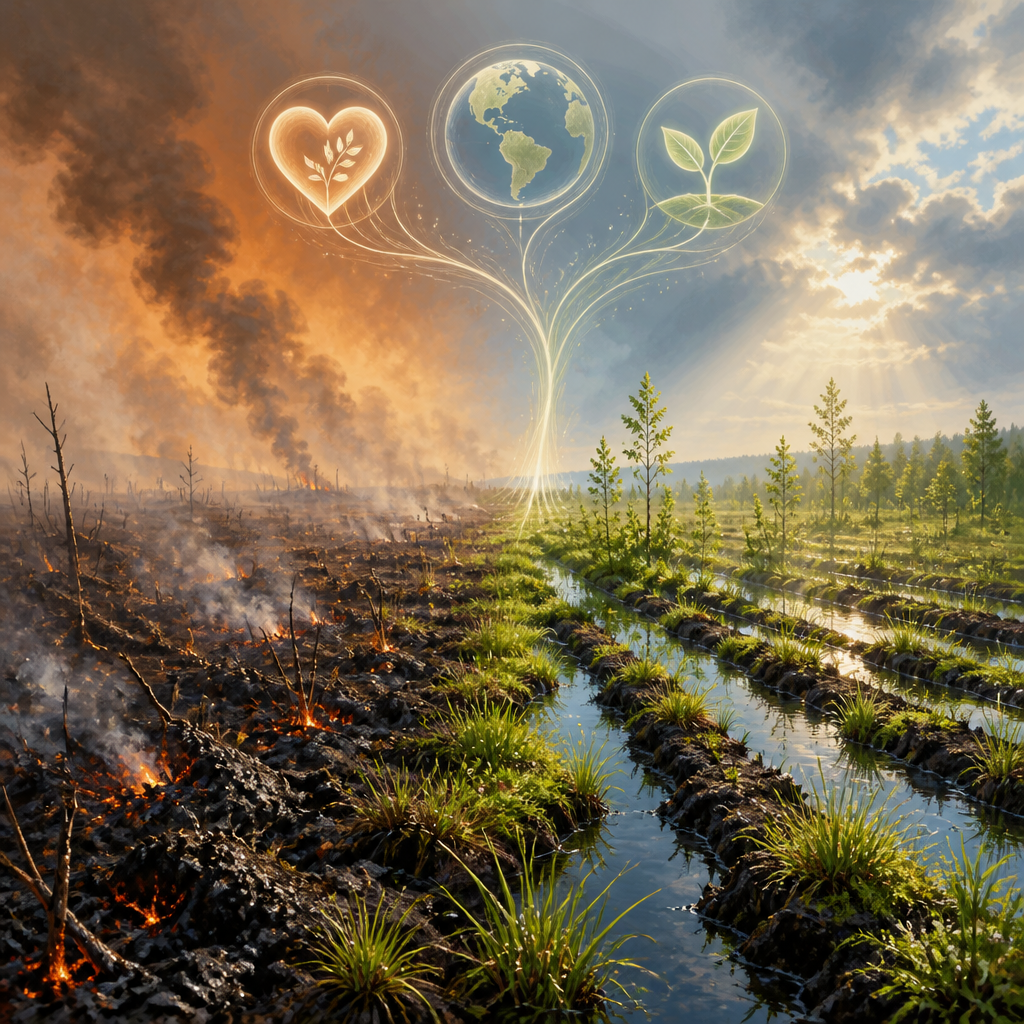
Crucially, the paper also tests a restoration scenario. Restoring 2.49 million hectares of degraded peatland — the government target at the time — would reduce the study’s estimated fire losses by about US$8.4 billion across the events analyzed. The health benefits are notable: restoration cuts estimated excess deaths by 11,914 (a 21% drop, from 55,819 to 43,905) and reduces DALYs by about 0.46 million (from 2.19 to 1.72 million). With restoration cost estimates in the paper ranging roughly US$3.2–7.0 billion, the authors conclude that the projected benefits (reduced CO2 emissions, health damages and land‑cover losses) outweigh the costs under their assumptions.
The authors are careful to flag important caveats. Their quantified channels — land‑cover, CO2 and health — do not capture the full suite of fire impacts: biodiversity loss, employment impacts, subsistence livelihoods, tourism, transport disruptions, regional climate feedbacks and many non‑market ecosystem services were excluded and would enlarge total societal costs if included. Valuation choices (single NPVs per land use, constant DALY and CO2 unit values) and uncertainties in emissions inventories and atmospheric modelling are other sources of uncertainty. The study’s analysis focuses on discrete large fire years up to 2015 and does not itself provide new estimates for later events.
The takeaway is stark but actionable: peatland fires produce multi‑billion‑dollar losses across climate, health and land values, and sizable reductions in those losses appear attainable through large‑scale peatland restoration. While implementation details and wider social impacts require further study and on‑the‑ground policy work, the cost‑benefit arithmetic in this study suggests restoration is a financially sensible part of a broader strategy to reduce the recurrent, large‑scale damages caused by peatland burning.
Leave a Reply