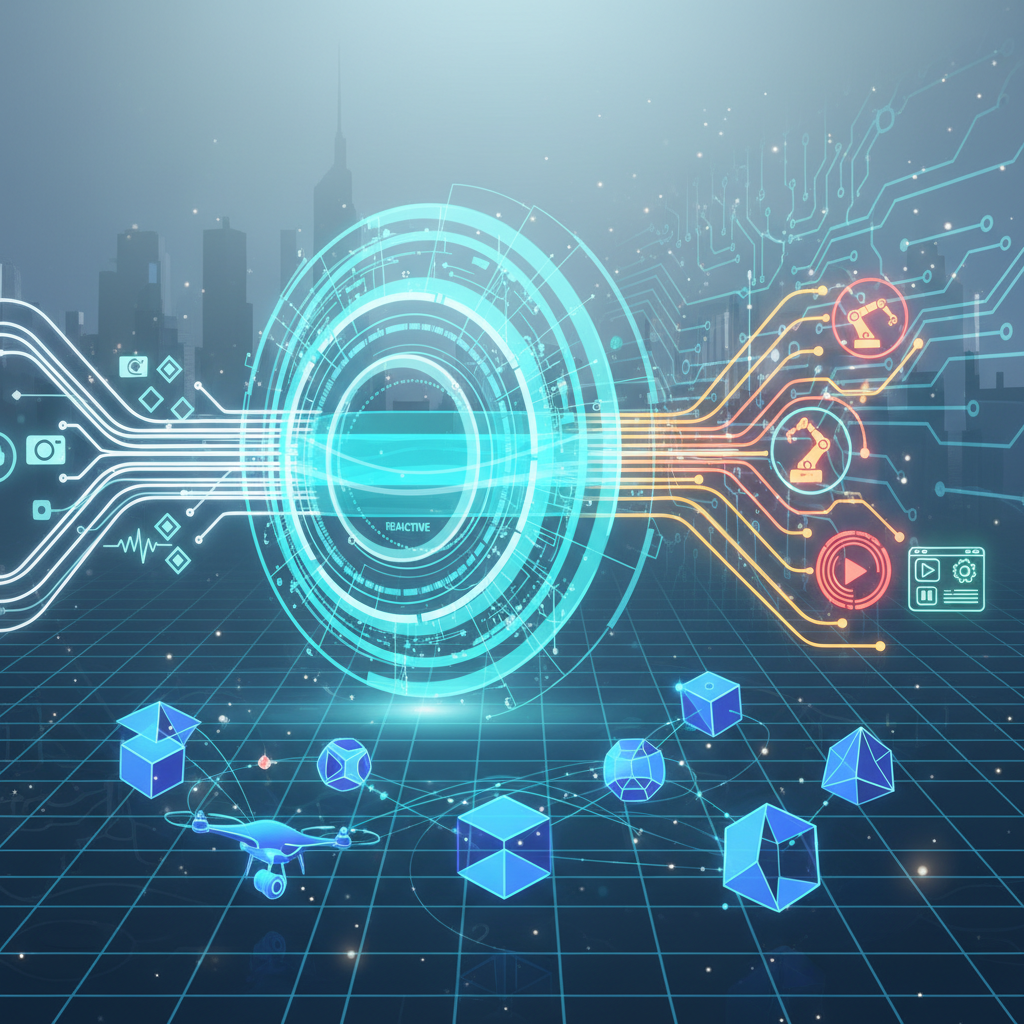
Autonomous software agents are programs that act on behalf of a user or another program with a degree of independence. Rather than following tightly scripted, step-by-step instructions, these agents perceive their environments through sensors, reason about what they perceive, and take actions through actuators to pursue goals in dynamic settings. That simple definition captures a wide family of systems—from small task-focused bots to networks of cooperating programs—bound together by the idea of goal-directed behavior without continuous human direction.
How agents work: the perception–decision–action loop
At the heart of most agent designs is a loop: sense the environment, decide what to do, act to change the environment. Different architectures realize that loop in different ways, trading speed, complexity, and flexibility:
– Reactive agents map perceptions directly to actions. They’re fast and simple, well suited to environments where quick responses matter and planning is less useful.
– Deliberative (symbolic) agents build internal models of the world and plan using symbolic reasoning. They can handle more complex tasks and foresee consequences, but planning adds latency and computational cost.
– Hybrid architectures combine reactive and deliberative parts to get the best of both—fast reflexes plus the ability to plan when there’s time.
– The Belief–Desire–Intention (BDI) model frames agents in mentalistic terms: beliefs about the world, desires (goals), and intentions (committed plans) that guide action.
– Learning agents augment this stack with machine learning—especially reinforcement learning—so behavior improves from experience rather than only from preprogrammed rules.
Multiple minds: multi-agent systems
When multiple agents operate together, new dynamics appear. Multi-agent systems (MAS) bring issues such as cooperation, competition, negotiation, distributed problem solving, and the potential for emergent behavior that wasn’t designed into any single agent. Research in MAS focuses on communication protocols, collective decision-making, coordination strategies, and conflict resolution so that many autonomous entities can work toward compatible or complementary outcomes.
Where autonomous agents are used
The article lists several application areas that illustrate the range of agent technologies:
– Robotics and autonomous vehicles, where agents perceive the physical world and act in it.
– Industrial control and automation.
– Network management and routing.
– Trading systems in finance.
– Game AI, powering non-player characters and game dynamics.
– Personal assistants and software agents that schedule, retrieve information, or carry out transactions.
These areas are illustrative rather than exhaustive, showing how agentic behavior appears across both physical and virtual domains.
What enables agents: intersecting technologies
Autonomous agents sit at the intersection of multiple fields: artificial intelligence and planning algorithms, machine learning (including reinforcement learning), distributed systems, sensor and actuator technology for embodied agents, and reasoning methods that enable purposeful action.
Design challenges and limitations
Building reliable, capable agents is technically demanding. Key challenges include:
– Coordination and communication: getting multiple agents to cooperate at scale is complex.
– Robustness under uncertainty: dynamic, partially observable, or adversarial environments make reliable decision-making hard.
– Scalability: maintaining performance as the number of agents or problem complexity grows.
– Verification and testing: ensuring autonomous behaviors are correct and safe is nontrivial, especially when agents learn or adapt.
Ethical, legal and safety considerations
Autonomy raises important non-technical issues noted in the article. Accountability can be unclear when an agent’s decision causes harm. Privacy concerns arise when agents collect and act on personal data. Security risks exist because networked agents can be compromised or misused. The article flags these topics as areas of concern without prescribing specific policy or legal remedies.
Context, terminology, and boundaries
The article distinguishes autonomous software agents from simple automated scripts and from human agents: autonomy implies goal-directed decision-making rather than fixed automation. It also situates agents within the broader research traditions of intelligent agents and multi-agent systems and notes overlapping terms—“software agent,” “intelligent agent,” and “multi-agent system”—and how they relate.
What this overview does not claim
The article provides a neutral, conceptual picture rather than forecasts or prescriptions. It does not offer quantified predictions about economic or societal impacts, concrete governance frameworks, step-by-step implementation guides for production-grade agentic systems, or assertions about whether current agents approach general artificial intelligence. For forward-looking analysis, policy recommendations, or empirical case studies, additional up-to-date sources would be required.
Takeaway
Autonomous agents are a flexible, long-standing idea in AI: programs that sense, decide, and act to achieve goals with varying degrees of independence. Their architectures range from reflexive to deliberative, and they scale from single agents to complex multi-agent systems. They enable capabilities across robotics, networks, finance, and everyday software, but they also bring technical hurdles and ethical questions that make careful design, testing, and governance important as these systems are developed and deployed.
Leave a Reply