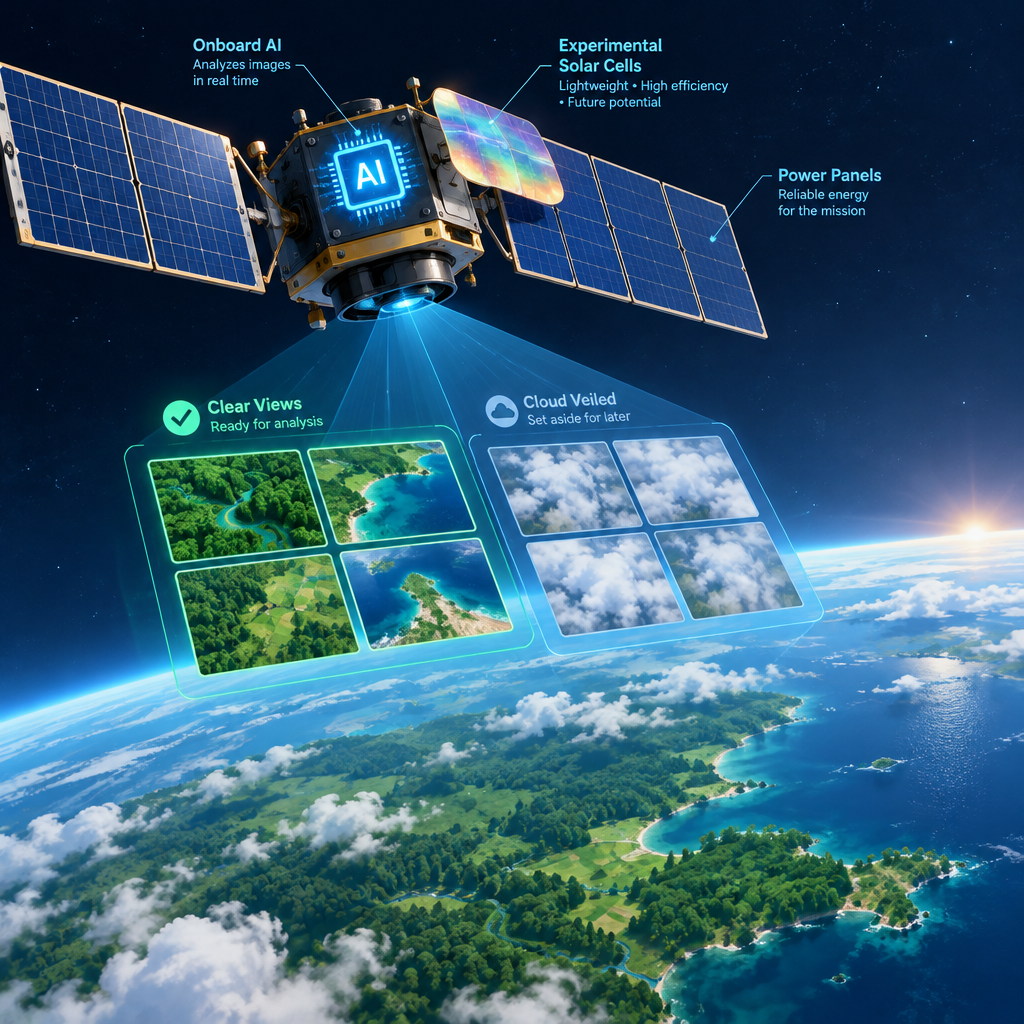
A shoebox-sized satellite carrying artificial intelligence is now in orbit, ready to test whether it can help researchers spot the images that matter most when monitoring Earth.
CRIMSON-1, developed by Nanyang Technological University and built by Singapore-based Satoro Space, weighs just 5kg. Its onboard AI is designed to examine satellite imagery and set aside pictures obscured by clouds or otherwise less useful. That could help researchers on the ground focus on relevant data for potential applications such as detecting forest fires and oil spills.
The satellite travelled as one of 130 space vehicles aboard a SpaceX Falcon 9. The rocket lifted off from Vandenberg Space Force Base in California on October 1 local time, and CRIMSON-1 was deployed about 55 minutes later at an altitude of roughly 520km. It is a Singapore-developed satellite launched from the United States—not a rocket launch from Singapore.
Over its planned year-long mission, CRIMSON-1 will put its computing system through demanding workloads to test how it manages heat and power. The mission will also assess thin, lightweight perovskite solar cells developed by NTU researchers and NUS spin-off Singfilm Solar. These experimental cells will be evaluated in space for their durability and electricity output; the satellite itself is powered by gallium-arsenide panels.
CRIMSON-1 is NTU’s 14th research satellite and one of the first projects supported by the National Space Agency of Singapore’s Space Technology Development Programme. For now, the mission is a test of what onboard AI and new solar technology can do in orbit. Its planned experiments are just beginning, and their eventual results remain to be seen.
Leave a Reply