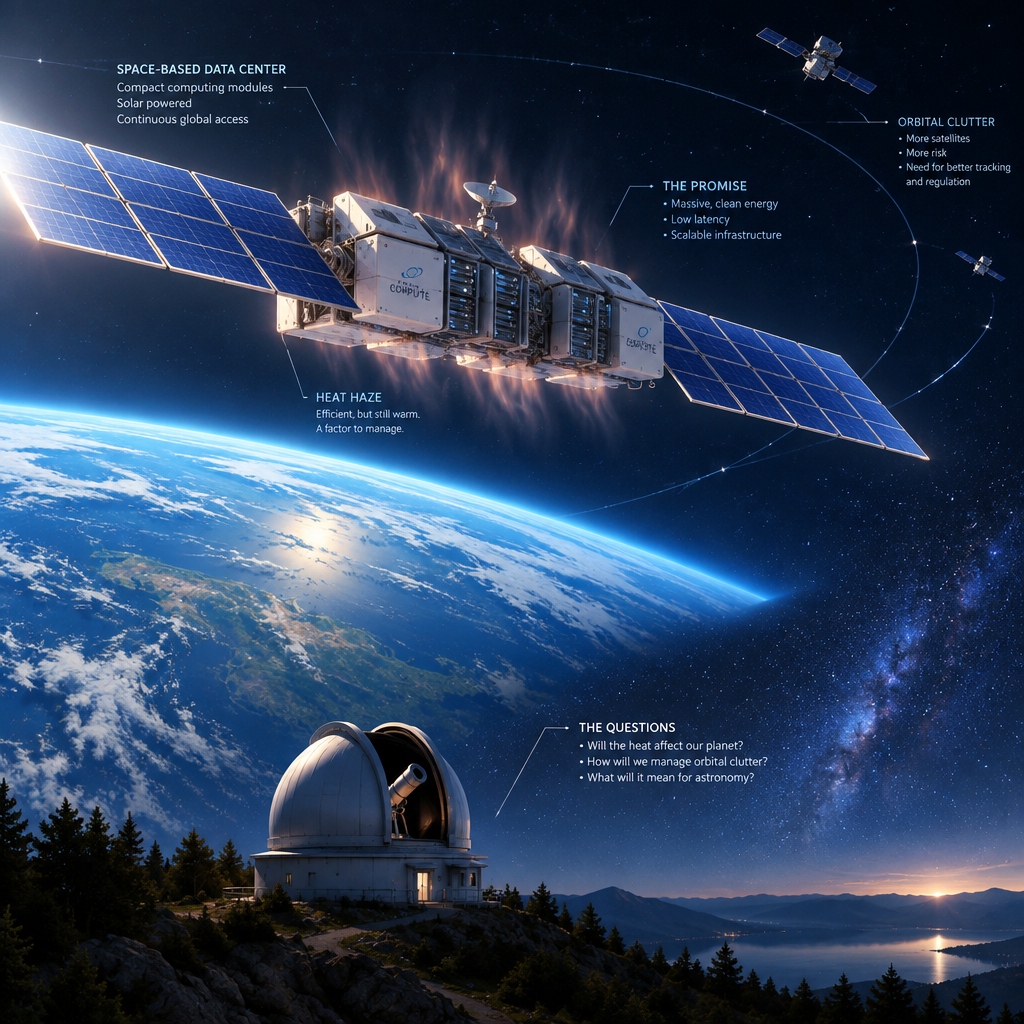
The Federal Communications Commission has authorized SpaceX to deploy up to one million satellites for a proposed orbital data-center network called Starmind. The idea is to process data in space and serve it on Earth, supporting Elon Musk’s ambition to power AI computing with solar energy.
The authorization sets a first milestone, not a guarantee of a vast constellation: SpaceX must deploy at least one authorized satellite by 2033, with further deployment permitted through 2040. The article does not establish that the satellites have been built, that the full network will be deployed, or that the plan will prove technically or economically viable.
Supporters see a potential advantage in moving some computing away from Earth. Orbital data centers, they argue, could ease pressure on power grids and reduce reliance on large, water-cooled facilities. But scientists and industry groups question whether the concept can work at the proposed scale. Their concerns include managing heat in space, the financial and technical challenge, pollution from launches and re-entries, collision risks, and possible impacts on astronomy.
The American Astronomical Society warned that numerous larger, brighter satellites could interfere with astronomical observations and make the night sky harder to enjoy. The FCC said the proposal complied with its orbital-debris rules, while dismissing environmental issues it considered outside its authority.
For now, Starmind remains an ambitious proposal with regulatory approval and a long list of unresolved questions. The authorization opens the door to a possible new kind of computing infrastructure—but it does not answer whether that infrastructure can be built, or what its effects might be.
Leave a Reply