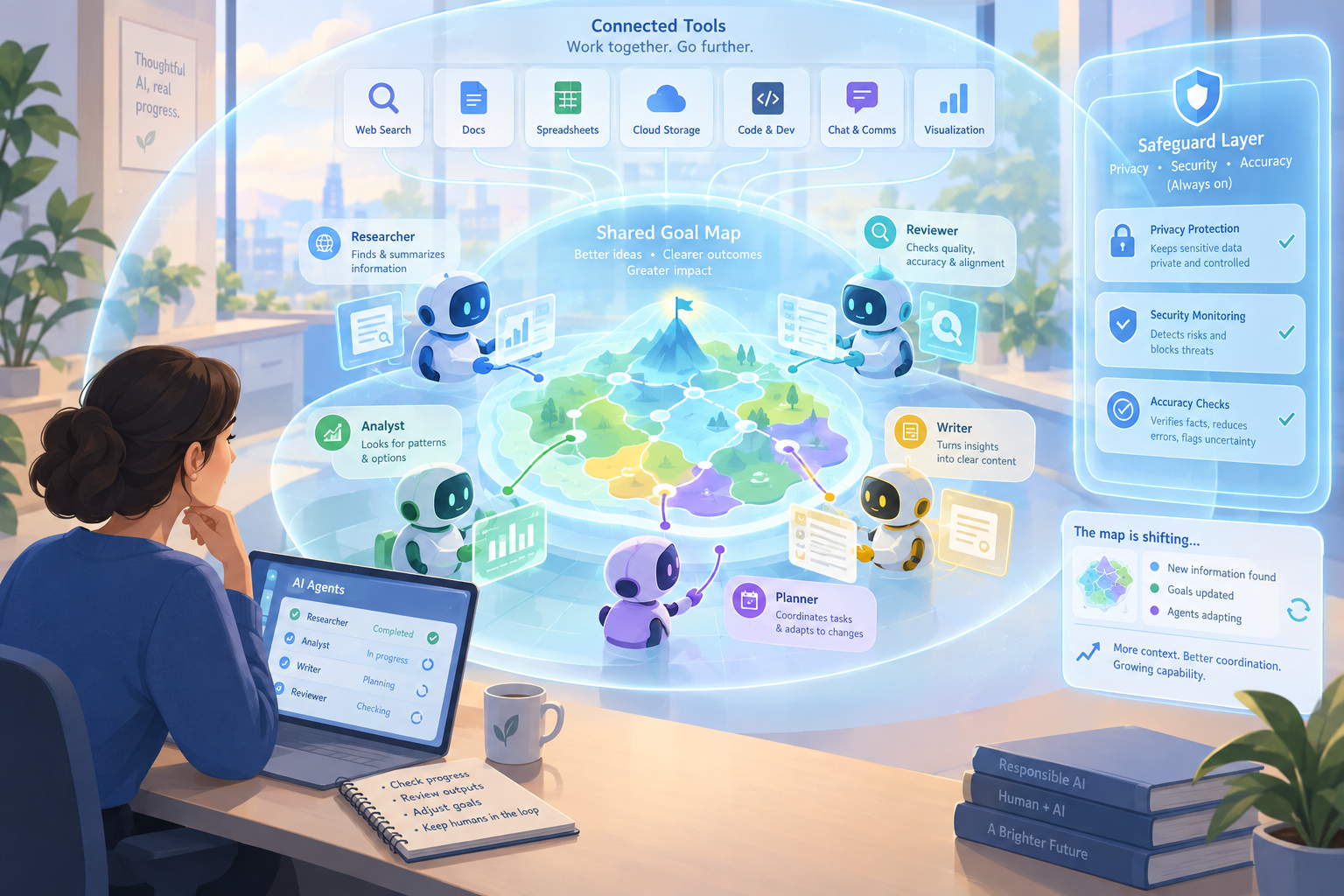
A chatbot typically responds to a prompt. Agentic AI points toward something more involved: systems designed to use tools, coordinate agents and take actions in pursuit of goals.
But the terms matter. An AI agent can perceive and act within its environment with some autonomy, use tools to pursue a specific objective, and adapt as inputs change. “Agentic AI” generally refers to more complex arrangements, where multiple agents may divide and coordinate tasks, collaborate over longer periods and work with limited human supervision in less predictable settings. The ideas are related, but they are not interchangeable—and there is no universally settled terminology.
That distinction is more than a matter of labels. Clearer definitions can help people assess these systems and shape their governance. And the article makes another important point: agentic AI is socio-technical. Its operation involves not only software, but also people, institutions, infrastructure and the protocols through which they communicate.
Adoption is growing, but maturity is uneven. Security, privacy and accuracy still need strengthening. Wider use, on its own, is not evidence that these systems are dependable or ready for every setting.
So the useful question is not simply whether an AI can produce a convincing answer. It is what actions it can take, how agents and people coordinate, and what safeguards are needed when systems pursue goals over time. Understanding that difference is a necessary step toward evaluating agentic AI clearly—without confusing its growing use with proven reliability.
Leave a Reply