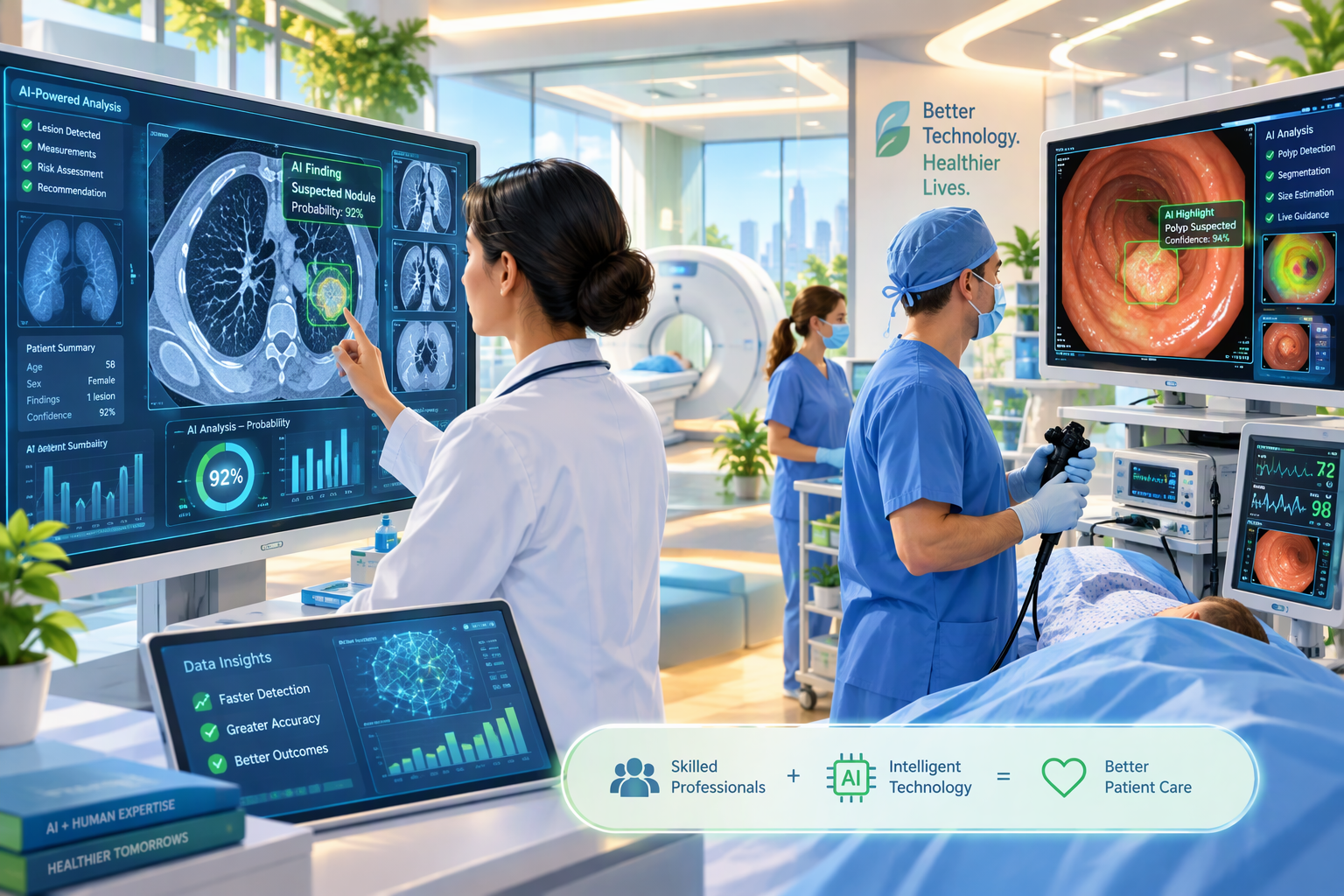
Artificial intelligence is appearing in several parts of Singapore’s healthcare landscape, from examining live endoscopy video to flagging possible brain bleeds on CT scans and supporting research into disease. Three initiatives highlighted in a recent Healthcare IT News brief show how these tools are being used to assist clinical work and investigate how illnesses develop.
Real-time support during endoscopy
Woodlands Hospital has introduced computer-aided detection AI in all endoscopy suites at its Digestive Health Centre. The system analyses live video from colonoscopies and gastroscopies, looking for gastrointestinal lesions as the procedure is taking place.
When it detects potential polyps, the software highlights them with visual boxes and audible alerts. It is designed to help endoscopists notice subtle, flat and small polyps that may be difficult to spot. The alerts provide an additional cue for the clinician during the examination; they do not replace the endoscopist’s role.
A faster flag for urgent CT review
At Singapore General Hospital, iScreen analyses head CT scans and flags suspected brain bleeds for urgent review. Its results take about six minutes, giving clinicians a prompt to examine a scan that may need attention.
The AI’s findings are checked by radiologists before final reports are issued. That verification step keeps specialist review central to the reporting process. iScreen is also the first head CT model launched on Singapore’s national AimSG medical imaging platform.
Together, these examples show different ways AI can assist with medical images: one tool highlights possible findings in moving endoscopy video, while another draws attention to suspected abnormalities in head CT scans. In both cases, the tools support healthcare professionals rather than making the final clinical judgment.
Using spatial data to study disease
AI is also part of research at the SingHealth Duke-NUS Academic Medical Centre, which has launched SPADE. The platform brings together spatial profiling, data science and AI to study how disease develops and how it responds to treatment.
SPADE aims to identify diagnostic targets and support the development of future precision therapies. It is also intended to build a spatial tissue atlas. That atlas could be used to train AI models and simulate disease behaviour, creating a research resource for examining patterns in tissue and how they relate to illness.
These deployments have distinct purposes: supporting detection during procedures, prioritising scans for review and enabling research. Their common thread is the use of AI to help people work with complex medical information, while clinical decisions and research goals remain in human hands.
Source: Latest hospital AI deployments in Singapore and more briefs, Healthcare IT News, September 29, 2026
Leave a Reply