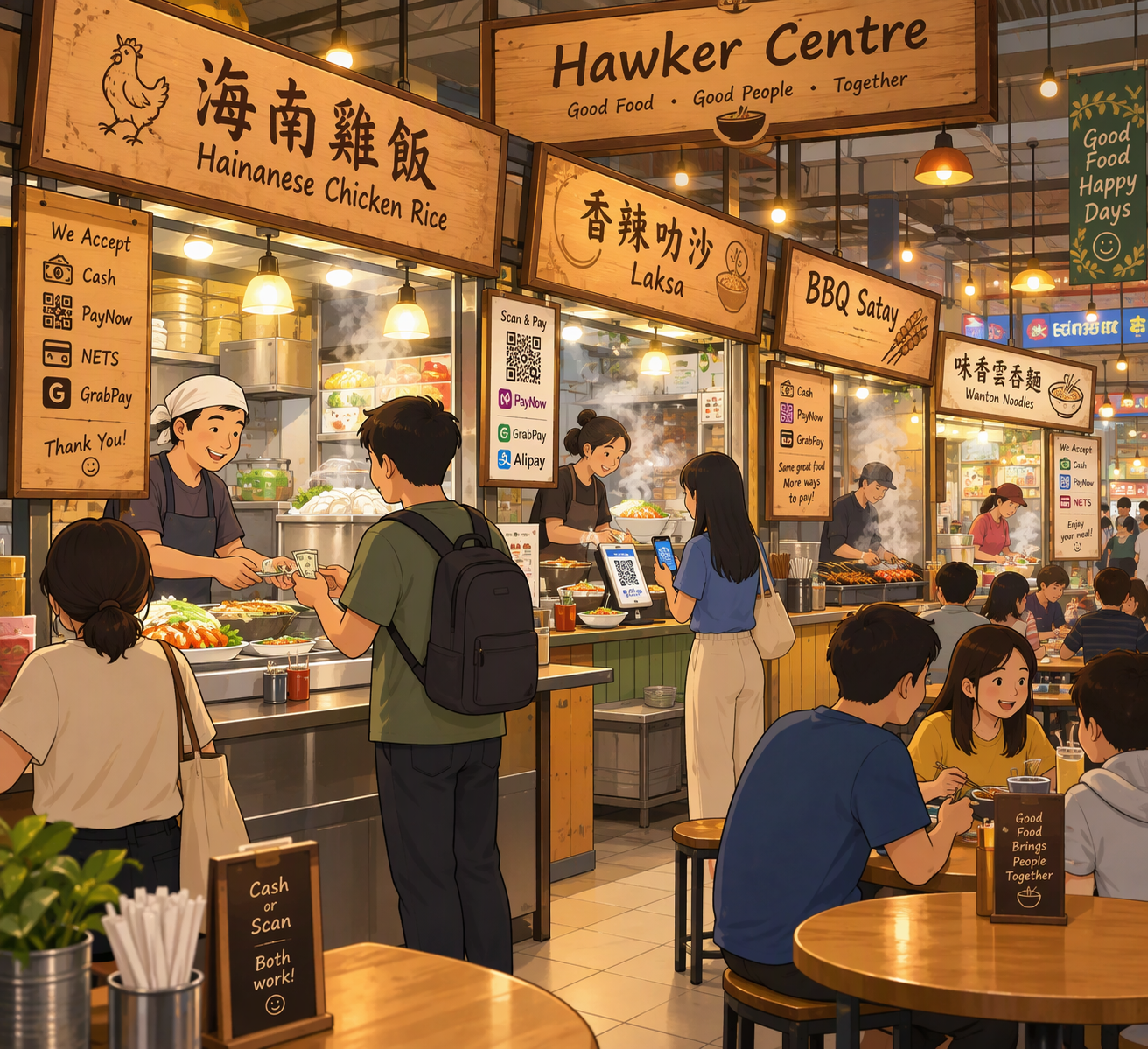
At West Coast Food Centre, QR codes were easy to spot. But at noodle stall owner Angie Sim’s counter, another message stood out: “Cash Only.” Her choice offers a glimpse of a quieter side of Singapore’s move towards digital payments—one where convenience can mean different things to different people.
Sim, 65, told The Straits Times that cash was easier and more convenient for her. Many of her customers were older, she said, and less comfortable with technology. They were also used to carrying cash. Sim had worked at the centre with her stall partner for more than 20 years, so her preference reflected both her own routine and the habits of people who came to her stall.
She was not alone. The newspaper spoke to stallholders across eight hawker centres who continued to resist digital payments. Their reasons were practical: some had limited digital literacy or poor eyesight; others worried that customers would be kept waiting while they tried to use a payment device.
At ABC Brickworks Market & Food Centre, a drinks-stall owner in his 70s said he found digital platforms difficult to remember and payments hard to verify, especially when business was busy. Sometimes, he served customers who had no cash and let them pay later. At Albert Centre Market and Food Centre, drinks-stall owner Mr Tan said checking whether an electronic payment had gone through was troublesome.
These experiences sit alongside a much wider push to make digital payments available. More than 11,500 hawkers had adopted SGQR, a standardised QR code launched in 2018 to simplify payments from multiple mobile e-wallets. In 2020, the Hawkers Go Digital programme began helping stallholders take up digital payments. Under the arrangement described in the article, hawkers did not pay a 0.5 per cent transaction fee on the first $20,000 of monthly transactions. On October 10, 2024, Enterprise Singapore and the Infocomm Media Development Authority announced that this fee waiver would be extended to the end of 2025.
The programme aimed to bring digital payments to roughly 18,000 stallholders in government-run food centres. Yet the accounts in the article show why a change in payment habits may take time. A QR code can offer another way to pay, but stallholders still have to manage the transaction, confirm it has succeeded and serve customers without slowing things down. For some hawkers and their customers, cash remains familiar and straightforward.
Singapore’s hawker centres are therefore not captured by a simple story of cash disappearing. Digital payments have spread, but the transition is gradual—and the reasons some people stick with cash include comfort, accessibility and the practical demands of a busy stall.
Source: Why cash is still king for some hawkers in Singapore despite digitalisation push, The Straits Times
Leave a Reply