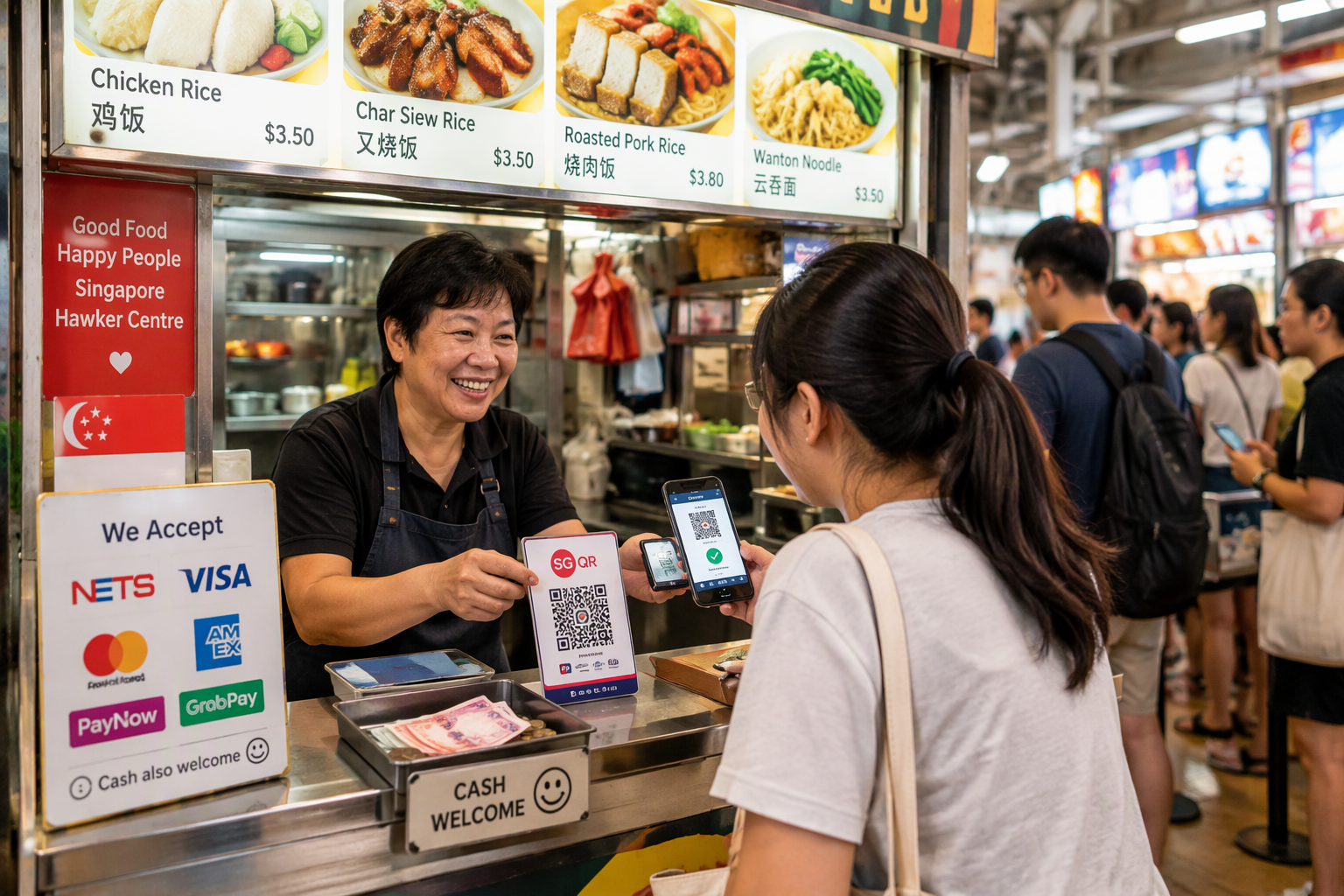
A lunch queue is moving, orders are being called out and customers are ready to pay. In that rush, even a small delay at the payment screen can matter. That is one reason some Singapore hawkers still prefer cash, even as electronic payments become more common.
A CNA article published on 13 March 2023 and updated on 11 April 2023 describes a hawker trade adapting to digital payments without leaving cash behind. A parliamentary statement on 2 March 2023 said that more than 70 per cent of cooked-food stallholders in hawker centres accepted e-payments. Support to help hawkers adopt technology was available at 37 centres. These figures show growing acceptance, but they do not mean that the stalls had stopped taking cash.
The government’s Hawkers Go Digital programme began in 2020. It included cash bonuses for hawkers who reached a required number of digital transactions. The programme was part of a wider effort to encourage digital payments, but the article also looks at what can make those systems difficult to manage during everyday business.
Anthony Low, a 55-year-old owner of three ngoh hiang and prawn-cracker stalls, stopped accepting digital payments after two months of discrepancies. The amounts his assistants recorded did not match the amounts appearing in his bank account. For a stallholder trying to keep track of sales, a mismatch like that can create uncertainty about whether each payment has gone through correctly.
At a beverage stall in China Square Food Centre, a worker described another practical snag: some customers would not show a transaction page as proof of payment. During busy periods, the worker said, collecting cash could be more efficient than waiting to verify an electronic transaction. The concern was not simply whether digital payments were available, but whether they fitted the pace and routines of a crowded stall.
The article points to other reasons some hawkers remain cash-only. Some need immediate cash, while others have limited understanding of payment technology. It also reports concerns about scams, attributed to Makansutra founder KF Seetoh. The article does not say how widespread discrepancies, delayed confirmations or scam worries are across hawker stalls; it presents them as concerns and experiences, not as problems affecting every stall.
There are signs of the shift in the other direction, too. Amoy Street Food Centre was promoting cashless transactions with signs describing it as a cashless food centre. But that example sits alongside the cash-only businesses in the article, rather than proving that all hawker centres or stalls have gone cashless.
The picture is a gradual change, not a clean switch from notes and coins to screens. More hawkers were accepting e-payments in the figures reported in March 2023, while some still found cash better suited to their needs. At the hawker centre, the way people pay is changing—but cash still has a place.
Source: Payment discrepancies, delayed transactions: Hawkers explain why they insist on cash payments, CNA
Leave a Reply