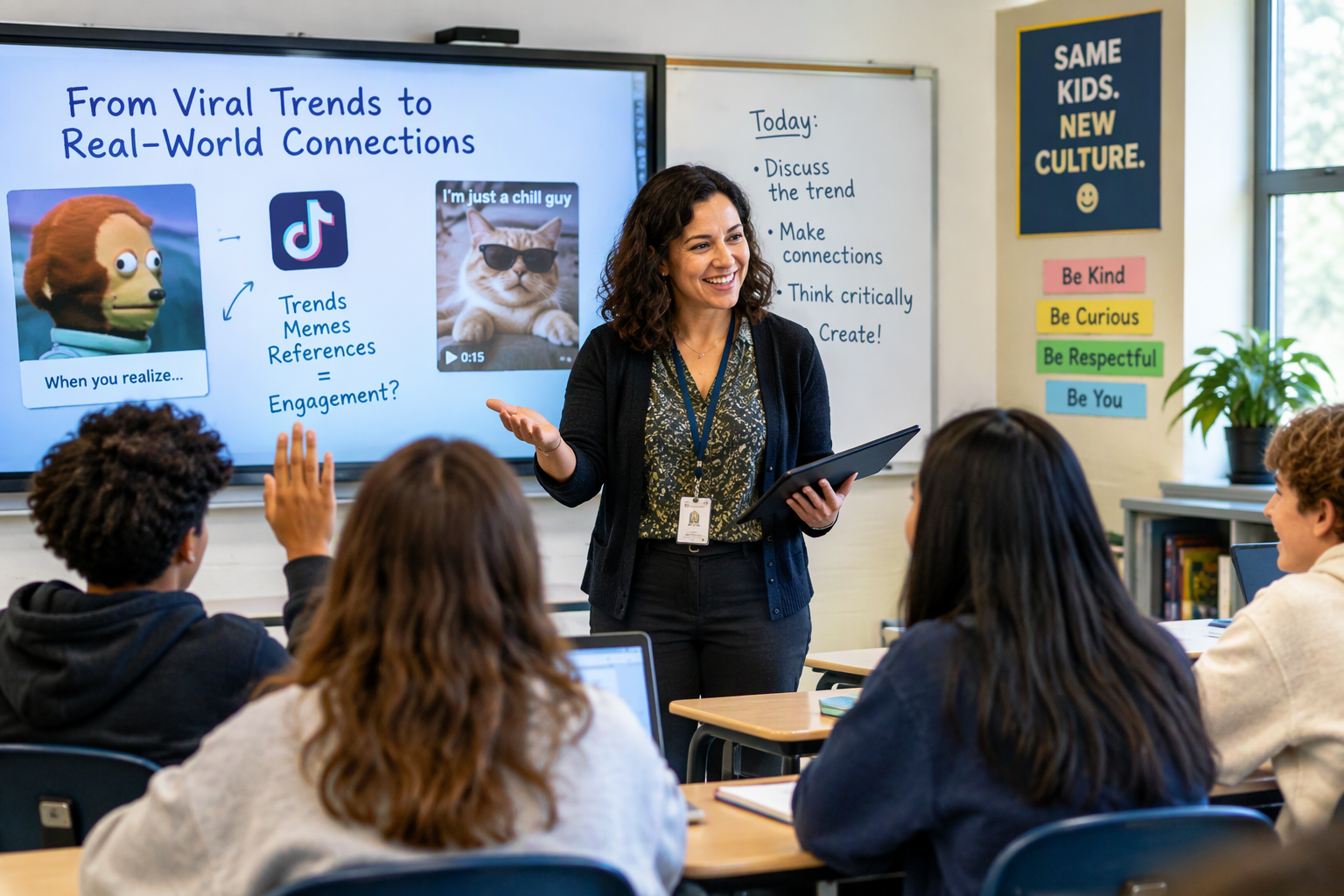
A pair of numbers on a sheet of music can be easy to overlook. But at Booker T. Washington Middle School in Baltimore, the markings “6-7” became a repeated joke—and a challenge for choir teacher Christina Franciosa.
For several weeks, Franciosa avoided teaching the page that contained them. Students had turned the number pairing into an exaggerated punchline, and the joke sometimes interrupted classwork. On one occasion, a student kept saying “6-7,” contributing to classmates receiving zeros on an exit ticket. Franciosa also tried turning the moment into a teaching opportunity, using TikTok language to explain rhythmic differences between notes.
The episode is one example of how online references can travel from phones into lessons. Franciosa described a steady stream of TikTok-linked dances, audio clips and memes entering classroom life. Another phrase students used was “good boy,” which the article connects to a TikTok trend in which a police officer is asked for his name and badge number.
Some of the references can be hard for adults to make sense of. The article also describes Tung Tung Tung Sahur, an AI-generated brainrot character with absurd, cartoonish features and a repeated catchphrase. Franciosa said one student compared another student to the character. The trend took off in early 2025, and its catchphrases are easy to imitate—making them simple to repeat in a classroom, too.
Not every concern is about disruption. Franciosa said students encounter explicit song lyrics online, and she finds it difficult to know whether they understand the sexual implications. That uncertainty raises a different question for teachers: when a phrase or audio clip spreads, do students understand what it means, or are they simply repeating what they have heard?
At Roland Park Elementary/Middle School, third-grade teacher Trinity Riggle said she hears “6-7” and similar references every day—at least 20 times a day by her estimate. Her account, alongside Franciosa’s, shows how often a trend can pop up during ordinary school routines, even when its meaning or origin is unclear.
The article does not establish a definitive meaning or original source for “6-7,” or show how widespread the trend is beyond the teachers’ experiences. Instead, it offers a close-up of educators dealing with online humor as it appears in their classrooms: sometimes as a distraction, sometimes as material to adapt into a lesson, and sometimes as a prompt to think about what students are seeing and hearing online.
Source: In Baltimore classrooms, educators navigate viral “6-7” jokes and TikTok brainrot trends, Baltimore Fishbowl
Leave a Reply