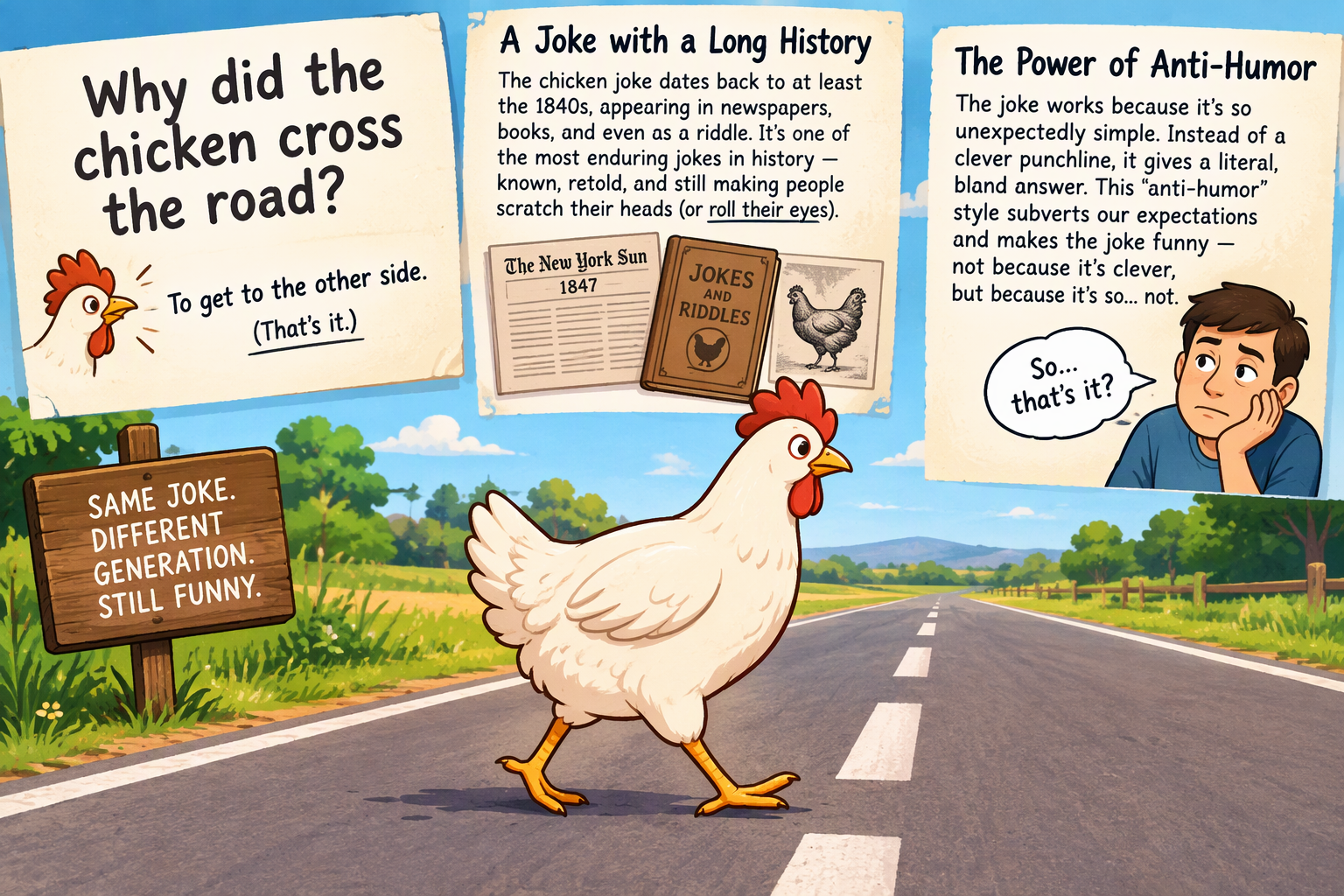
A chicken approaches a road. A question follows: “Why did the chicken cross the road?” It sounds like the beginning of a puzzle. We expect a clever explanation, perhaps one that makes us rethink the question. Instead, the familiar answer is wonderfully plain: “To get to the other side.”
That anticlimax is the joke. The setup invites us to look for a surprising solution, but the punchline offers only a literal reason. The article describes this style as anti-humor: the laugh comes from withholding the elaborate twist that listeners may be expecting. The answer is not a hidden riddle waiting to be cracked. It is exactly what it says.
The joke has been around in print for a long time. According to Mental Floss, the earliest known printed version appeared in an 1847 issue of the New York periodical The Knickerbocker. Its wording was slightly different: “Why does a chicken cross the street?” The response was, “Because it wants to get on the other side!” The magazine treated it as a quip that sounded like a conundrum but was not one.
That distinction helps explain why such a simple joke can be memorable. A conundrum promises a puzzle and usually rewards us with an answer that connects the clues in an unexpected way. This chicken joke makes a similar promise, then declines to play along. The punchline is almost stubbornly ordinary. Its comic effect depends on the gap between the sort of answer we anticipate and the one we receive.
The first printed version does not necessarily mark the joke’s true beginning. The article suggests it may have circulated orally before appearing in The Knickerbocker. It also mentions a suggestion that Christy’s Minstrels, a 19th-century blackface troupe, performed the joke as early as the 1840s. But the troupe’s role in originating it cannot be confirmed. The article does not identify the joke’s inventor, so its authorship remains unknown based on the evidence described there.
That uncertainty is part of the joke’s history, but it should not be filled in with guesses. We can point to an early printed example and describe a possible earlier performance without claiming either tells us who came up with the line. And, of course, the punchline tells us only the joke’s answer—not why any particular real chicken might cross a road.
A line this short has lasted because it turns a grand-sounding question into the smallest possible explanation. Ask for a mystery, and you get a plain destination. The chicken crosses to the other side—and the joke crosses from expectation to anticlimax.
Source: Why Did the Chicken Cross the Road? The History Behind the World’s Most Famous Joke, Mental Floss
Leave a Reply