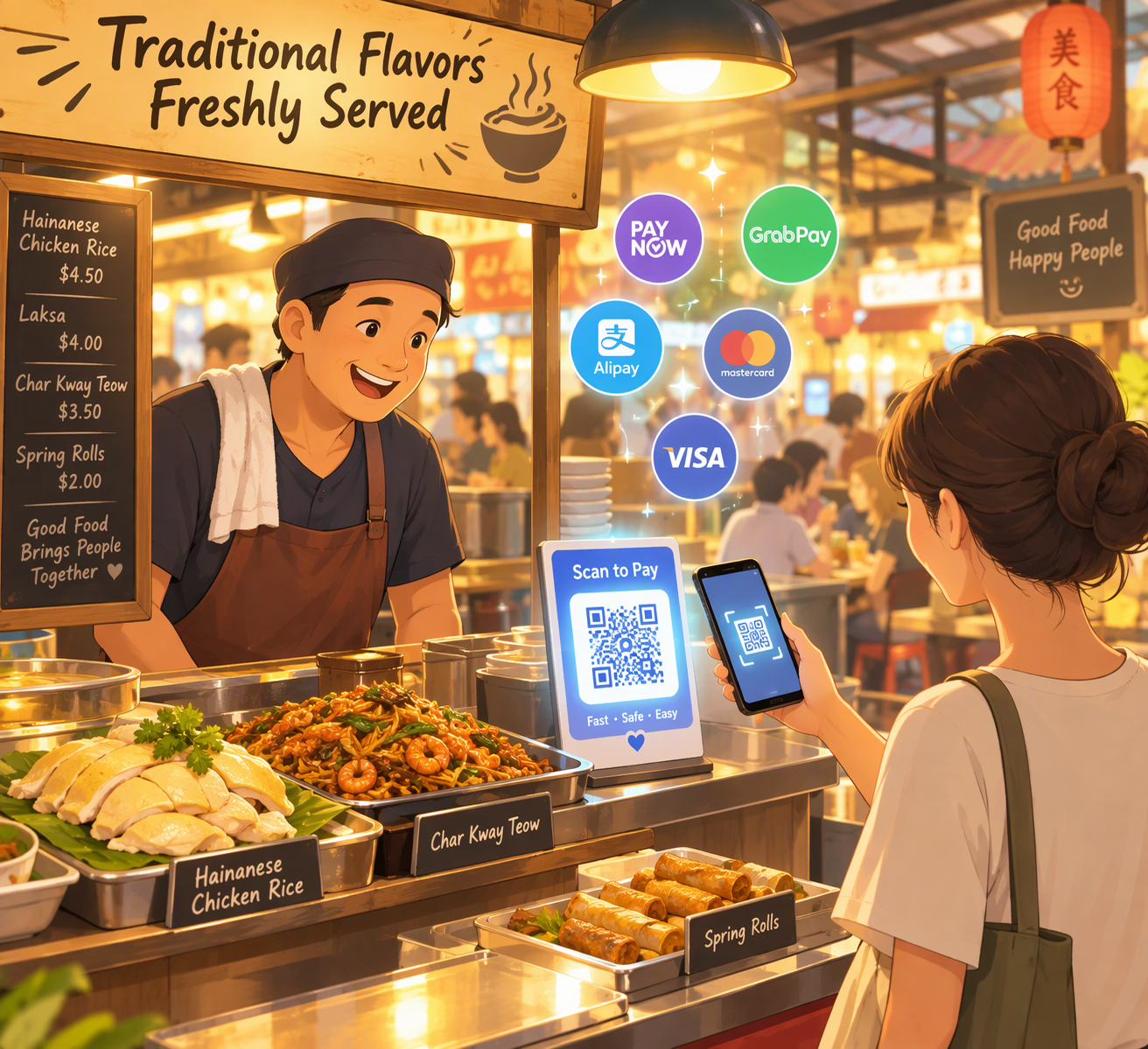
At a hawker stall, a meal can be paid for with cash—or, increasingly, with a quick scan of a QR code. Singapore’s Hawkers Go Digital programme has been encouraging stallholders to add electronic payments, including payments through the Singapore Quick Response Code (SGQR) platform. The change is gathering pace, but the story is not that hawker centres have gone cashless. It is a gradual shift, supported by a temporary subsidy.
Introduced in 2018 by Enterprise Singapore and the Infocomm Media Development Authority (IMDA), the programme aimed to get about 18,000 stallholders in government-run food centres to adopt digital payments. By October 2024, more than 11,500 hawkers had done so.
For stallholders, accepting digital payments can also mean paying transaction fees. To help make the transition easier, the Government extended the programme’s subsidy until the end of 2025. At the time of the report, the subsidy covered the 0.5 per cent transaction fee on the first $20,000 of digital transactions made by each stall every month.
The extension was intended to encourage hawkers to continue adopting digital payments and to help them adjust to paying transaction fees without a subsidy. That support mattered in a period when hawkers were also facing rising operating costs, the agencies said.
The figures in the article offer a snapshot of how use of the system has grown. In August 2023, transactions through the programme totalled $45 million in value, across 5.4 million transactions. A year later, in August 2024, monthly transaction value had reached $60 million, while transaction volume had risen to 7.6 million.
Those increases sit alongside the growing number of participating hawkers. They show that electronic payments through the programme were being used more often, while the subsidy gave stallholders a window to adapt to fees. The figures do not tell us what share of all hawker stalls had adopted e-payments, or whether participating stalls stopped accepting cash; the report does not say either.
The extension had a clear end point: the end of 2025. The article describes support through that date, but does not establish what subsidy arrangements would follow. For hawkers and customers alike, the programme’s story is therefore one of a continuing transition: more stalls taking digital payments, growing use of the system, and a temporary measure intended to make the adjustment easier.
Source: Subsidy for hawkers to adopt digital payments extended to end-2025, The Straits Times
Leave a Reply