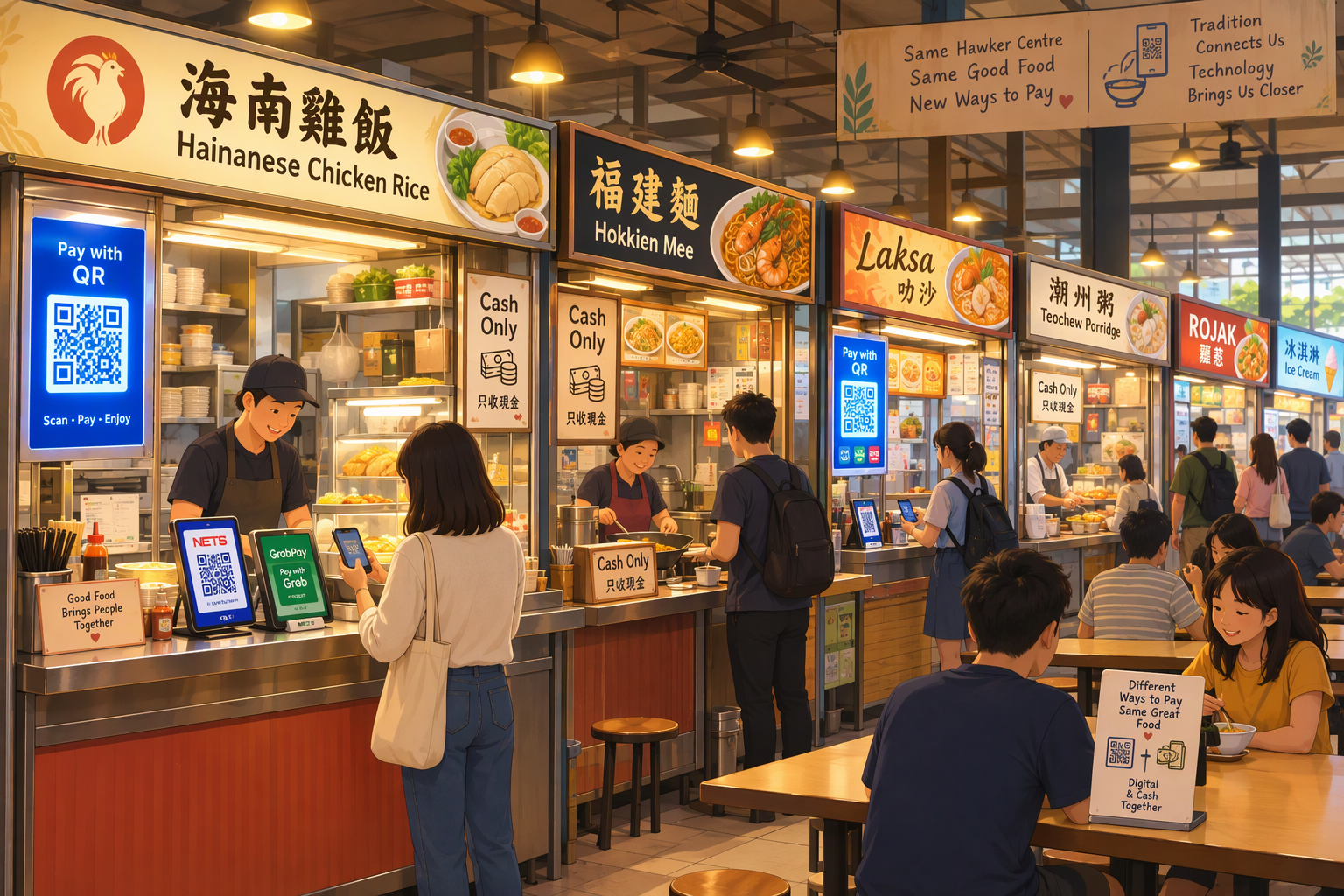
Walk through a Singapore hawker centre and you might see two payment worlds side by side: a QR code at one stall, a “Cash Only” sign at the next. A 2024 Straits Times report captured that uneven change, showing that the move towards digital payments was still a work in progress—not a switch that every hawker had made.
At West Coast Food Centre, noodle-stall owner Angie Sim, then 65, preferred cash. She said it suited both her and many of her customers, some of whom were older and less comfortable with technology. Sim had worked at the centre with her stall partner for more than 20 years. For her, keeping payments familiar made sense.
The newspaper spoke with stallholders across eight hawker centres who had not adopted digital payments. Their reasons varied. Some had limited digital skills or poor eyesight. Others worried that customers might find payment devices difficult to use, or that they would have to spend time checking whether each transaction had gone through.
At ABC Brickworks Market & Food Centre, a drinks-stall owner in his 70s said it was difficult to remember how to use digital platforms and verify payments during busy periods. If a customer did not have cash, he sometimes served them and let them pay later. At Albert Centre Market and Food Centre, drinks-stall owner Mr Tan, who was in his 60s, also found checking each e-payment troublesome.
There was a national push to make digital payments easier for hawkers. By the time of the article, more than 11,500 hawkers had adopted SGQR, a standardised QR code introduced in 2018. It was designed to let stalls accept payments from multiple mobile e-wallets using one code.
The Hawkers Go Digital programme, launched in 2020, offered a waiver of the 0.5 per cent transaction fee on the first $20,000 of a hawker’s monthly SGQR transactions. On October 10, 2024, Enterprise Singapore and the Infocomm Media Development Authority announced that the waiver would be extended to the end of 2025. The stated aim was to bring the 18,000 stallholders in government-run food centres on board with digital payments.
For some hawkers, going digital brought practical benefits. The article says some found cashless payments convenient and appreciated handling less cash. Some also reported increased sales, particularly from younger customers. Yet those advantages did not mean every stall had switched—or that cash had disappeared.
The story is less about one payment method winning than about a change happening at different speeds. A QR code can offer convenience, while cash may feel simpler for a stallholder or customer. In Singapore’s hawker centres, the two were still sharing the counter, and the transition remained ongoing.
Source: Why cash is still king for some hawkers in Singapore despite digitalisation push, The Straits Times
Leave a Reply