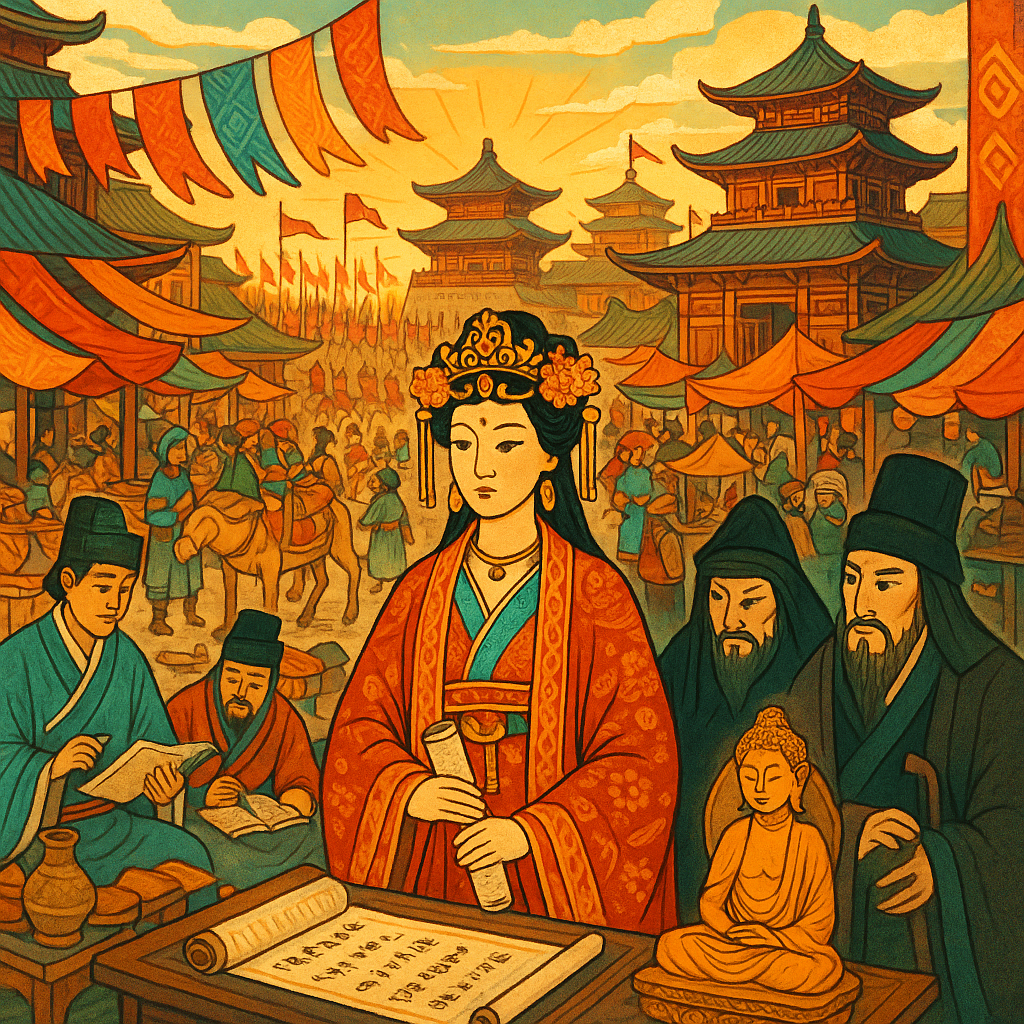
The Tang dynasty, ruling from 618 to 907 CE, is often celebrated as a golden age in Chinese history, characterized by political stability, economic prosperity, and a remarkable flourishing of culture. Emerging from the chaos left by the fallen Sui dynasty, the Tang established a strong centralized government that expanded China’s territory and influence. Under the leadership of Emperor Taizong, military triumphs such as the defeat of the Eastern Turks helped solidify the dynasty’s power. Taizong also promoted Confucian state schools, opening paths for talented scholars through the civil service system, which helped shape the governance of China.
One of the dynasty’s most extraordinary figures was Empress Wu Zetian, China’s only female emperor. Rising to power during her husband Gaozong’s reign, she eventually declared herself emperor and founded the Zhou dynasty. Wu Zetian’s reign was marked by significant reforms, strong patronage of Buddhism, and the creation of a secret police force to maintain strict control over her realm.
The Tang capital, Chang’an (modern Xi’an), was a vibrant and cosmopolitan center, drawing merchants, scholars, and artists from throughout Asia. This cultural exchange was fueled by the Silk Road, which not only facilitated trade but also the spread of ideas and art. The era saw a cultural renaissance with advances in literature, art, and technology. This period produced some of China’s most famous poets, such as Li Bai and Du Fu, whose poetry has left a lasting legacy in world literature.
Despite its achievements, the Tang dynasty was not without challenges. The devastating An Lushan Rebellion in the mid-8th century severely weakened the dynasty’s central authority. Though there were efforts to restore stability, the dynasty gradually declined, leading to its collapse in 907 CE.
The Tang dynasty’s story is one of extraordinary achievement and cultural richness, leaving a profound impact on China’s historical and cultural trajectory. Its legacy as a golden age endures, remembered for its contributions to governance, cultural arts, and the shaping of Chinese civilization.
Leave a Reply