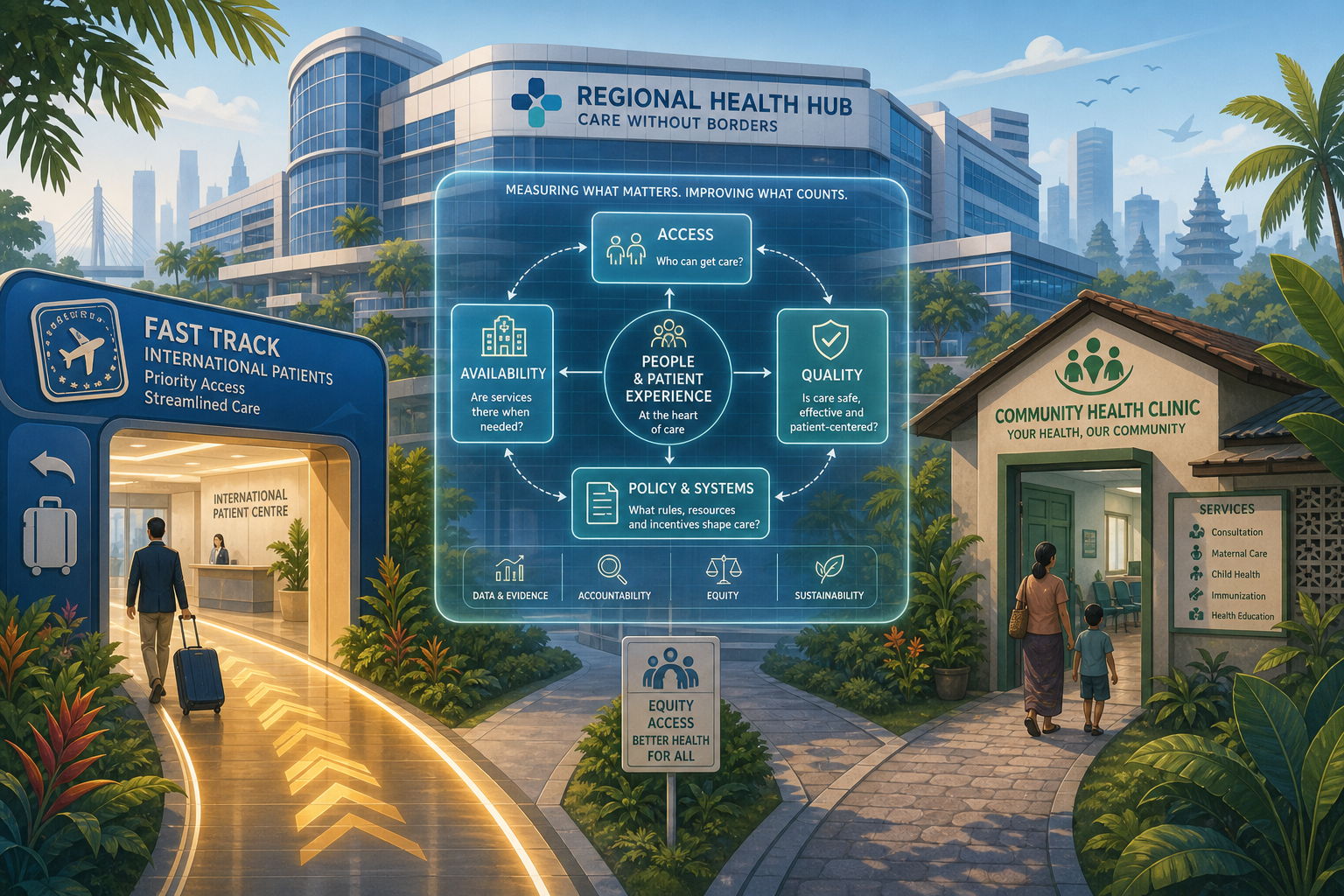
Medical tourism is no longer a niche side story in global healthcare. The article “Medical tourism and policy implications for health systems: a conceptual framework from a comparative study of Thailand, Singapore and Malaysia” frames it as a growing phenomenon—one being actively promoted by private actors and governments in Southeast Asia—while emphasizing that its effects on destination-country health systems are not yet clearly understood.
At the center of the article is a basic tension: as Thailand, Singapore, and Malaysia position themselves as regional hubs for medical tourism, what does that growth mean for the people who already rely on those countries’ health systems? The authors highlight that the potential impact on health systems—especially questions of equity in access and availability for local consumers—remains unclear. In other words, the industry’s expansion may bring benefits, but it may also reshape who gets care, when they get it, and under what conditions.
Rather than offering a simple verdict for or against medical tourism, the article’s contribution is structural. It presents a conceptual framework outlining the policy implications of medical tourism’s growth for health systems, drawing from an extensive review of both academic and grey literature on the three country cases. This approach matters because medical tourism can be discussed in broad, abstract terms, but the article underscores the need for grounded ways to examine its consequences.
A key feature of the framework is its focus on what should be measured and scrutinized. The article identifies variables for further analysis of medical tourism’s potential impact on health systems—signaling that policymakers and researchers need clearer tools and shared reference points to evaluate trade-offs. Those variables are intended to support empirical, in-country studies that can weigh both benefits and disadvantages, rather than relying on assumptions.
Ultimately, the article positions its framework as a practical starting point: a basis for real-world studies in Thailand, Singapore, Malaysia, and beyond. While the cases are Southeast Asian, the authors stress that the policy implications described are particularly relevant for policymakers and industry practitioners in other settings as well—especially where governments and private providers are actively promoting medical tourism without full clarity on how it may affect domestic health system equity and access.
Leave a Reply