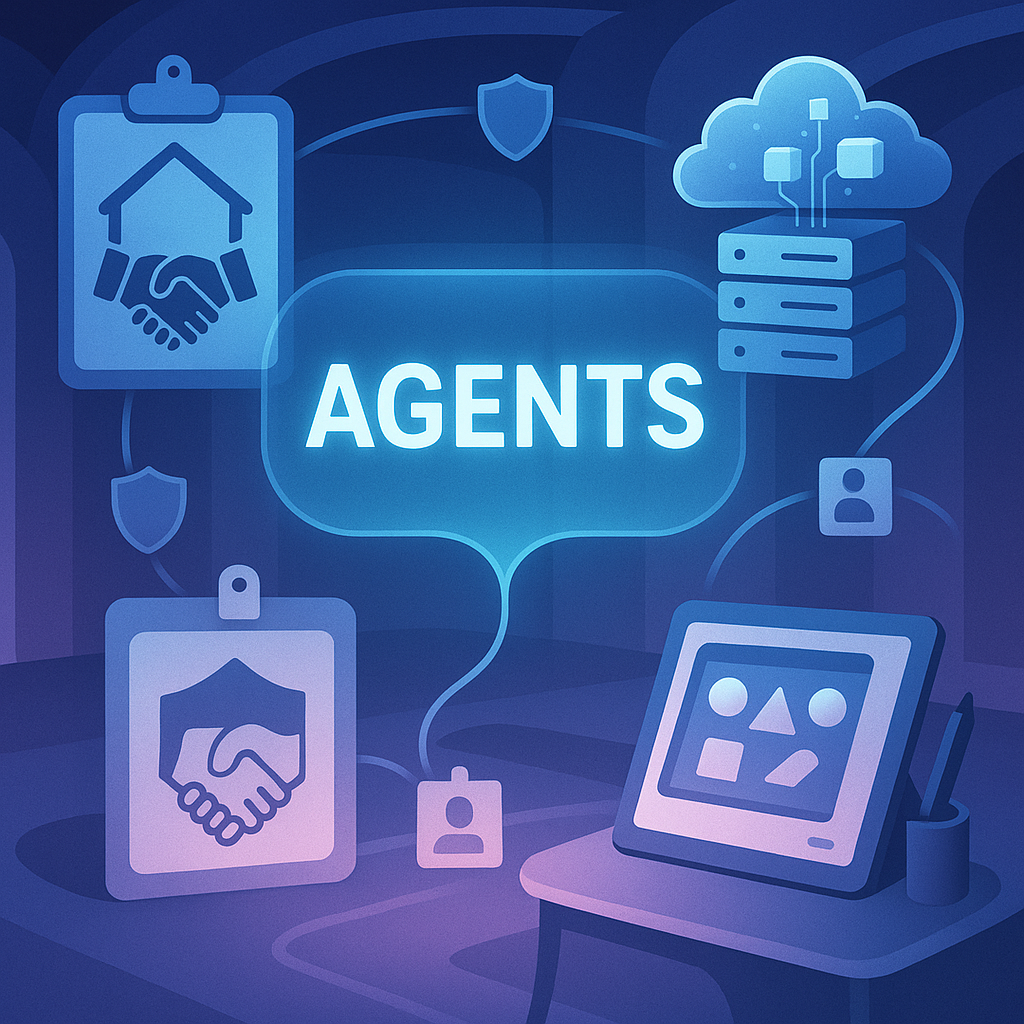
If there’s a single word that keeps popping up across headlines this year, it’s “agents.” But in 2026, that word is doing a lot of work—describing everyone from real estate professionals being recruited more aggressively, to software workloads running inside Kubernetes, to new “agentic AI” systems framed as colleagues that act on our behalf.
Here’s what the recent mix of articles suggests: “agents” aren’t one trend. They’re a sign of multiple industries reorganizing around talent, automation, and new ways of getting work done.
## Real estate: recruiting heats up again
A Florida Realtors report notes that agent recruiting activity accelerated in the first quarter of 2026, with brokerages competing more aggressively for talent after a slower 2025. The shift signals a more competitive stance among brokerages—one where attracting agents is once again a front-burner priority.
Alongside the recruiting storyline, the 2026 Agent Rise Summit (April 12–14 in Fort Myers, Florida) is positioned as three focused days for real estate agents to learn a “proven roadmap” aimed at getting “off the real estate roller coaster” and building a more stable business.
## Higher education: the “agentic AI university” emerges
In a UPCEA piece, agentic AI is described as no longer merely an interactive tool people talk to, but a colleague that can act for them. The article frames this as part of a highly active and competitive environment for AI’s expansion—suggesting that universities and continuing education leaders are now grappling with what it means when AI moves from answering prompts to carrying out tasks.
## Business and identity: “identic AI” enters the conversation
A Harvard Business Review podcast episode features a discussion with tech expert Don Tapscott about the potential—and pitfalls—of “identic AI,” positioned in the context of the rise of agents. The focus on both promise and risk underscores that as agent-like systems become more capable, questions of identity, trust, and governance become harder to ignore.
## Enterprise forecasting: agentic AI at scale
An IDC FutureScape 2026 item highlights a forecast that by 2030, 45% of organizations will orchestrate AI agents at scale, embedding them across business functions. Whether or not that timeline holds, the direction is clear: the “agent” concept is moving from experimentation toward broad operational planning.
## Infrastructure: AI agents as first-class workloads
A Tigera outlook argues that by 2026 Kubernetes environments will increasingly host agent-based workloads, with “AI agents become first-class workloads” as a central prediction. The implication is that “agents” aren’t only an application-layer phenomenon—they’re reshaping how platform teams think about what runs in their clusters and how it should be governed.
## Creativity: the age of creative agents—and the creative director
Adobe’s blog points to “the age of creative agents” and links that moment to the rise of the creative director, explicitly tying the trend to Adobe Firefly AI Assistant. The framing suggests a shift in creative work: as agent-like tools take on more execution, human roles tilt toward direction, taste, and decision-making.
## Marketing: agents, shrinking moats, and trust
A Spark Novus “Marketing AI Pulse Brief” for March 2026 connects multiple agent-adjacent themes—agent infrastructure (including Nvidia), adoption gaps in marketing, and the “rise of trust.” The title alone captures a tension echoed across sectors: as agentic capabilities spread, competitive advantages may erode faster (“shrinking moats”), making trust and execution more decisive.
## Public sector: agents as people, and the risks they face
Not all “agent” stories are about AI. Two DHS press releases focus on U.S. Immigration and Customs Enforcement (ICE):
– One announces a “historic 120% manpower increase,” attributing it to a recruitment campaign that brought in more than 12,000 officers and agents in less than a year.
– Another describes new DHS statistics citing a more than 1,300% increase in assaults against ICE officers, a 3,200% increase in vehicular attacks, and an 8,000% increase in death threats.
Together, these releases highlight a starkly different “agent” reality: human staffing growth alongside escalating safety concerns.
## One word, many shifts
Across these articles, “agents” points to a broader 2026 pattern: organizations are either competing harder for human agents (in real estate and government) or racing to deploy software agents (in universities, enterprises, and creative tools). In both cases, the stakes revolve around capability and coordination—how to attract, train, govern, and trust the agents (human or AI) that increasingly define how work gets done.
Leave a Reply