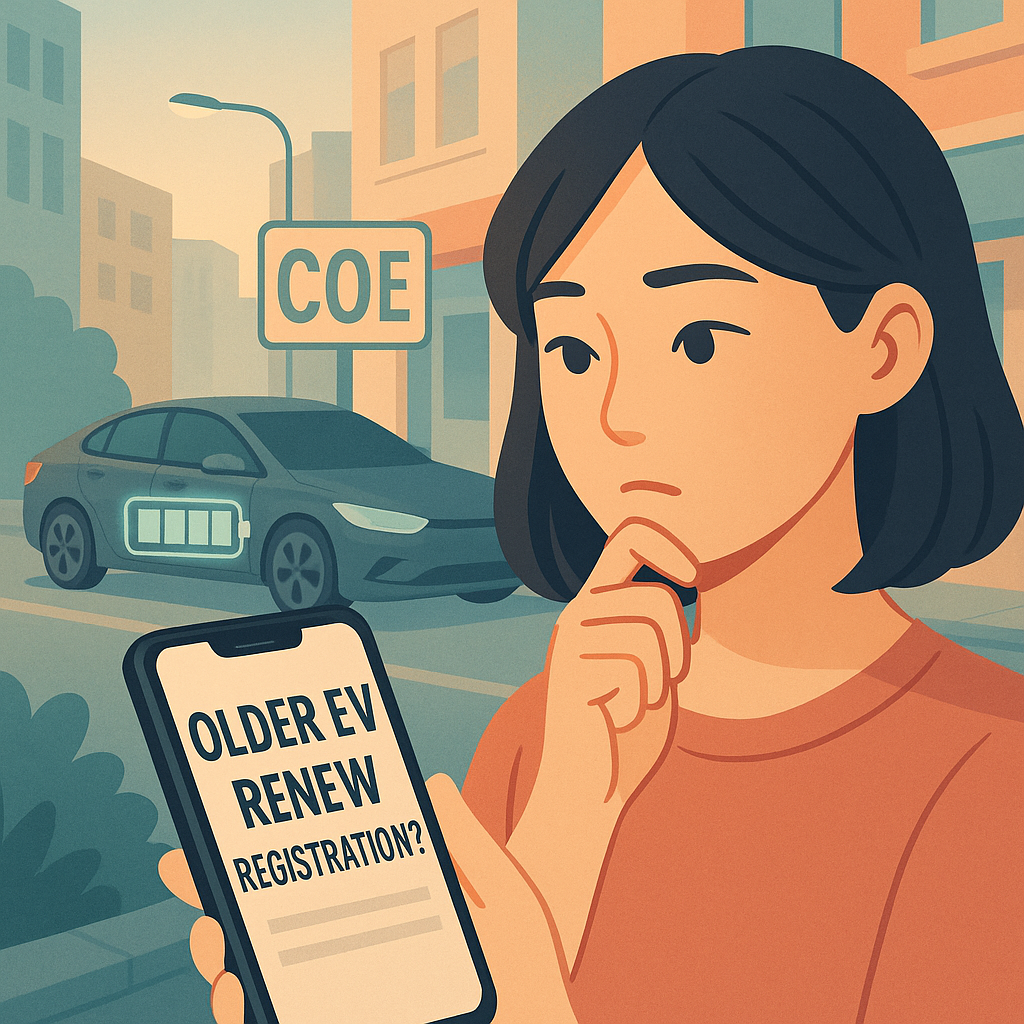
Tracey was scrolling online when she spotted a headline that made her pause: **“Can an ‘old’ EV survive a COE renewal?”** In Singapore, the COE (Certificate of Entitlement) is a big deal for every vehicle owner. And now that more electric vehicles (EVs) are appearing on the roads, Tracey wondered: *What happens when these EVs get older?*
According to the article, one important clue is the **battery warranty**. Many EVs sold in Singapore come with battery warranties that last **eight years or 150,000km**. Tracey read that twice, because it sounded like a “promise” from the carmaker: the battery should be supported for that length of time or distance.
But Tracey also noticed that the article is asking a tricky question—whether an older EV can handle a COE renewal. That question matters because COE renewal is about keeping a vehicle registered for longer, and for EVs, the battery is a key part of how well the car continues to work.
Tracey started imagining two different EV futures:
– If an EV is still within its **battery warranty period**, owners may feel more confident about keeping it longer.
– If an EV is older, people might worry more about whether the battery can keep performing well as time goes on.
The article points out the challenge in a simple way: EVs are not just like regular cars with a fuel tank—they rely on batteries, and that affects how people think about long-term ownership.
By the end, Tracey felt like she had learned something important: **as EVs become more common in Singapore, questions about their “second life” and COE renewal will become more and more relevant**. And for Tracey, the battery warranty detail—**eight years or 150,000km**—was a key fact that helped her understand why this topic matters.
Image idea (for illustration): Tracey (Asian Chinese, head/upper torso visible) holding a phone and reading the headline about older EVs and COE renewal, with an EV and a “COE” sign in the background.
Leave a Reply