
Blog

  • Counting the Cost: How Indonesia’s Peatland Fires Devastated Health, Climate and Economy (2004–2015)

    Counting the Cost: How Indonesia’s Peatland Fires Devastated Health, Climate and Economy (2004–2015)

    Between 2004 and 2015, six of Indonesia’s largest dry‑season fire events left a deep and measurable mark on the region’s economy, climate and public health. A Nature Communications study that quantifies those impacts finds the combined economic losses from those six events totaled about US$93.9 billion — a reminder that landscape fires are not only an environmental problem but a major socioeconomic shock.

    The worst single year in the series was 2015. That season’s fires cost roughly US$28 billion — about 3.3% of Indonesia’s GDP for that year. The study breaks that figure into three main channels: land‑cover damage (about one‑third of the total), imputed CO2‑related climate damages (roughly 40%), and long‑term health costs (around 26%). In dollar terms, health‑related losses from the 2015 fires were estimated at US$7.3 billion in total — with Indonesia bearing about US$5.7 billion of that, Malaysia about US$1.3 billion, and Singapore roughly US$0.3 billion.

    Other major fire years in the 2004–2015 sample produced annual losses between about US$9.1 billion and US$20.4 billion, equivalent to roughly 1.1–2.4% of Indonesian GDP in those years. Those headline numbers show how episodic fires can accelerate into large, economy‑scale events when they occur on peatlands and close to populated or agricultural areas.

    How did the authors arrive at these figures? They combined a peat‑specific fire emissions inventory (FINNpeatSM) with atmospheric modelling to estimate PM2.5 and CO2 emissions from fires, then overlaid gridded population data to estimate exposure. Health impacts were calculated as excess mortality and DALYs (disability‑adjusted life years) attributable to fire‑borne PM2.5 and then monetized to estimate health damages. CO2/climate costs were imputed by applying an average CO2 price drawn from the European carbon market (2009–2020 average) to fire CO2 emissions. Land‑cover damages were valued by combining burned area with net‑present‑value estimates for the affected land uses. To make year‑to‑year comparisons driven by fire magnitude and location rather than changes in valuation, the study holds unit valuations (NPV, DALY price, CO2 unit price) constant across years.

    Crucially, the paper also tests a restoration scenario. Restoring 2.49 million hectares of degraded peatland — the government target at the time — would reduce the study’s estimated fire losses by about US$8.4 billion across the events analyzed. The health benefits are notable: restoration cuts estimated excess deaths by 11,914 (a 21% drop, from 55,819 to 43,905) and reduces DALYs by about 0.46 million (from 2.19 to 1.72 million). With restoration cost estimates in the paper ranging roughly US$3.2–7.0 billion, the authors conclude that the projected benefits (reduced CO2 emissions, health damages and land‑cover losses) outweigh the costs under their assumptions.

    The authors are careful to flag important caveats. Their quantified channels — land‑cover, CO2 and health — do not capture the full suite of fire impacts: biodiversity loss, employment impacts, subsistence livelihoods, tourism, transport disruptions, regional climate feedbacks and many non‑market ecosystem services were excluded and would enlarge total societal costs if included. Valuation choices (single NPVs per land use, constant DALY and CO2 unit values) and uncertainties in emissions inventories and atmospheric modelling are other sources of uncertainty. The study’s analysis focuses on discrete large fire years up to 2015 and does not itself provide new estimates for later events.

    The takeaway is stark but actionable: peatland fires produce multi‑billion‑dollar losses across climate, health and land values, and sizable reductions in those losses appear attainable through large‑scale peatland restoration. While implementation details and wider social impacts require further study and on‑the‑ground policy work, the cost‑benefit arithmetic in this study suggests restoration is a financially sensible part of a broader strategy to reduce the recurrent, large‑scale damages caused by peatland burning.

  • The Spoon-Friendly Legend: Exploring the History of Katong Laksa

    The Spoon-Friendly Legend: Exploring the History of Katong Laksa

    If you find yourself in Singapore’s Katong district, you are likely to be lured by the irresistible, spicy aroma of coconut-based broth. Katong Laksa isn’t just a meal; it is a cultural icon with a story as rich and layered as its famous gravy. \n\nAt the heart of this dish is a fascinating history that blends Chinese and Malay influences. The dish evolved from the local Peranakan community in the seaside precinct of Katong. While the origin of the word “laksa” remains a point of debate—potentially stemming from the Sanskrit word for “many” or the Persian word for “noodles”—the story of how the dish became a local legend is centered on one man: Ng Juat Swee.\n\nKnown by the nickname “Janggut” (Malay for “beard”) because of a distinctive mole on his chin, Ng began selling his laksa from a pushcart along Marine Parade in the late 1940s. He introduced a simple yet revolutionary change: he cut the thick rice vermicelli noodles into shorter strands. This small modification meant that the entire dish could be enjoyed with just a spoon, freeing diners from the need for chopsticks. \n\nAn authentic bowl of Katong Laksa is defined by its rich, coconut milk-based gravy. Flavored with a complex *rempah* of lemongrass, galangal, turmeric, and chili, it is further elevated by the umami punch of dried shrimp (*hae bee*). Traditionally, this broth was kept bubbling over a charcoal fire to impart a subtle, smoky depth. Topped with cockles, fishcake, and prawns, and garnished with fragrant *daun kesum* (laksa leaves), it is a masterpiece of balance.\n\nAs the dish grew in popularity, it sparked the legendary “Laksa Wars,” with various stalls throughout Katong vying for the title of the “original.” While Janggut Laksa continues to carry the torch of Ng’s 1950s lineage, others like 328 Katong Laksa have gained worldwide acclaim—notably when founder Nancy Koh famously defeated celebrity chef Gordon Ramsay in the 2013 “Hawker Heroes” challenge.\n\nToday, whether you visit a Michelin-recognized stall or a local neighborhood favorite, the experience remains the same. The bowl of soup with the spoon-friendly noodles has moved from its humble beginnings on a beach to the center of Singapore’s culinary identity, proving that a little innovation can leave a lasting legacy.

  • Mayo Clinic Diet: A Practical Two‑Phase Plan for Lasting Weight Loss

    Mayo Clinic Diet: A Practical Two‑Phase Plan for Lasting Weight Loss

    What it is
    The Mayo Clinic Diet is framed as a lifestyle-first weight‑loss program developed by Mayo Clinic experts that stresses sustainable habit change over short‑term restriction or obsessive calorie counting. Its goal is to help people lose weight safely, improve health (lowering risk of diabetes, heart disease, high blood pressure and sleep apnea) and—critically—maintain the loss for life.

    Two phases: what to expect
    1) “Lose It!” (first 2 weeks)
    – A jump‑start designed to introduce and reinforce new habits and to produce an early, safe weight loss. The article gives a realistic early target: up to about 6–10 lb (2.7–4.5 kg) during these two weeks.
    – Focus: adopt five healthy habits, break five unhealthy habits, and add bonus tracking habits.

    2) “Live It!” (ongoing/lifelong)
    – An education and maintenance phase that teaches portion estimation, meal planning, time‑saving strategies and how to reset habits when you slip.
    – Expected steady progress: roughly 1–2 lb (0.5–1 kg) per week until you reach your goal, then continued habits to help maintain weight long term.

    The habit list (the 5 + 5 + 5)
    Five healthy habits to start:
    – Eat a healthy breakfast.
    – Make vegetables and fruit the main part of meals and eat them first.
    – Choose whole grains.
    – Pick healthy fats (olive oil, avocado, nuts) and prefer grilling/broiling/baking over frying.
    – Move: aim for at least 30 minutes of physical activity each day.

    Five unhealthy habits to break:
    – Don’t eat in front of screens (TV/computer/phone).
    – Reduce sweets (sugary drinks, desserts).
    – Stop snacking on calorie‑dense processed snacks; if you must snack, choose vegetables or fruit.
    – Limit high‑fat animal foods (recommend about 3 oz of lean meat/poultry/fish daily and shift toward more plant proteins).
    – Cut down on eating out or make lighter choices when you dine away from home.

    Five bonus (tracking & reinforcement) habits:
    – Keep a food record.
    – Keep an activity record.
    – Gradually increase movement toward 60 minutes/day when feasible.
    – Favor “real” minimally processed foods.
    – Set a small, achievable daily goal and build on it.

    How food and portions are handled
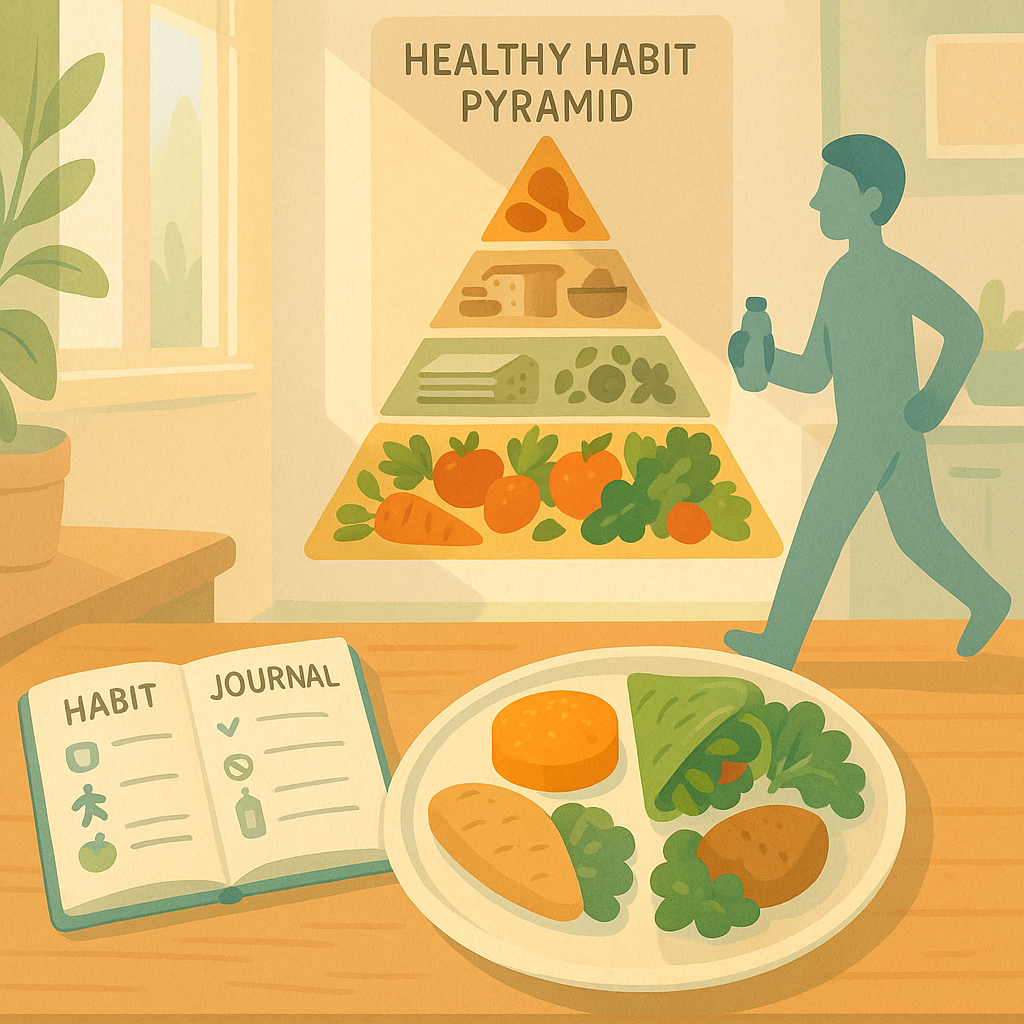
    – The program uses the Mayo Clinic Healthy Weight Pyramid to prioritise foods (base = vegetables/fruits; top = foods to eat less often).
    – The approach teaches portion estimation rather than strict calorie counting and provides education on energy and nutrient needs.
    – The site offers multiple eating styles at different calorie levels and sample daily menus so people can choose a plan that fits them.

    Example 1,200‑calorie day (sample menu shown in the article)
    – Breakfast: fruit/oat/yogurt/milk smoothie.
    – Lunch: vegetable and roast‑beef wrap.
    – Dinner: broiled salmon with cabbage and tomato salad.
    – Snack: a small piece of fruit.

    Safety notes and limitations
    – The diet is presented as generally safe for most adults. A common short‑term effect can be increased gas or other digestive changes when fibre is increased; the article recommends increasing fibre gradually and drinking enough fluids.
    – People with diabetes or other medical conditions should work with their healthcare professional to adapt the plan (medication changes are not detailed in the article). The Mayo Clinic piece recommends consulting a clinician before starting a new diet or exercise program.
    – What the article does NOT claim: it does not present head‑to‑head randomized trial evidence proving superiority over other named diets, nor does it provide long‑term follow‑up statistics in this article. Calorie goals and individualized plans vary by sex, weight and needs; the article points readers to program tools for tailored guidance.

    Bottom line
    If you want a practical, habit‑focused route to losing weight and keeping it off, the Mayo Clinic Diet frames the work as two manageable phases: a two‑week habit jump‑start with measurable early results, then a lifelong education and maintenance plan that emphasises portion sense, whole foods and daily movement. For tools, sample meal plans and calorie‑level options, the article points to the Mayo Clinic Diet program site (diet.mayoclinic.org). As always, check with your healthcare provider—especially if you have diabetes or other medical concerns—before beginning a new diet or exercise plan.

    Source: Mayo Clinic. “The Mayo Clinic Diet: A weight‑loss program for life.” June 4, 2026.

  • Choose next step: One‑page outline or fetch additional source?

    I can do either — tell me which you prefer:

    Option A — One‑page blog outline: I’ll create a concise, ready-to-write outline based only on the OpenText GXS page you provided (brand integration story, rebrand mapping, Business Network Cloud benefits, and support/next steps).

    Option B — Add one authoritative source then produce a combined brief: I’ll fetch one additional reputable source (press release or SEC/news coverage) to fill gaps the OpenText page leaves (exact acquisition date, purchase price, pre-acquisition history) and then produce a short combined brief that includes those verified facts plus the product/rebrand details.

    Recommendation: If you only need a practical blog or outline now, pick A. If you want precise acquisition details or historical context for publishing, pick B. Which should I do?