Blog

  • Why Bleach Has a Style All Its Own

    Why Bleach Has a Style All Its Own

    What makes one long-running anime stand out from its rivals? For CBR, the case for Bleach is not about topping the sales charts. It is about the details that give the series its own character: its music, its cast, its fashion and the way its hero comes across.

    Bleach was part of shonen’s “Big Three” alongside Naruto and One Piece, series that were major forces in the genre during the 2000s and early 2010s. The comparison is a familiar one, but CBR’s article makes a case for looking at Bleach from a different angle. It acknowledges that Bleach sold less than its two peers, while arguing that sales are not the only way to talk about what fans might value in a story.

    One of the article’s main talking points is the soundtrack, composed by Shiro Sagisu. CBR describes it as distinctive and memorable, with experimental synth sounds and choruses that fit the series’ supernatural atmosphere. It also points to hard-rock music for battles and Spanish-inspired music in later arcs. These are critical judgments, not measurements that prove one soundtrack is better than another—but they help explain the particular mood the article associates with Bleach.

    The article also highlights representation in the cast, naming Kaname Tōsen, Yoruichi Shihōin and Zommari Rureaux as Black characters with significant roles. That is another part of its argument about what makes the series appealing. Rather than treating its characters as background decoration, the article points to their place in the story as a reason to pay attention to Bleach’s cast.

    Then there is the clothing. Bleach’s characters often appear in stylish alternate outfits, which CBR connects to creator Tite Kubo’s interest in modern fashion. Their looks help the series feel visually distinct, giving fans something to notice beyond the supernatural conflicts and battles.

    The article’s comparison also comes down to personality. It suggests that some viewers may find Ichigo less grating than the louder protagonists Naruto and Luffy. That is plainly a matter of taste: viewers may prefer a more boisterous hero, or they may connect more with Ichigo’s approach. The point is not that every fan will agree, but that protagonist style can shape how a series feels to watch.

    So CBR’s case for Bleach is best read as an invitation to notice its particular strengths, not as proof of an objective anime champion. Music, representation, fashion and characterization offer different reasons to enjoy it—and different viewers will weigh those reasons differently. The Big Three comparison may invite debate, but the article’s most useful takeaway is simple: a series can stand out for more than its place on a sales chart.

    Source: 10 Ways Bleach Is The Best Of The Shonen Big Three, CBR
  • A Transformer Failure Brings an Unexpected Start to Fair Week

    A Transformer Failure Brings an Unexpected Start to Fair Week

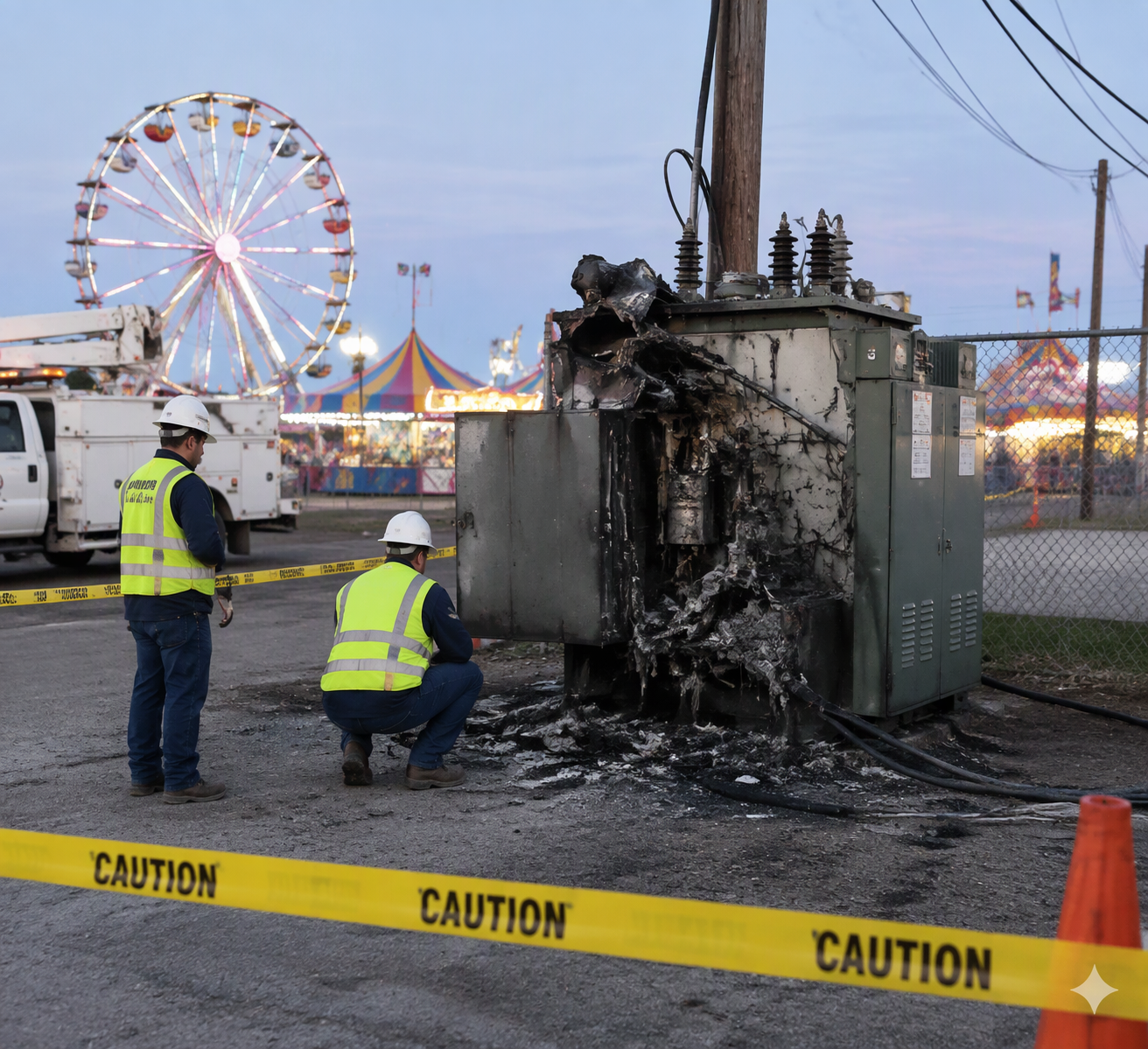
    Fair week at the Washakie County Fairgrounds began with an electrical failure—and, as one fair board member put it, “with a bang.” On Monday, July 20, a transformer failed and caught fire at the grounds, turning the start of the week into a repair effort for local crews and utility workers.

    A photo caption in the Northern Wyoming News described a Worland volunteer firefighter wetting down a power pole while an oil-filled unit burned. The action was intended to help prevent further damage. The article does not describe injuries or report how many people were at the fair, so the incident’s impact should not be confused with a report of a crowded opening.

    The cause of the failure was not known. Washakie County Maintenance Supervisor Heath Kiser told county commissioners that he did not know what had made the transformer fail. Several inflatables were operating nearby, and many campers were on the fairgrounds; every camping spot was full. Those details provide a picture of the busy site, but the article does not say that either the inflatables or the campers caused the electrical problem.

    The transformer served more than the fairgrounds. It also supplied power to the city cemetery’s sprinkler system. Sheriff Austin Brookwell and Kiser said live wires were running along the back of the cemetery without conduit. At a Tuesday council meeting, Public Works Director Nick Kruger reported that part of the sprinkler system was not working and that crews were giving repairs priority.

    Rocky Mountain Power replaced the transformer on Monday night, installing a unit with higher capacity. Kiser said officials told him that the older transformer had already been scheduled for replacement, although that work had not yet been completed when it failed.

    The replacement restored an important piece of equipment, but the report also points to the practical work that followed: firefighters acted to limit further damage, utility workers changed out the transformer, and public works crews focused on the cemetery sprinkler repairs. The exact cause remains unknown, and the article does not claim that the nearby activity was responsible.

    So the fair’s first “bang” was not a celebration or a sign of what caused the failure. It was an unexpected problem at the beginning of fair week—one that affected power serving both the fairgrounds and the cemetery, and prompted a quick response from local and utility crews.

    Source: Blown transformer starts fair off with a “bang”, Northern Wyoming News

  • A Neighbourhood Designed for City Life

    A Neighbourhood Designed for City Life

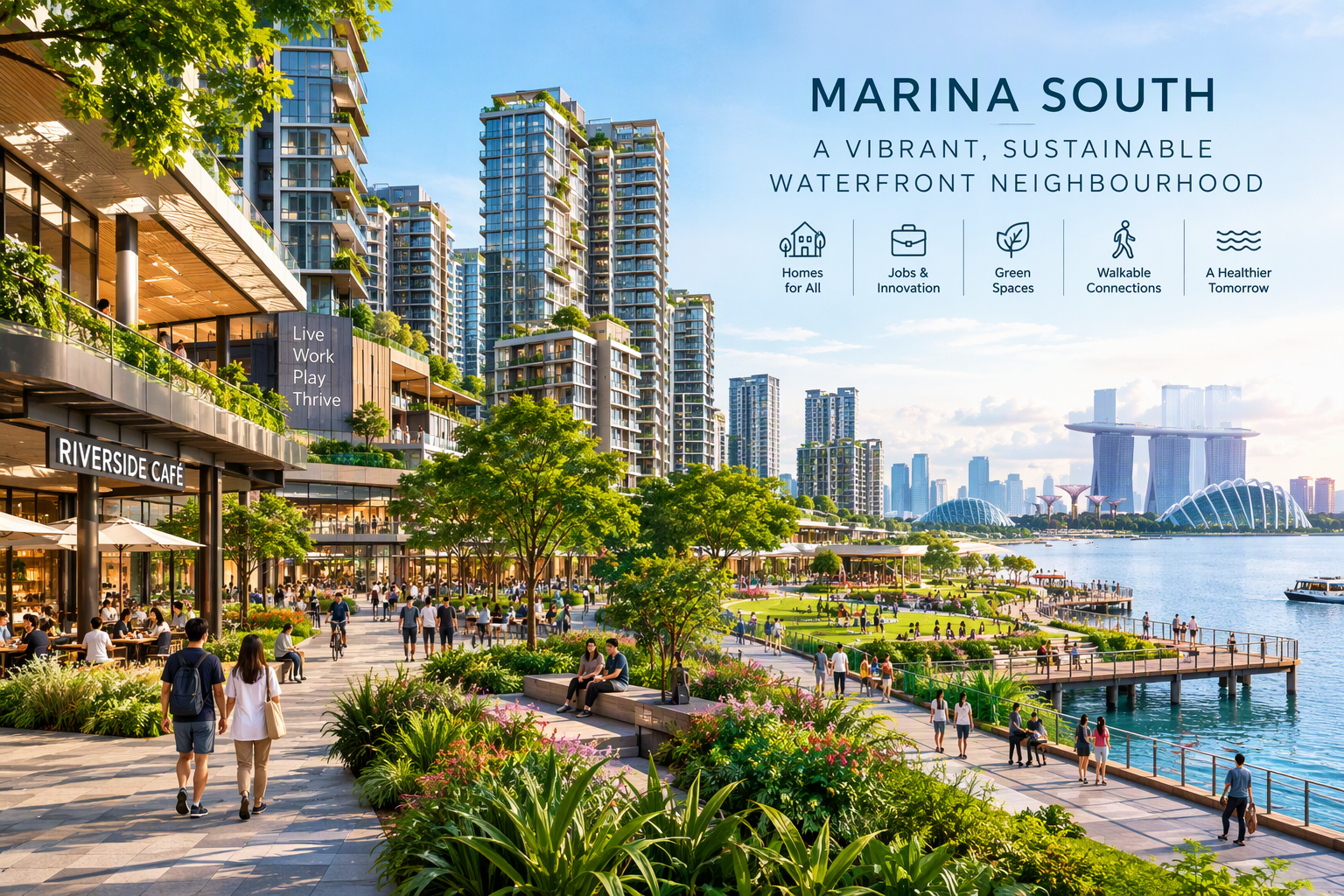
    What if the places you need each day—shops, childcare, public transport and green space—were all part of your neighbourhood? Singapore’s plans for Marina South imagine a new kind of city living, where homes sit close to work, amenities and places to unwind.

    The Urban Redevelopment Authority describes Marina South as a planned 45-hectare mixed-use residential neighbourhood that could accommodate more than 10,000 homes. Rather than treating it simply as a place to sleep after work, the plan is to make it part of a lively city centre, alongside business areas and destinations for recreation, arts, culture and entertainment.

    Getting around on foot is central to the idea. The neighbourhood is planned around a 10-minute walk to daily amenities, with access to two MRT stations. Gardens by the Bay and Marina Coastal Park are also intended to be within walking distance, linked by an elevated landscaped bridge. Beneath the Pedestrian Mall, a proposed underground pedestrian link would offer a sheltered route between developments and the Marina South stations on the Thomson-East Coast Line.

    The first upcoming residential development named on the URA page is One Marina Gardens. It is planned to include retail amenities and a childcare centre, with direct connectivity to Marina South Station. These features could make everyday journeys simpler, although the page does not confirm when the development or other parts of the neighbourhood will be completed.

    The plan also gives public spaces an important role. Pedestrian malls, neighbourhood streets, courtyards and plazas are intended to be places where people can meet casually, gather with neighbours or take part in community events. The URA describes them as shared “living rooms” for residents—a reminder that a neighbourhood is shaped not only by its buildings, but also by the spaces between them.

    Singapore’s heat and rainfall are part of the design challenge, too. Environmental modelling is intended to guide building forms so wind can move through streets and public spaces, helping lower ambient temperatures and reduce the urban heat-island effect. The plans also call for lush greenery and native plant species. Developments are required to be energy-efficient and use tropical design, while recycling points, food-waste composting and stormwater-management features are encouraged. Future developments are also expected to reduce solar heat gain, support natural ventilation and prioritise sustainable waste management.

    Marina South is one part of a wider effort to enhance city neighbourhoods; the URA page also names Pearl’s Hill and Newton, though it gives less detail about their plans in the material summarised here. For Marina South, the vision is clear: bring homes, transport, greenery and shared public spaces closer together. The plans offer a picture of how city-centre life might feel—but final designs, costs, housing types and delivery dates have not been established in the source.

    Source: Enhancing City Neighbourhoods, Urban Redevelopment Authority (URA), Singapore

  • Beyond the Circuit: How F1 Race Week Lit Up Singapore’s Businesses

    Beyond the Circuit: How F1 Race Week Lit Up Singapore’s Businesses

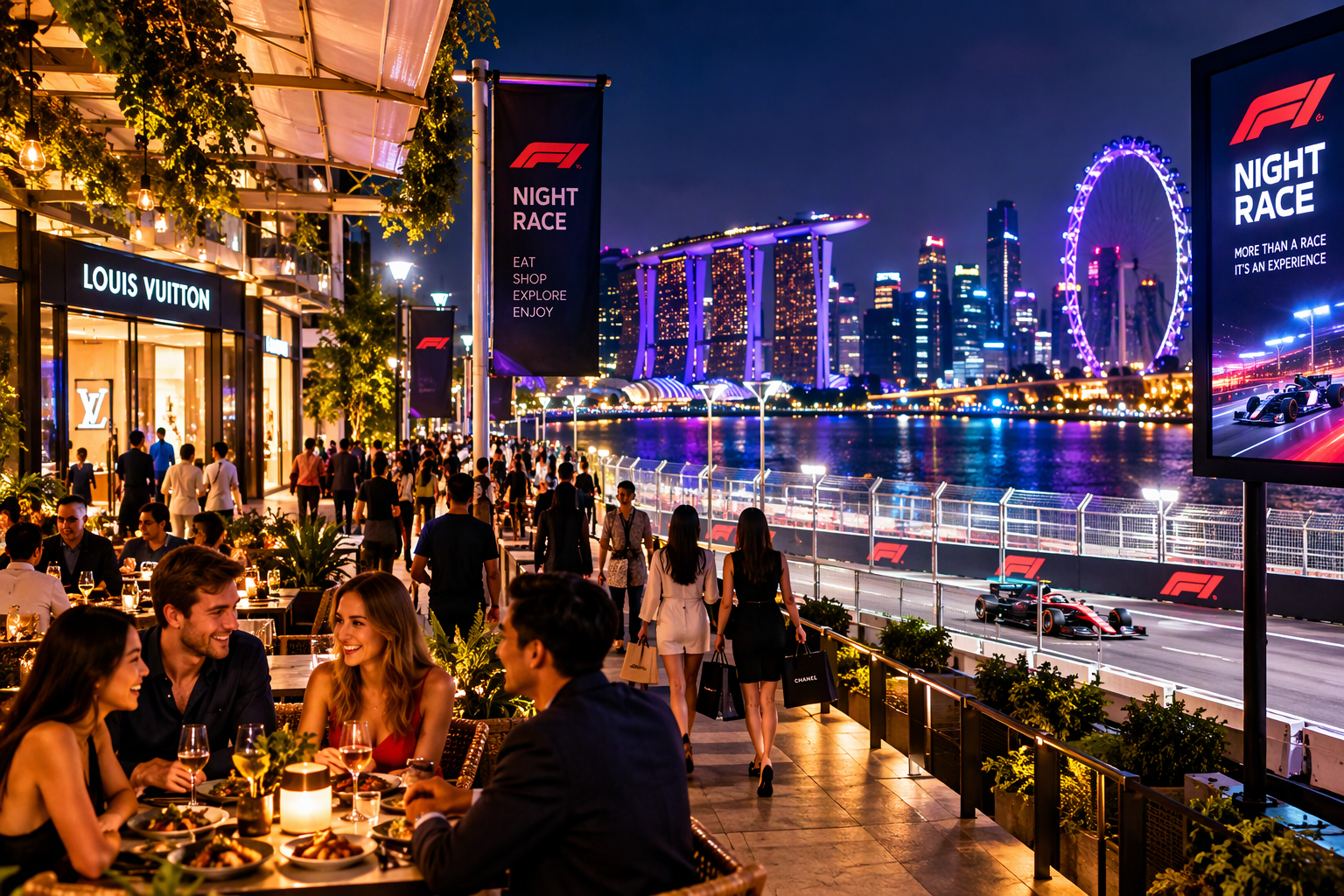
    The engines may roar around Marina Bay, but the activity of Singapore’s F1 Night Race week does not stop at the circuit. Visa says its VisaNet payment data showed higher travel-related spending and commercial activity across the city, as international visitors and business travellers explored restaurants, shops and entertainment venues.

    Compared with the same period a year earlier, transaction volumes and overall spending rose by double-digit percentages across hospitality, retail and entertainment, according to Visa. Visitors came from several markets, including Mainland China, Australia, the United States, Malaysia and Indonesia. The figures suggest that race week can bring attention—and spending—to businesses well beyond the grandstands, although the article does not establish that the race alone caused the increases.

    One striking detail is the spending by travellers Visa describes as affluent. They made up about 30% of travellers during race week but accounted for 40% of traveller spending. Their travel to Singapore was about 30% higher than in an average week, while their spending was nearly 45% higher. Visitors from Mainland China, Australia, the United States and Indonesia together accounted for more than 40% of all traveller spending during race week.

    Where did some of that money go? Visa highlights dining and retail, including apparel and restaurants. It also reports particularly large increases at discount stores and electronics retailers. These patterns offer a glimpse of how a major sporting event can overlap with ordinary city life: visitors might come for the race, but their plans can also include a meal, shopping or an evening out.

    Race week was busy for work as well as leisure. It coincided with conferences and exhibitions, and Visa reports that about 80% more business cardholders visited Singapore than in an average week. Their spending rose by approximately 170%—nearly three times the average-week level. The article describes this mix of work and leisure as “bleisure”: business visitors also spending at restaurants, electronics shops, apparel stores and department stores.

    The night-time figures are another reminder that Singapore’s day does not end when the race cars leave the track. Visa reported that spending between 11pm and 5am increased by more than 90% during race week. Restaurants, fast-food outlets and entertainment were the leading categories for traveller spending at those hours. Visa suggests that businesses around Marina Bay, Clarke Quay and Tanjong Pagar may have contributed to the pattern.

    These figures make the race week story broader than a sporting spectacle: it is also a busy period for dining, shopping and late-night entertainment. But they are payment-data comparisons, not a full calculation of the event’s economic impact. Visa’s article gives no absolute dollar totals, visitor count or estimate of spending specifically received by Singapore-owned businesses. Even with those limits, its findings offer a lively snapshot of how a major event can coincide with activity across a city.

    Source: Tourism and Commerce Surged During F1™ Singapore Night Race, Visa

  • Singapore’s CS2 Major: Three Weeks, 32 Teams and a Grand Final

    Singapore’s CS2 Major: Three Weeks, 32 Teams and a Grand Final

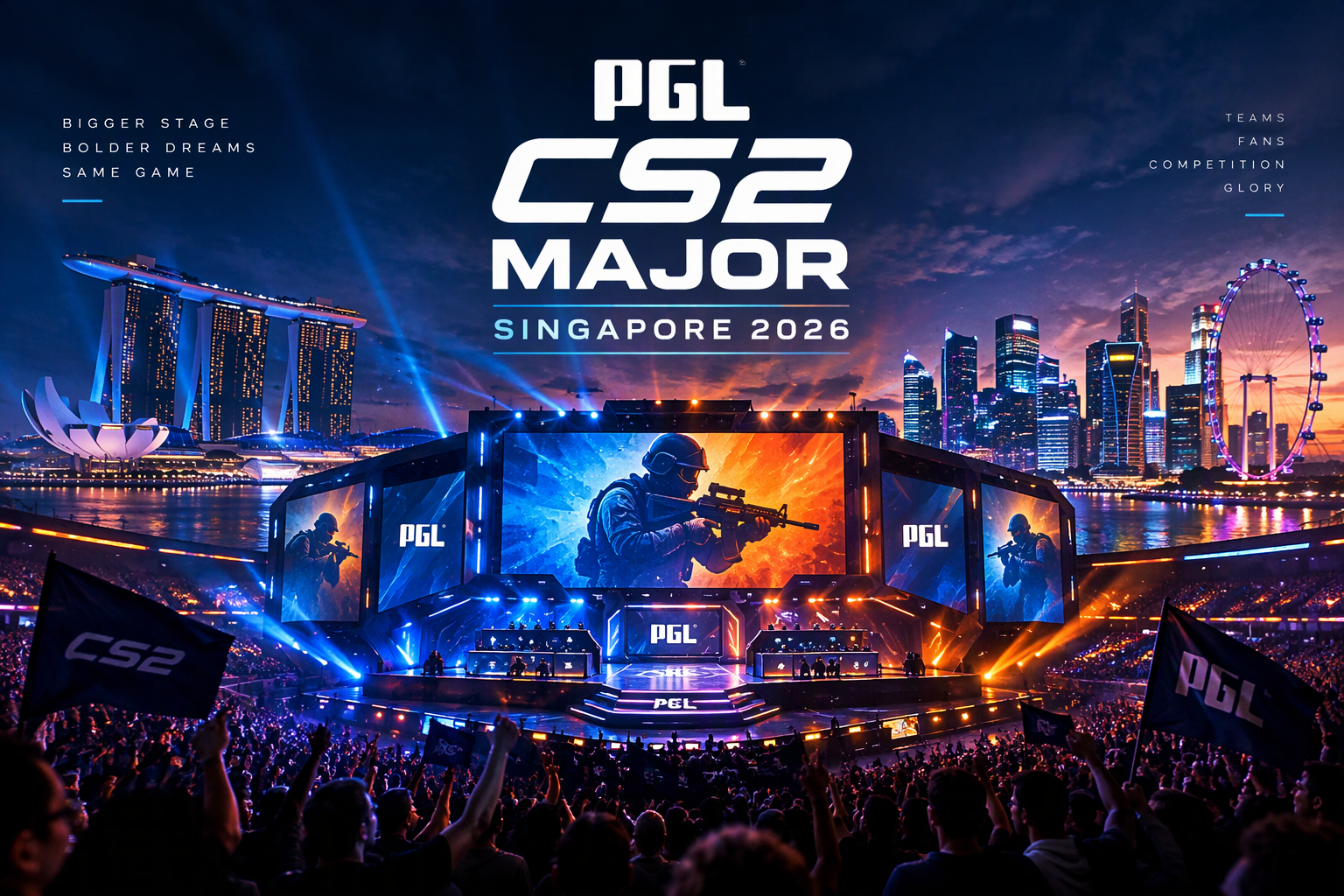
    From November 24 to December 13, 2026, Singapore is scheduled to host a Counter-Strike 2 tournament that stretches across several weeks—not just one big match. PGL describes its Singapore Major as the year’s second CS2 Major, bringing 32 teams together to compete across three stages before the tournament reaches its Grand Final.

    That format gives the event a clear journey. Teams will first face the challenge of the tournament’s three competitive stages, with the eventual finalists progressing to a best-of-five Grand Final. “Best-of-five” means the championship match is set up to be contested across as many as five games, giving the final a different scale from a single-match finish.

    The dates make this a substantial fixture on Singapore’s esports calendar. The Major is scheduled to begin on November 24 and conclude on December 13, so the tournament will unfold over multiple weeks. For readers following along, that means the event is more like a sustained competition than a one-day spectacle: its stages lead towards a finale at the end of the schedule.

    The closing stretch is planned for Singapore Indoor Stadium. PGL lists the venue’s capacity as more than 12,000 spectators, and says the final four days of the event will take place there. That provides a striking setting for the tournament’s last chapter, as the competition moves from its earlier stages towards the Grand Final.

    There is still plenty the announcement does not tell us. It does not name the participating teams or give specific matchups, individual match dates, start times, ticket details or broadcast information. So while the overall dates, team count and tournament structure are outlined, readers will need further announcements for the practical details of following the matches.

    For now, the broad picture is already clear: 32 teams, three stages, a multi-week schedule and a best-of-five championship match, with the final four days planned for Singapore Indoor Stadium. The PGL CS2 Major Singapore 2026 is set to bring a major international esports tournament to the city in late November and December—and its final result will be decided only after a long road through the competition.

    Source: PGL CS2 Major Singapore 2026, PGL Esports

  • A.R. Rahman Turns Singapore’s National Stadium into a ’90s Singalong

    A.R. Rahman Turns Singapore’s National Stadium into a ’90s Singalong

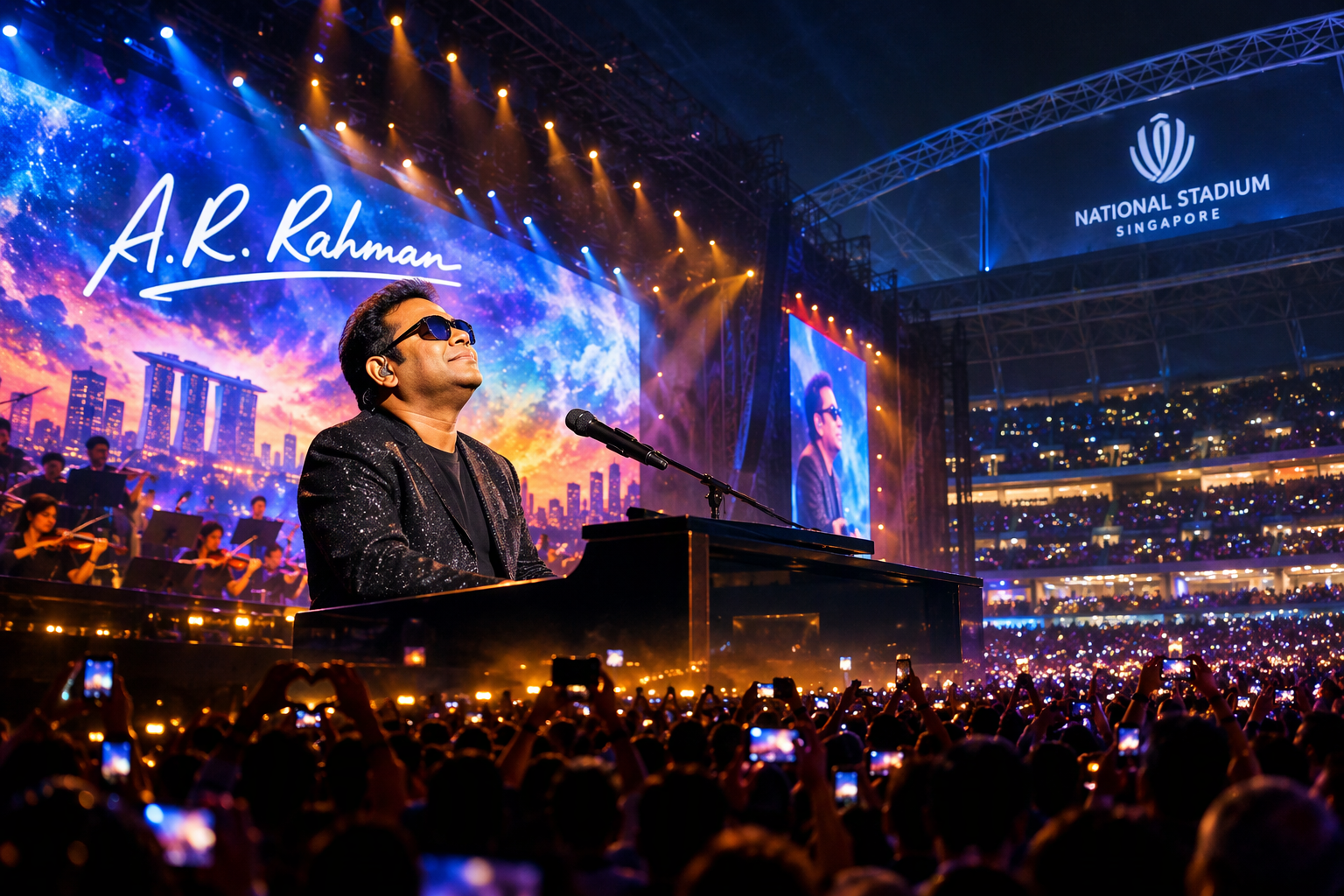
    When the opening bars of “Mukkala Mukkabala” rang out, the response was unmistakable: the crowd at Singapore’s National Stadium was ready to revisit A.R. Rahman’s 1990s hits. About 25,000 people attended the concert on August 31, 2024, where the composer and performer brought together songs from across his career.

    The evening began before Rahman took the stage. Radio deejay Joakim Gomez and actor Jay Nesh warmed up the audience, splitting concertgoers into two teams named after Rahman songs: “Mukkala Mukkabala” and “Urvasi Urvasi.” They also led a Kallang wave and introduced local musician Shabir Sulthan as the opening act. Among the people spotted in the front row were former Singapore president Halimah Yacob and her husband, Mohammed Abdullah Alhabshee.

    At around 7.30pm, Rahman opened with “Jai Ho,” from the 2008 film Slumdog Millionaire. He was joined by a 31-member group of singers, dancers and band musicians, including his son A.R. Ameen. Over the three-hour concert, the performance moved between current songs and popular Hindi and Tamil numbers, while Rahman’s 1990s Tamil hits drew particular enthusiasm.

    Guest singers added to the mix. Playback singers Mohit Chauhan and Rakshita Suresh joined Rahman for “Nadaan Parinde” and “Minsara Poove.” He also introduced Ameen, then 21, as a “shy boy from Chennai.” The two performed “Ninaivirukka” together, joined by vocalist-composer Shakthisree Gopalan.

    But the strongest audience reactions came with the first notes of “Mukkala Mukkabala” and “Veerapandi Kotayyile.” Those moments showed how powerfully Rahman’s earlier songs still connected with listeners in the stadium. The concert was not only a look back at familiar hits; it also brought together performers and songs from different parts of his musical career.

    Singapore has been part of Rahman’s story for decades. The review describes this as his fourth performance in the country, following appearances at the Singapore Indoor Stadium in 2005, Marina Bay Sands in 2011 and Gardens by the Bay in 2014. It also notes that Singapore was the first country he travelled to outside India, in the mid-1980s.

    By the end of the three-hour show, the evening had traced that long connection through music: from an opening song familiar to international audiences to Tamil favourites that prompted especially enthusiastic responses. For the crowd of about 25,000, Rahman’s return to the ’90s was a chance to hear those songs together, live in Singapore.

    Source: Concert review: Crowd of 25,000 goes crazy as A.R. Rahman takes them back to the ’90s, The Straits Times

  • Finding a First Car in Singapore: Small, Steady and Right for You

    Finding a First Car in Singapore: Small, Steady and Right for You

    For a new driver, a short trip can come with a long list of firsts: a tight turn, a narrow lane, a crowded carpark. A car that feels manageable may help make those moments less daunting. In a 2022 guide, sgCarMart explores first-car options in Singapore with size and ease of driving in mind—and describes three of its recommendations in the accessible article text.

    One is the Honda Jazz, also known as the Fit. The article describes it as a reliable, compact hatchback that is relatively affordable to maintain. The names reflect different routes into Singapore: the Jazz is sold by authorised dealer Kah Motors, while the Fit is brought in by parallel importers. Equipment can differ, so the guide advises checking the features of the particular car rather than assuming every version is the same.

    The guide discusses 1.3-litre and 1.5-litre versions. It recommends the 1.5-litre for its stronger performance, while noting annual road-tax figures of $684 for that version and $578 for the 1.3-litre. Those are figures reported in the article, not a current cost comparison—an important distinction for anyone looking at cars today.

    Another suggestion is the Kia Picanto. Its small size and 1.1-litre engine make it a compact option that the article presents as easy to handle, with comparatively low fuel and maintenance costs. But there is a trade-off: the very compact cabin may feel cramped. That makes it worth thinking about how much room you need, not just how easy a car may be to manoeuvre.

    For buyers seeking something more premium and willing to spend more, the guide includes the Audi A1 Sportback. It recommends the 1.0-litre version over the 1.4-litre option found on the used market, pointing to fuel savings and lower annual road tax. The article treats it as a different kind of choice from the smaller, more budget-conscious suggestions—not as a universal upgrade for every new driver.

    The useful lesson is that “best first car” depends on what matters most to you. A manageable size, running costs, performance, cabin space and premium features can pull a decision in different directions. A car that suits one learner’s priorities may not suit another’s, and the guide does not declare one model the winner.

    There is also a limit to what this particular article can tell us: its accessible text identifies and describes only the first three of its ten suggested cars. Published on 16 September 2022, it should be treated as a snapshot of recommendations from that time, not proof that these are the best cars available today. For a first-time buyer, it is a starting point for questions—not a substitute for checking current prices, availability and the details of each car.

    Source: Nervous as a new driver? Don’t worry, here are some of the best first cars to own in Singapore, sgCarMart

  • The Chicken, the Road and a Punchline That Refuses to Show Off

    The Chicken, the Road and a Punchline That Refuses to Show Off

    A chicken approaches a road. A question follows: “Why did the chicken cross the road?” It sounds like the beginning of a puzzle. We expect a clever explanation, perhaps one that makes us rethink the question. Instead, the familiar answer is wonderfully plain: “To get to the other side.”

    That anticlimax is the joke. The setup invites us to look for a surprising solution, but the punchline offers only a literal reason. The article describes this style as anti-humor: the laugh comes from withholding the elaborate twist that listeners may be expecting. The answer is not a hidden riddle waiting to be cracked. It is exactly what it says.

    The joke has been around in print for a long time. According to Mental Floss, the earliest known printed version appeared in an 1847 issue of the New York periodical The Knickerbocker. Its wording was slightly different: “Why does a chicken cross the street?” The response was, “Because it wants to get on the other side!” The magazine treated it as a quip that sounded like a conundrum but was not one.

    That distinction helps explain why such a simple joke can be memorable. A conundrum promises a puzzle and usually rewards us with an answer that connects the clues in an unexpected way. This chicken joke makes a similar promise, then declines to play along. The punchline is almost stubbornly ordinary. Its comic effect depends on the gap between the sort of answer we anticipate and the one we receive.

    The first printed version does not necessarily mark the joke’s true beginning. The article suggests it may have circulated orally before appearing in The Knickerbocker. It also mentions a suggestion that Christy’s Minstrels, a 19th-century blackface troupe, performed the joke as early as the 1840s. But the troupe’s role in originating it cannot be confirmed. The article does not identify the joke’s inventor, so its authorship remains unknown based on the evidence described there.

    That uncertainty is part of the joke’s history, but it should not be filled in with guesses. We can point to an early printed example and describe a possible earlier performance without claiming either tells us who came up with the line. And, of course, the punchline tells us only the joke’s answer—not why any particular real chicken might cross a road.

    A line this short has lasted because it turns a grand-sounding question into the smallest possible explanation. Ask for a mystery, and you get a plain destination. The chicken crosses to the other side—and the joke crosses from expectation to anticlimax.

    Source: Why Did the Chicken Cross the Road? The History Behind the World’s Most Famous Joke, Mental Floss

  • BTS’s Singapore Concerts: A Festive Boost, Still to Be Counted

    BTS’s Singapore Concerts: A Festive Boost, Still to Be Counted

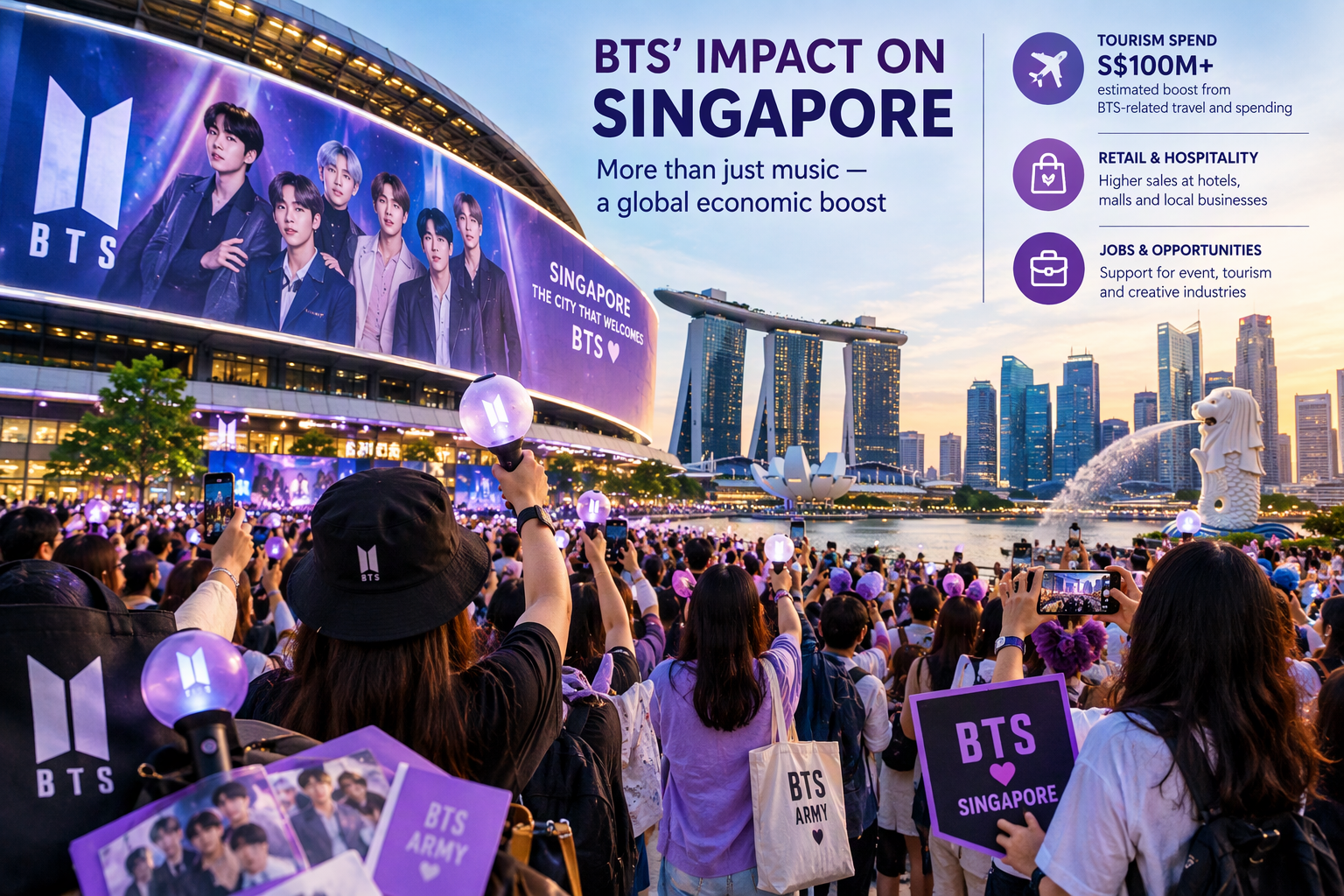
    When BTS arrive at Singapore’s National Stadium for four concerts in December 2026, the music may be only part of the story. The performances are also expected to draw fans into hotels, restaurants, shopping centres and other businesses—though the size of any economic boost remains a forecast, not a result.

    The Straits Times reported on July 6 that fans, known as ARMY, could travel from Singapore and overseas to attend the shows. That demand may spread well beyond the stadium: visitors need places to stay, meals to enjoy and things to do. Airlines, hotels, retailers and hospitality businesses are among those that could benefit.

    There are already signs of strong interest in travel planning. Trip.com Singapore general manager Edmund Ong told the newspaper that hotel bookings on the platform for the concert period had risen more than 18-fold, while searches for accommodation had also increased. Those figures point to growing interest, but they do not tell us how many people will ultimately travel or how much they will spend.

    BTS began their Arirang world tour in April 2026. It covers 34 regions across five continents and follows a nearly four-year break from touring while the members completed mandatory military service. Yonsei University economic researcher Seo-young Kwon suggested that the long absence may encourage fans to travel to see the group perform in other cities and countries.

    The article compares the expected effect with “Swiftonomics”, the term associated with Taylor Swift’s Singapore concerts in March 2024. Economists estimated that Swift’s six-show run generated $300 million to $400 million in tourism receipts. The comparison is useful, but the circumstances differ: Swift performed exclusively in Singapore during her regional stop, while BTS are also holding concerts in other South-east Asian countries.

    For BTS’s four Singapore shows, DBS economist Chua Han Teng estimated a possible addition of about $200 million to tourism receipts in the fourth quarter of 2026. The article also cites a broader estimate of $200 million to $300 million. Chua attributed the lower estimate compared with Swift partly to the smaller number of Singapore shows and BTS’s concerts elsewhere in the region.

    Resorts World Sentosa is preparing BTS-themed packages and events, another example of businesses looking to welcome concertgoers. But projections are not guarantees. The article does not provide a detailed method for calculating the estimates, break down expected spending by industry or establish what the final impact will be. Once the concerts take place, the actual figures may tell a fuller story.

    For now, BTS’s December visit looks like a promising opportunity for Singapore’s tourism and hospitality businesses—and a reminder that a major concert can reach far beyond its audience. The economic encore, however, has yet to be measured.

    Source: BTS are set to bring year-end festive cheer to Singapore’s economy, The Straits Times

  • Yae Miko: Shrine Priestess, Publisher and Kitsune of Inazuma

    Yae Miko: Shrine Priestess, Publisher and Kitsune of Inazuma

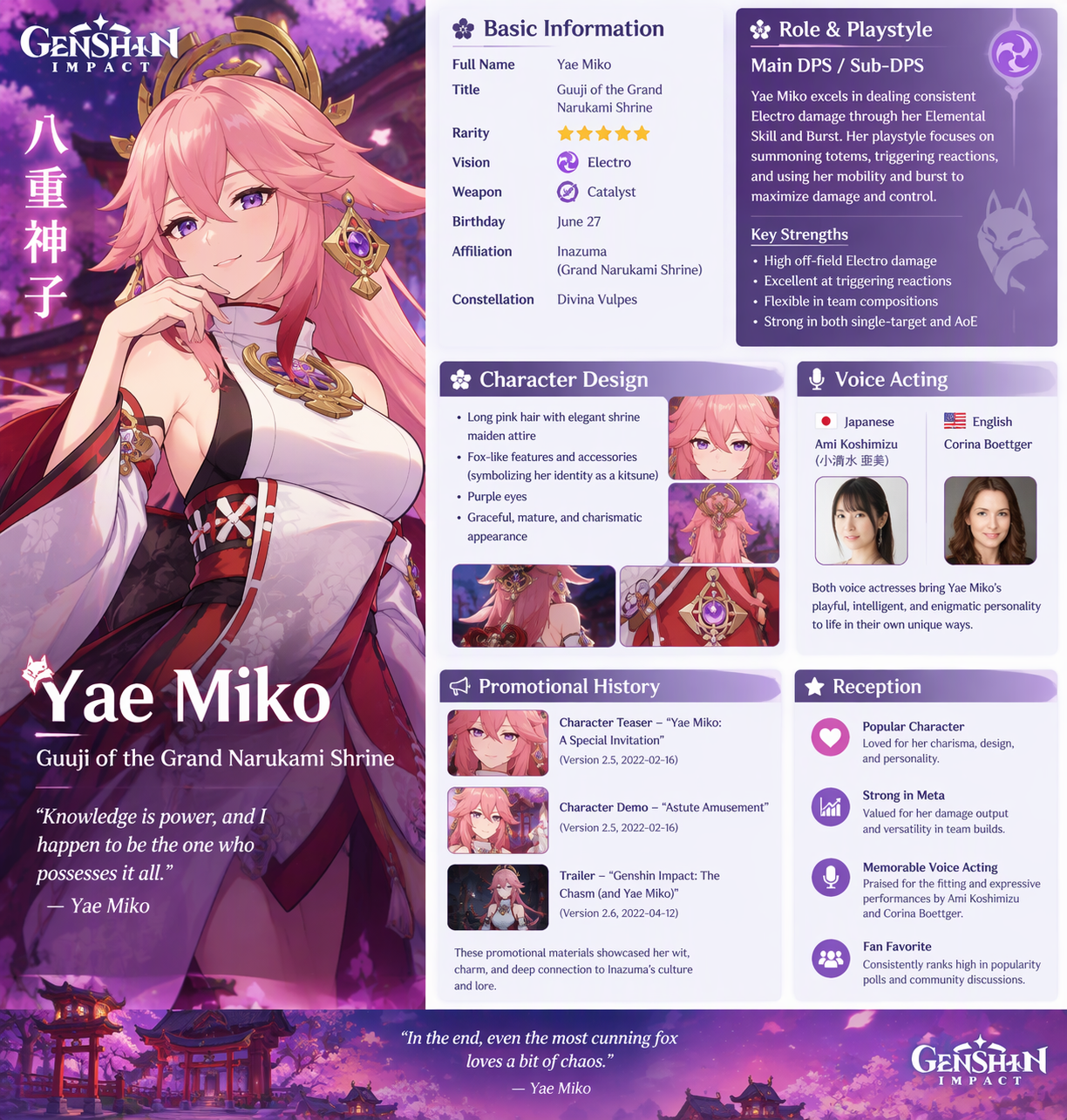
    In Inazuma, Yae Miko wears several important hats. She is the chief priestess of the Grand Narukami Shrine, a familiar of the Raiden Shogun, and a co-founder and editor-in-chief of Yae Publishing House. That combination makes her more than a shrine figure: she is also part of the nation’s cultural and publishing life in Genshin Impact’s fictional world.

    Yae Miko is a character in Genshin Impact, the action role-playing game developed by miHoYo. She first appeared as a non-playable character in version 2.0 in 2021, then became playable in 2022. In the game, she is a kitsune, and her abilities are associated with the Electro element. Her weapon is a catalyst.

    Her design draws on Japanese cultural imagery, including the tradition of Shinto shrine maidens and the deity Inari Ōkami. The article also notes a resemblance to Yae Sakura, a character from miHoYo’s Honkai Impact 3rd. Yae Miko’s four listed voice actors are Ratana in English, Du Mingya in Chinese, Ayane Sakura in Japanese, and Moon Yoo-jung in Korean.

    The game’s promotional material offered players different glimpses of her character. On February 10, miHoYo released a character teaser and a web mini-game called “Fox’s Daydream: Strolls Around the World.” In the mini-game, players could accompany Yae Miko as she visited shops in Inazuma; completing it rewarded them with character-themed desktop wallpapers. A video highlighting her role as editor-in-chief followed on February 15, and stickers featuring Yae Miko and the Raiden Shogun were released on March 11. The article text available here does not specify the years for those promotional dates.

    Her personality and her place in Inazuma are part of her appeal. The article characterizes her as intelligent and influential. It also points to a gameplay detail beyond combat: while crafting, she has a chance to produce additional regional talent materials. This links her character to a practical in-game activity, too.

    Reactions to Yae Miko have not been entirely one-sided. The article says her portrayal has generally received positive evaluations, while opinions about her combat performance have been more mixed, describing it as average. It does not provide a specific review sample or explain how those assessments were measured, so that broad summary should be read with that limitation in mind.

    Taken together, Yae Miko’s roles—as shrine priestess, publisher, familiar and playable character—give her a distinctive place in Inazuma. Her story and design draw on cultural imagery, while her in-game role also reaches into exploration, crafting and combat.

    Source: Yae Miko, Wikipedia