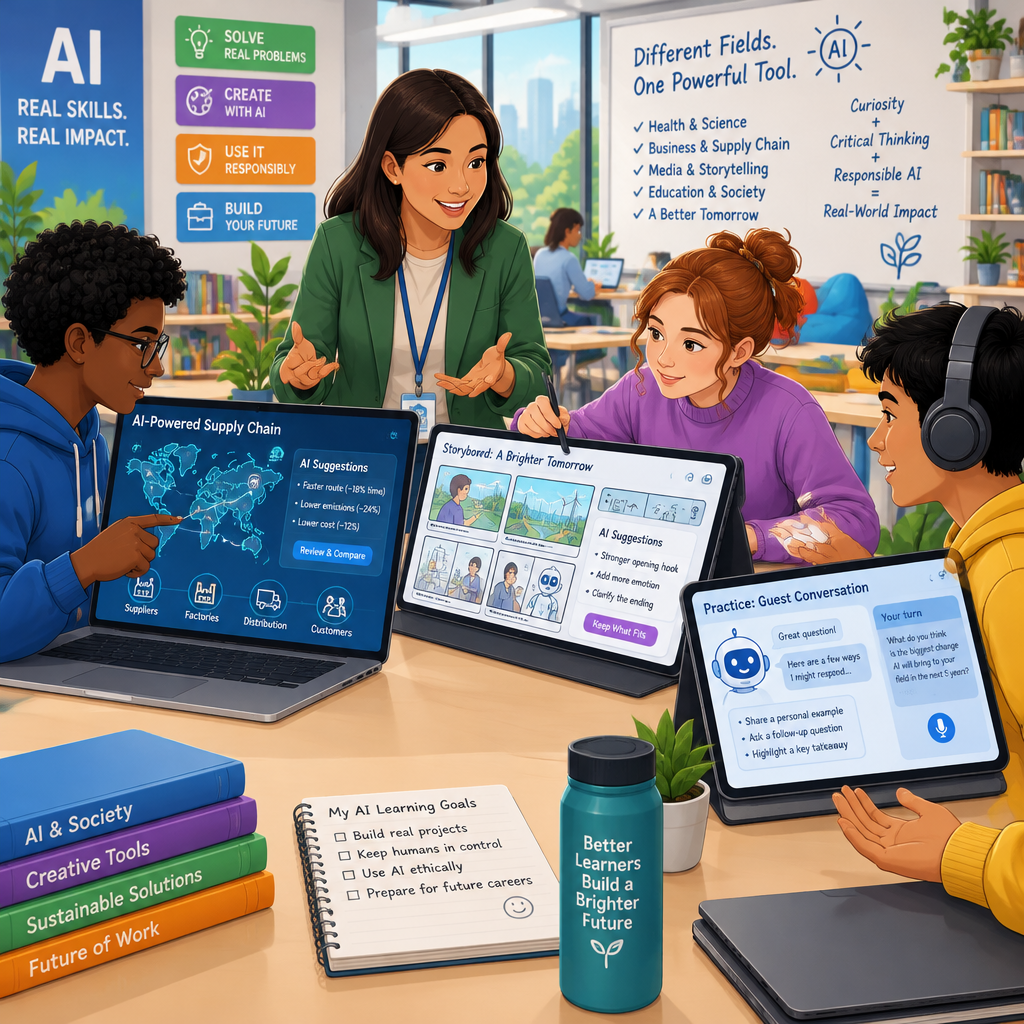
At Republic Polytechnic, artificial intelligence is set to become part of how students learn across their diplomas—not just a subject taught on its own. The school’s campus-wide AI Transformation strategy aims to help students use AI in their studies and prepare for workplaces where the technology is increasingly used.
The plan is to weave AI into RP’s existing modules and problem-based learning approach. By academic year 2027, the polytechnic aims for at least half of the discipline-specific modules in every diploma to use AI tools and applications that reflect workplace practice.
What that looks like will depend on the field. Supply-chain students are expected to use AI to analyse demand, manage inventory and plan delivery routes. Creative arts and media students will explore generative AI for tasks such as ideation, storyboarding and post-production, while keeping creative control and ethical standards in view. Hotel and leisure management students can practise guest interactions with an AI-driven chatbot designed to simulate scenarios and build soft skills.
RP says realistic AI-supported practice can also free up classroom time for discussion and reflection. The strategy progresses through four levels: understanding AI, using tools ethically and responsibly, developing industry-relevant AI tools, and, at the most advanced level, designing AI.
Assessment is also expected to evolve. Rather than focusing only on final outputs, RP plans to consider students’ reasoning and how effectively they work with AI. The initiative extends to continuing-education programmes for adult learners, where relevant skills may include productivity, data analysis and decision-making.
Industry partnerships with AI Singapore, Autodesk, Microsoft, Nvidia and ST Engineering are intended to give students access to industry-grade tools, applied research projects, innovation challenges and industry-led training. Staff development is part of the strategy too: of RP’s 1,200 staff, more than half had reached baseline AI capability when the article was published, and the school expected all staff to reach that level by the end of 2026.
For students, learning to use AI also means learning to question it. Third-year student Kymberly Uthaya Kumar described using AI in Internet of Things learning and a design project, while emphasising the need to check its outputs because they can be wrong.
RP’s plans set out an ambitious direction for bringing AI into learning. The article reports targets and intended implementation; it does not establish whether the curriculum or staff-training goals have since been met.
Leave a Reply