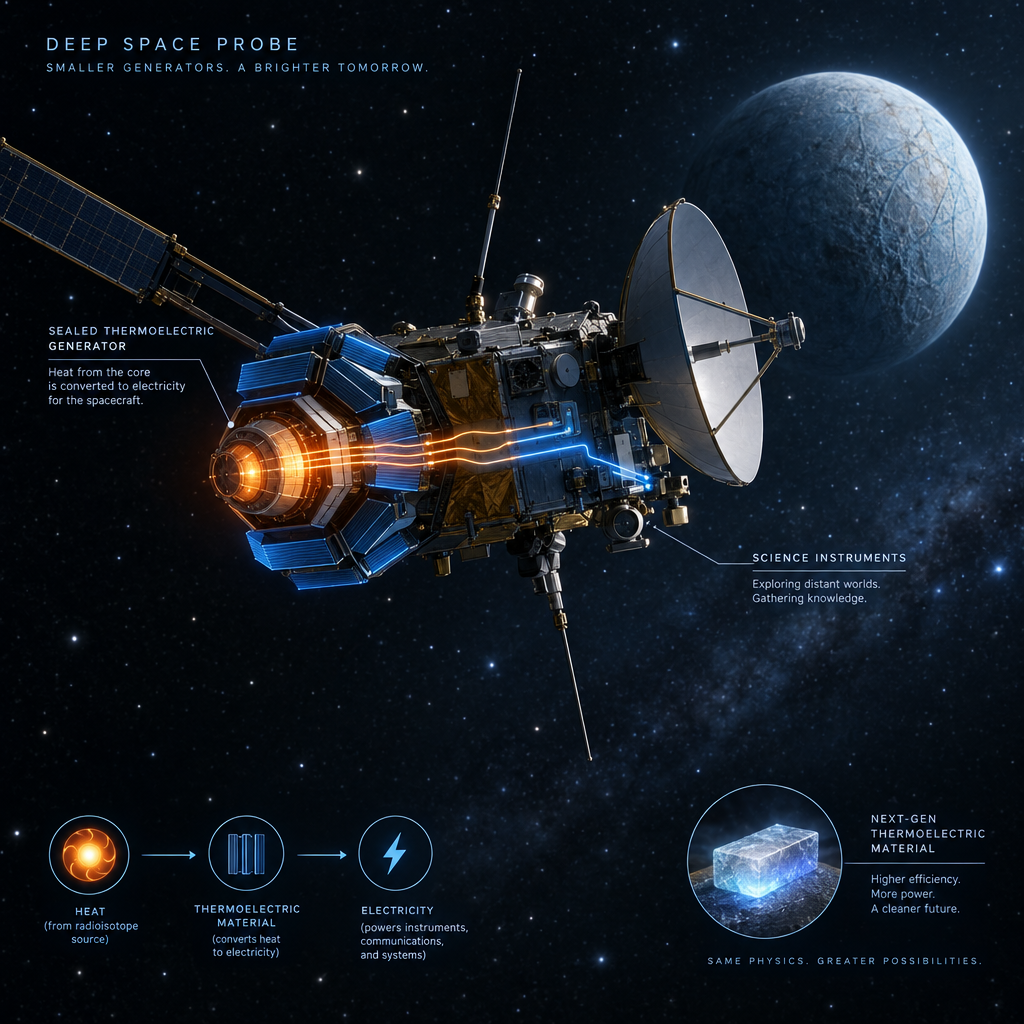
When a spacecraft ventures far from the Sun—or equipment must operate somewhere difficult to reach and maintain—ordinary power sources can become impractical. Radioisotope thermoelectric generators, or RTGs, offer a different approach: they convert heat released by radioactive decay into electricity through the Seebeck effect.
A November 2024 review by Muhammad Bilal Naseem, Junho Lee, and Su-Il In surveys how these generators work and why they matter. RTGs have a long-standing role in the power needs of interplanetary and interstellar missions, and their ability to serve hard-to-reach locations makes them relevant wherever recharging or replacing a power source is challenging.
The review examines RTG operating principles and architecture while taking stock of obstacles to further development. It also looks toward possible advances, including improvements in thermoelectric materials and the use of alternative radioisotopes.
That future remains open-ended. The review explores potential directions, but does not establish which applications will prove operationally or commercially viable. Its central message is that RTGs remain a compelling technology for demanding environments—and that materials and isotope choices may shape what comes next.
Leave a Reply