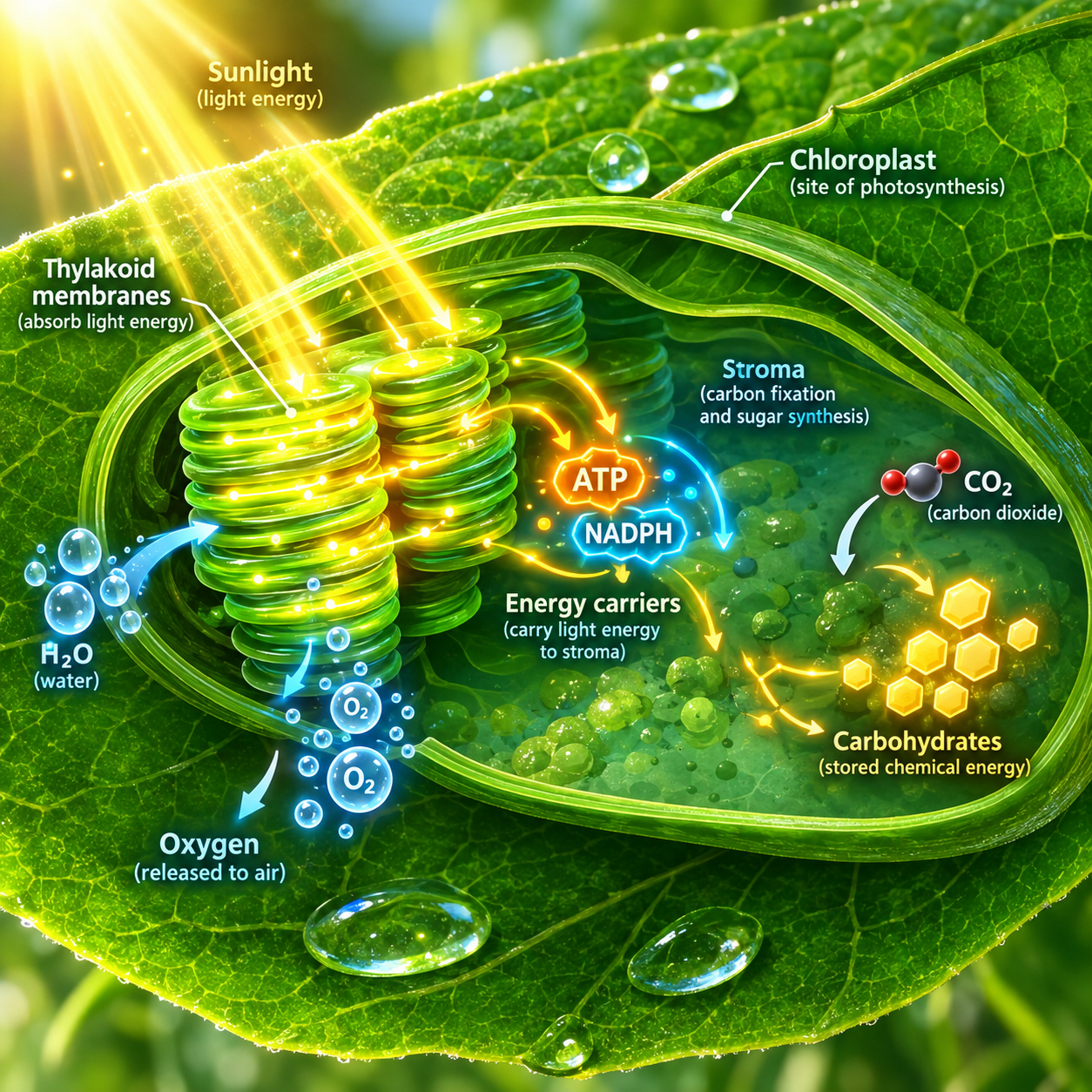
A leaf does more than catch the light. Inside its chloroplasts, photosynthesis transforms that light energy into chemical energy stored in carbohydrates.
The process unfolds in two connected sets of reactions. First, the light-dependent reactions take place in the chloroplast’s thylakoid membranes. Chlorophyll absorbs light, helping split water molecules. Oxygen is produced, while energy is captured in ATP and NADPH.
Next, in the chloroplast’s stroma, the light-independent reactions use ATP and NADPH to build carbohydrates from carbon dioxide. These reactions do not directly require light, but they rely on the energy-carrying molecules made in the first stage.
Taken together, the overall process uses carbon dioxide and water, with light energy, to produce carbohydrates and oxygen. Photosynthesis does not create energy; it changes its form—from light into chemical energy that can be stored in carbohydrates.
Leave a Reply