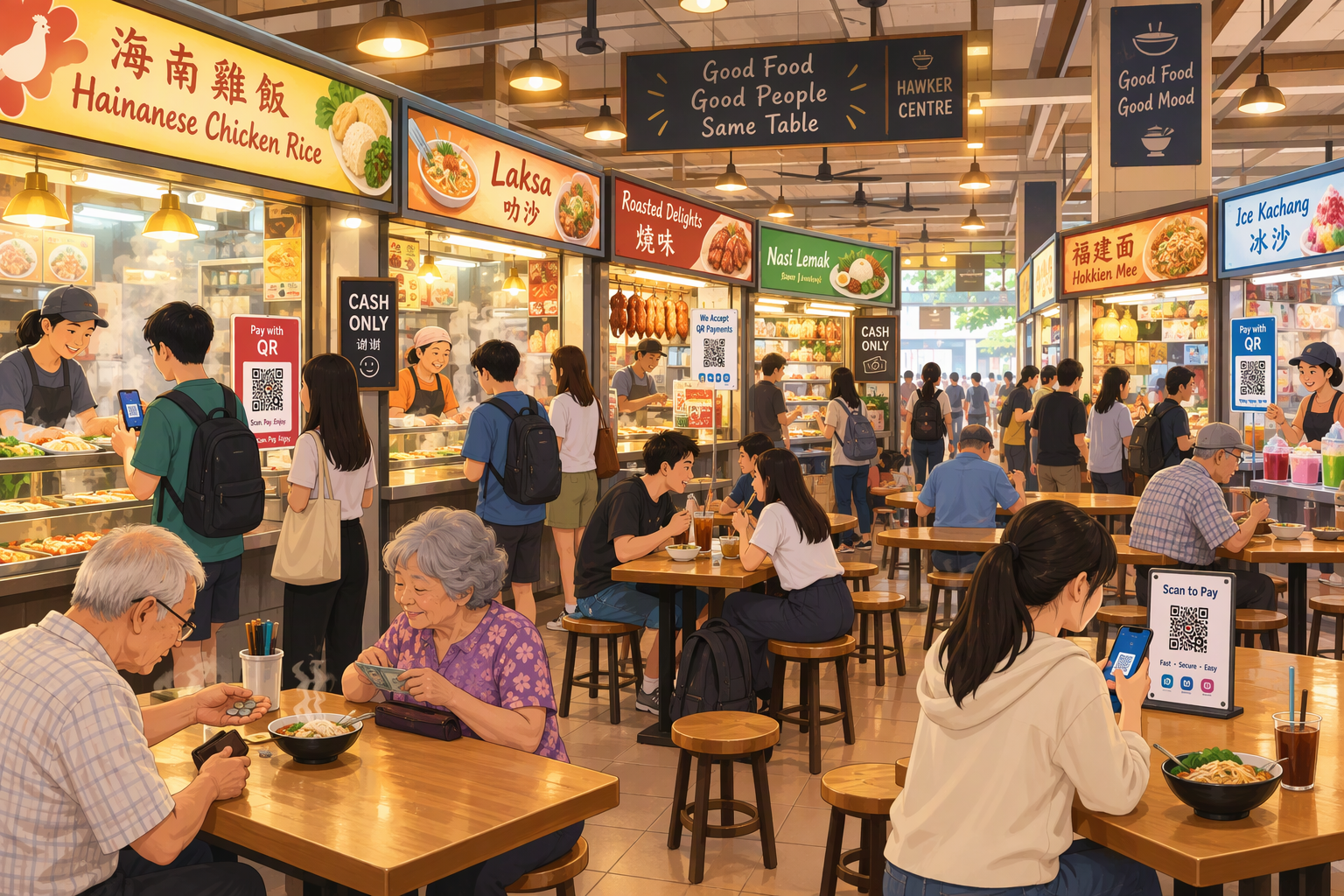
At a hawker centre, the next meal might be paid for with a quick scan—or with notes and coins placed on the counter. Singapore’s move towards digital payments has brought QR codes to many stalls, but cash remains part of daily life for some hawkers and their customers.
One example is Angie Sim, a 65-year-old noodle-stall owner at West Coast Food Centre. Her stall displays a “Cash Only” sign. Sim told The Straits Times that cash was easier and more convenient for her. Many of her customers, she said, were older, less comfortable with technology and accustomed to carrying cash. She and her stall partner have worked at the centre for more than 20 years.
Sim is not the only stallholder who prefers cash. The newspaper spoke with cash-only or reluctant hawkers across eight food centres. Their reasons were practical: some found digital platforms difficult to use, some had poor eyesight, and some worried that payment devices could inconvenience customers.
At ABC Brickworks Market & Food Centre, a drinks-stall owner in his 70s said he struggled to remember how to navigate digital platforms. During busy periods, he also found it hard to check whether a payment had gone through. Still, if a customer had no cash, he would provide the drinks and let the person return to pay later. At Albert Centre Market and Food Centre, another drinks-stall owner, Mr Tan, described e-payments as troublesome because he needed to verify every transaction.
These experiences sit alongside a broader push to make digital payments more common. The government’s Hawkers Go Digital programme began in 2020. It builds on SGQR, a standardised QR code launched in 2018 that allows customers to pay using multiple mobile e-wallets. By November 2024, more than 11,500 hawkers had adopted e-payments through SGQR.
The programme also aimed to encourage adoption among 18,000 stallholders in government-run food centres. At the time of the article, the 0.5 per cent transaction fee was waived on the first $20,000 of monthly e-payment transactions per stall. Enterprise Singapore and the Infocomm Media Development Authority had announced that the waiver would continue until the end of 2025.
The picture is not simply cash versus technology. QR codes are increasingly visible, and many hawkers have adopted them, but the change is not universal. For stallholders such as Sim and the drinks vendors, familiarity, accessibility and the rush of serving customers all matter. Their choices are a reminder that digitalisation happens at different speeds—and that a payment method is useful only when both the person paying and the person serving can manage it comfortably.
Source: Why cash is still king for some hawkers in Singapore despite digitalisation push, The Straits Times
Leave a Reply